
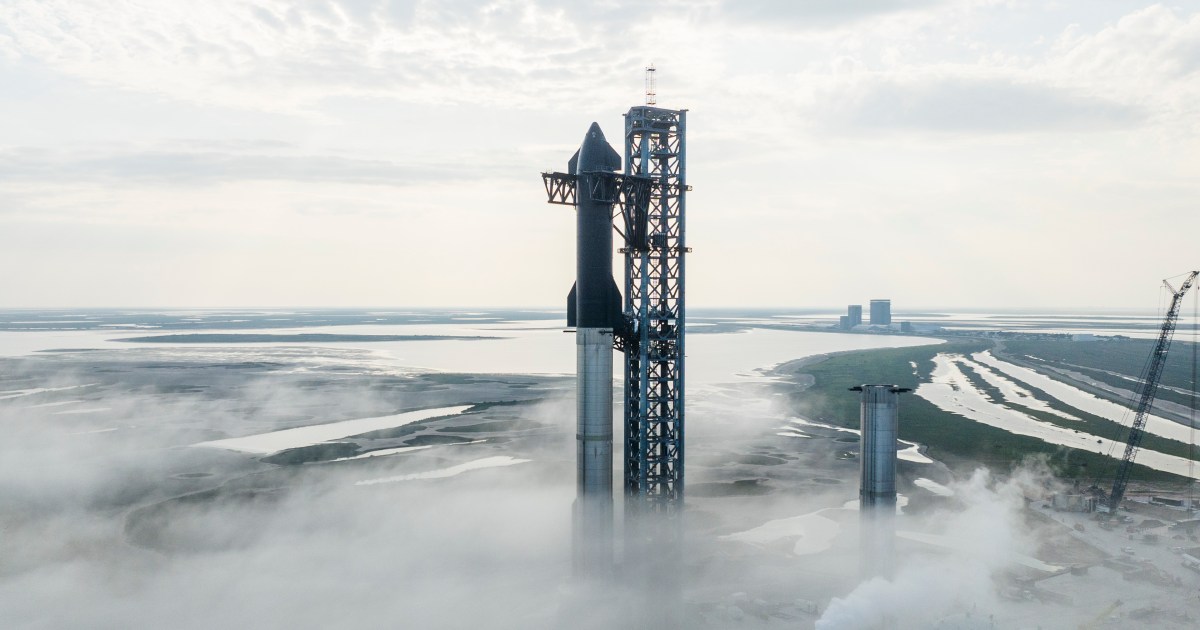
A fully stacked Starship stands beside its launch tower at Starbase, Texas, on Jan. 9, 2023. That stack, Ship 24 atop Booster 7, flew Starship’s first integrated test flight three months later. SpaceX is now preparing to catch both stages on Flight 15. Credit: SpaceX, via Flickr, CC BY-NC 2.0 Rocket launches this week On Monday, Nov. 9, SpaceX is targeting 10:03 p.m. EST to launch USSF-627 on a Falcon 9 from Space Launch Complex 4 East at Vandenberg Space Force Base in California. The mission is a classified payload for the U.S. Space Force. The booster will aim for the droneship Of Course I Still Love You in the Pacific Ocean. On Wednesday, Nov. 11, the state-owned China Aerospace Science and Technology Corporation (CASC) is targeting 6:40 a.m. EST for a Long March 2D launch from the Jiuquan Satellite Launch Center in northwestern China, according to Next Spaceflight. The payload has not been disclosed. On Thursday, Nov. 12, ExPace, a subsidiary of the state-owned China Aerospace Science and Industry Corporation (CASIC), is targeting 2:50 p.m. EST for a Kuaizhou 11 launch from Jiuquan, according to Next Spaceflight. Kuaizhou 11 is a solid-fueled rocket designed for fast-turnaround launches of small satellites. Its payload is also undisclosed. Later Thursday, Nov. 12, SpaceX returns to Vandenberg at 11:23 p.m. EST for USSF-317, another classified Space Force mission on a Falcon 9. The booster is again slated to land on Of Course I Still Love You. On Friday, Nov. 13, United Launch Alliance (ULA) is targeting 12:54 p.m. EST for Vulcan Leo 1 from Space Launch Complex 41 at Cape Canaveral Space Force Station in Florida. The launch ends a nine-month grounding that followed a nozzle failure during February’s USSF-87 mission; ULA says the boosters now carry a redesigned nozzle. It’s also Vulcan’s first flight for Amazon, carrying 40 satellites for Amazon Leo, the broadband megaconstellation formerly known as Project Kuiper. Later Friday, Nov. 13, SpaceX opens a 75-minute window at 5:45 p.m. EST for Starship Flight 15 from Pad 2 at Starbase, Texas. It’s the 15th test flight of the company’s reusable megarocket and only its second trip to orbit, after Flight 14’s success in September. About six and a half minutes after liftoff, the Super Heavy booster should return to the launch tower and be caught by its chopstick arms. SpaceX has made that catch before with the rocket’s V1 and V2 boosters, but this will be a first for the new V3 booster. The upper stage, called Ship, will continue to orbit and release 26 of SpaceX’s next-generation Starlink V3 satellites as it did in September. You can watch the launch live on SpaceX’s website. The next day, SpaceX will try to catch Ship, too. Until now, Ship’s test flights have ended with a practice landing at sea where the vehicle flips upright, fires its engines, and sets down on the water. This time, after about 14 orbits at roughly 171 miles (275 km) up — a flight of more than 22 hours — Ship must run that same landing maneuver over Starbase, settling into the tower’s arms instead. SpaceX says Ship will head for the tower only if flight controllers confirm that every system it needs for the catch is prepared. If not, the company can bring Ship down at preplanned spots in the Pacific, with checks built into the flight for splashdowns near Hawaii or off the coast of Chile. If the catch works, Starship will become the first orbital rocket ever recovered in full. On Saturday, Nov. 14, Rocket Lab is targeting 12:30 a.m. EST for The Mountain God Rises, the 100th launch of its Electron rocket, from Launch Complex 1 on New Zealand’s Māhia Peninsula. Electron will deploy a QPS-SAR satellite for the Japanese company iQPS in Rocket Lab’s 11th dedicated launch for the operator. The iQPS constellation uses synthetic aperture radar (SAR), bouncing microwaves off the ground to map Earth’s surface even through rain, smoke, and total darkness. Last week’s recap On Monday, Nov. 2, Rocket Lab launched The Sea God Surveys from New Zealand at 11:41 a.m. EST, delivering another QPS-SAR radar satellite for iQPS. It was Electron’s 99th flight and Rocket Lab’s 10th mission for the Japanese operator. That evening at 7:15 p.m. EST, CAS Space’s Kinetica 2 lifted off from Jiuquan and placed 18 satellites for China’s SpaceSail broadband constellation in polar orbit. It was only the rocket’s second flight, following its debut in March. On Thursday, Nov. 5, a Long March 2C launched from the Xichang Satellite Launch Center in southwestern China with three Yaogan 51 satellites. Yaogan is the label China gives its government Earth-observation spacecraft, which are widely believed to perform military reconnaissance. Friday, Nov. 6, brought two launches about an hour apart. Galactic Energy’s Ceres 2 put four satellites in orbit from Jiuquan at 6:37 p.m. EST. Then, after several days of delays, SpaceX launched the classified USSF-432 mission from Vandenberg at 7:48 p.m. EST, landing the booster on Of Course I Still Love You. On Saturday, Nov. 7, Russia’s Aerospace Forces launched a Soyuz-2.1b from the Plesetsk Cosmodrome in northern Russia. The payload is believed to be a GLONASS satellite for Russia’s version of GPS. The week closed Sunday, Nov. 8, when a Long March 12 lifted off from the Wenchang commercial launch site on Hainan Island at 3:24 p.m. EST, carrying nine more satellites for Guowang, China’s state-run internet megaconstellation. Looking ahead On Friday, Nov. 20, CASC is targeting 6:00 a.m. EST for a Long March 8A launch from Wenchang, likely carrying another batch of Guowang satellites, according to Next Spaceflight. On Tuesday, Nov. 24, at 2:00 a.m. EST, a Long March 12 is slated to fly another Guowang group from Wenchang, according to Next Spaceflight. Brooks Mendenhall is a staff writer at Astronomy, based in Chattanooga, Tennessee, fueled by an unending curiosity about the universe. A former classroom teacher, he has a knack for breaking down complex concepts for a wide audience.
SpaceX goes for a Starship double catch
Full Article
Original Source
Read the full article at Astronomy →KhanList aggregates and links to publicly available news content. We do not host full articles from third-party sources. Always verify important information with original sources.