
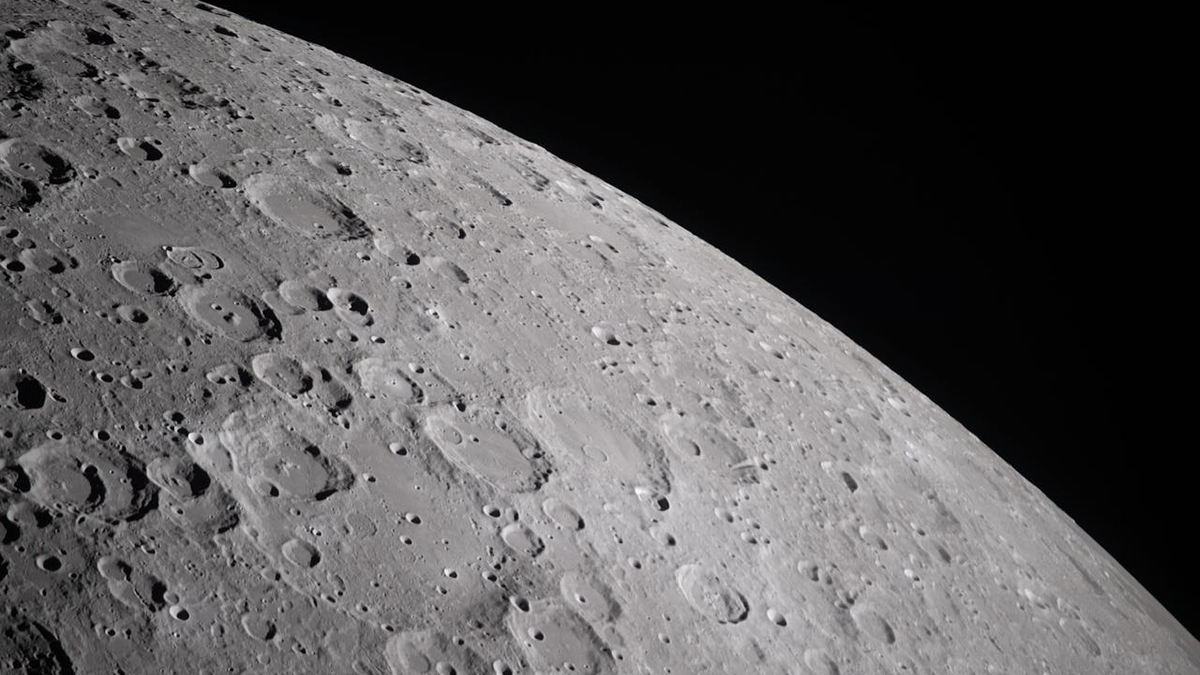
Craters on the surface of the moon captured during the Artemis II flyby on 6 April 2026. Credit: NASA Editors’ Highlights are summaries of recent papers by AGU’s journal editors. Source: AGU Advances Lunar impact craters are widely used to determine the ages of surface units and can also serve as cold traps that preserve water ice. However, craters degrade over time, and understanding the factors that control degradation rates is essential for accurate age determination. Zhang et al. [2026] investigates the morphology of small lunar craters (50-500 meters diameter) through numerical simulations of crater formation and evolution, combined with comparisons to observed crater dimensions. Crater degradation depends strongly on both crater size and local topography; maria versus highlands. This study estimates the variations in degradation rate, resulting in substantially improved constraints on crater retention ages. Because craters can trap water delivered either by impacts or through the gradual accumulation of solar-wind-derived hydrogen, understanding their lifetimes also has important implications for the origin and preservation of lunar water. Small craters (<100 meters diameter) have relatively short lifetimes (<100 million years); therefore, any water currently preserved within these features is likely of recent origin. Citation: Zhang, M., Fa, W., Tong, J., & Liu, Y. (2026). Degradation rate and lifetime of small impact craters on the Moon. AGU Advances, 7, e2026AV002542. https://doi.org/10.1029/2026AV002542 —Vincent Salters, Editor, AGU Advances Text © 2026. The authors. CC BY-NC-ND 3.0Except where otherwise noted, images are subject to copyright. Any reuse without express permission from the copyright owner is prohibited.
Disappearing Moon Craters
Full Article
Original Source
Read the full article at Eos →KhanList aggregates and links to publicly available news content. We do not host full articles from third-party sources. Always verify important information with original sources.