
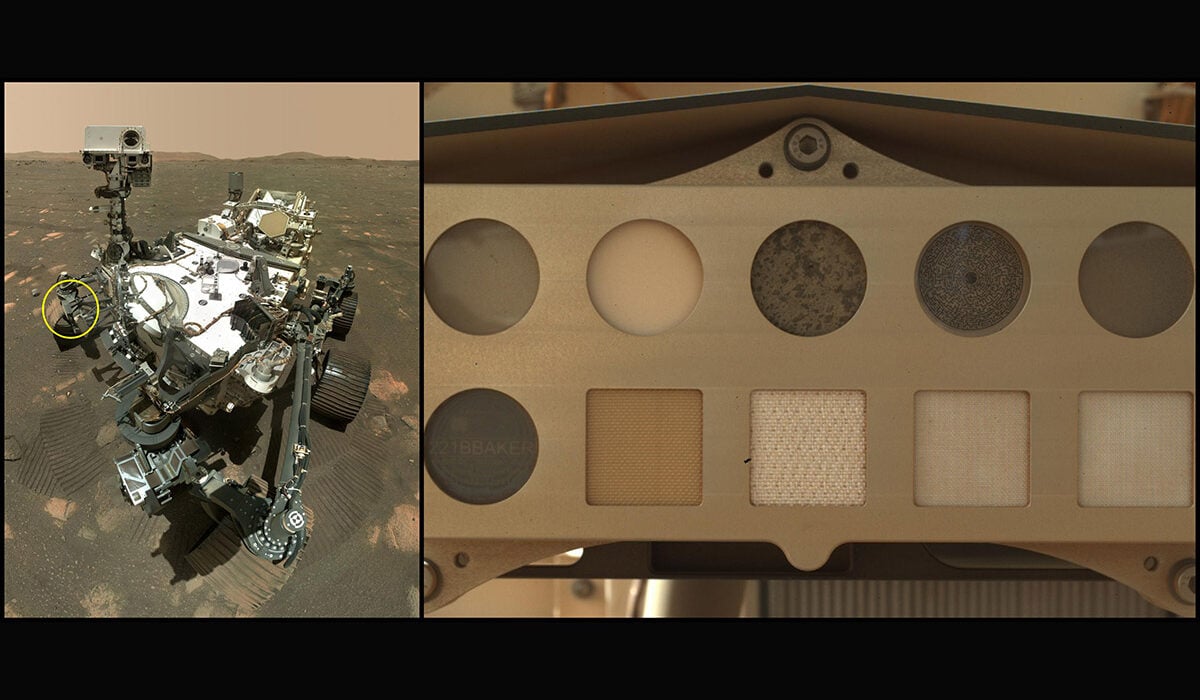
Martian dust is a major hurdle for human missions to Mars. Like Moon dust, its fine size and electrostatically charged nature allow it to stick to spacesuits, metal, and just about any other surface they come into contact with. Dust storms are also common on Mars, ranging from small whirlwinds that happen daily to global dust storms that occur once every 3 Martian years (~5.5 Earth years) and envelop the entire planet. Due to the low density of Mars' atmosphere, these storms don't generate much physical force. The danger lies in how the dust plays havoc with instruments, machine parts, and astronaut health and safety. Given how well it adheres to surfaces, Apollo astronauts found that lunar dust accompanied them back into their landing modules, degrading mechanical joints and seals and causing respiratory problems. A recent study led by Washington University in St. Louis (WashU) highlights the need, using data from NASA's Perseverance rover, for sufficient astronaut training to prepare for the Martian environment. Assistant Professor Scott VanBommel led the research effort along with staff scientist Abigail Knight, both of whom are fellows of the McDonnell Center for the Space Sciences (MCSS). They and their colleagues were joined by an international team of scientists from the U.S., Canada, Australia, and Europe, the MIT Haystack Observatory, Research Institutes of Sweden, the Commonwealth Scientific and Industrial Research Organisation (CSIRO), the Space Science Institute (SCI), the Astromaterials Research and Exploration Science (ARES) division at the NASA Johnson Space Center, and NASA's Jet Propulsion Laboratory. A very large Martian dust devil. This one reached 20 km high. Image Credit: NASA/JPL/University of Arizona In addition to its array of sensors, cameras, drilling equipment, and sample cache, Perseverance also carries small swatches of spacesuit material that are constantly exposed to Mars' atmosphere. Using data acquired by the rover's Planetary Instrument for X-ray Lithochemistry (PIXL), the team examined the swatches for signs of wear and tear. They also applied a method developed by VanBommel to estimate the size of each particle in the PIXL data, providing the first direct characterization of fine (≲2.5 µm) and ultrafine particles (≲0.1 µm). Their analysis found that the swatches showed little visible wear after 1,645 Martian days (sols) of exposure, largely because the particles observed were much smoother than the jagged grains found on the Moon. In summary, the results showed that Martian dust may be less likely to be abrasive to equipment or harmful to astronaut health than lunar regolith. The PIXL data also allowed the team to analyze the chemical composition of the particles that had caked the swatches. From this, the team confirmed the presence of perchlorates and other toxins, as well as high levels of sulfur, iron, and silica in the dust grains. In addition, Martian dust can be exceptionally fine, with some ultrafine particles measuring as little as 100 nanometers (nm) in diameter. On Earth, ultrafine particles typically come in the form of smoke and air pollution, which can cause significant health problems because they can sink deep into the lungs and enter the bloodstream. With Martian dust carrying perchlorates and other toxins, the health risk is magnified. There's also the way it is electrostatically charged like its lunar counterpart. "The electrostatic properties of Martian dust are likely causing it to preferentially adhere to some surfaces," Knight added, who helped conceptualize and conduct the analysis while a Ph.D. student at the MCSS. So while Martian dust may be less abrasive to surfaces and irritating to the lungs, it poses a hazard because of its toxicity and how easily it can be tracked into habitats where astronauts will not have the protection of a spacesuit. Mars Perseverance rover - PIXL studies a rock (artist concept). Credit: NASA/JPL-Caltech These considerations must be taken into account when mission planners are designing space suits and infrastructure for Mars. As astronauts will be passing in and out of vehicles and habitats regularly, small amounts of dust will likely be introduced that (if left unchecked) will constitute a mounting health hazard. Fortunately, the level of health risk largely depends on dose and duration. With proper mitigation strategies, both can be limited to a point where they do not pose a significant threat. The particles in the Martian atmosphere have been blowing in the wind for potentially billions of years, so they tend to be well-rounded, like pebbles in a river. We've been operating rovers on the surface of Mars continuously for more than 20 years at this point. We know that dust will be a challenge, but it's something we can prepare for and overcome. These results highlight the effectiveness of rover missions in advancing human spaceflight and the exploration of extraterrestrial bodies. In addition to providing immense insights into the geological history and conditions on Mars, they've also served as test beds for technologies that will be crucial to human exploration when it begins. Further Reading: Washington University
A Perseverance Experiment Could Help Astronauts Prepare for Dust Storms on Mars
Full Article
Original Source
Read the full article at Universetoday →KhanList aggregates and links to publicly available news content. We do not host full articles from third-party sources. Always verify important information with original sources.