
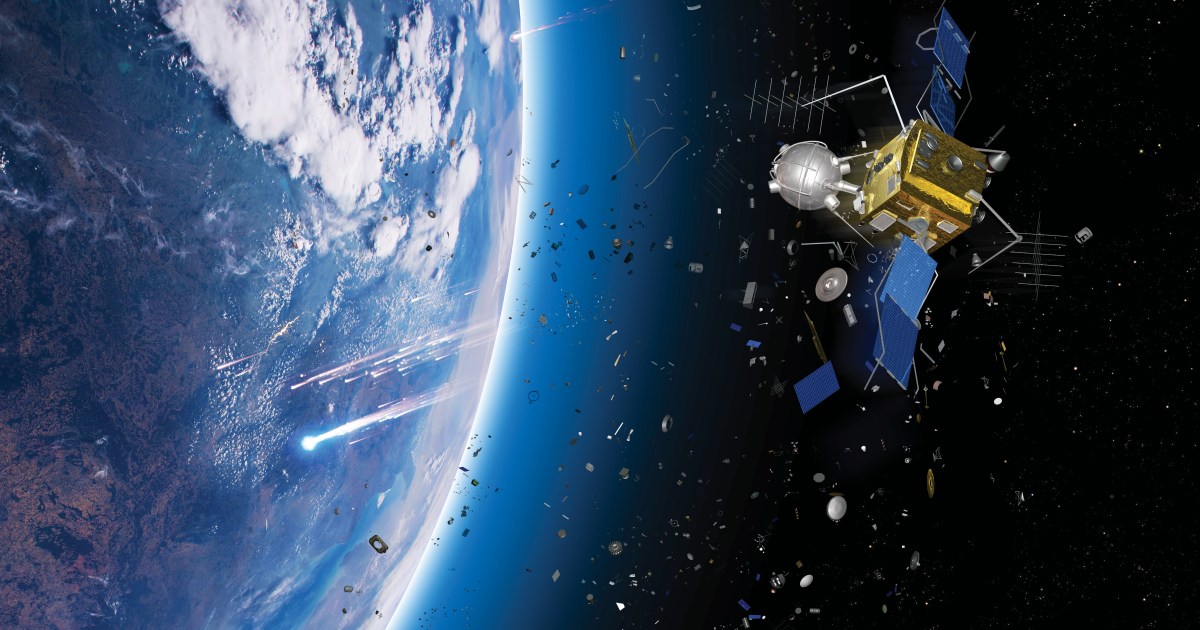
Space junk refers to any inoperable material orbiting our planet, from spent rocket stages to defunct and damaged satellites, as illustrated here. Some debris stays in orbit, creating the potential for more debris through collisions, while other pieces eventually fall back to Earth, completely or partially burning up in our atmosphere. Credit: Astronomy: Roen Kelly; Earth image: NASA Johnson In the 2013 movie Gravity, Russia destroys its own spy satellite with a missile, creating a cloud of shrapnel and subsequent orbital collisions that rip apart spaceships and astronauts alike. Earth orbit is a place where life imitates art: Eight years later, Moscow launched an actual missile strike on a defunct Soviet satellite, blasting thousands of pieces of metal through space and threatening the International Space Station (ISS) at the nearby altitude of 250 miles (400 kilometers). As the lethal grapeshot sped through space 10 times faster than a rifle bullet, astronauts and cosmonauts huddled in escape pods. Luckily, the debris overshot them, avoiding a real-life Gravity sequel. This close call was not a lone event. In 2009, history’s first collision between two intact satellites — an American Iridium 33 and a defunct Russian Cosmos-2251 — generated at least 2,000 pieces of debris, some of which passed on uncertain trajectories about 7 miles (11.3 km) from the ISS in March 2012 as crew sheltered in two docked Soyuz craft. And just last year, Chinese crew aboard the Tiangong space station delayed their return to Earth and left their replacements temporarily without an evacuation vehicle when a piece of space junk smaller than 0.04 inch (1 millimeter) hit their docked return capsule. Fallout from these incidents remains in orbit today, along with myriad debris from other adventures. These fragments are collectively known as space junk. Scientists warn that space junk may be fast approaching a critical threshold that sparks cascading satellite collisions, creating an impassable belt of debris and rendering that region of Earth orbit too dangerous to use. This is called Kessler syndrome, a concept outlined in a 1978 paper by NASA researcher Donald Kessler. Surpassing that threshold is not inevitable, but avoiding it will require considerable engineering and stringent international cooperation. This visualization maps the active satellites and tracked pieces of space debris orbiting Earth as of August 2024. Green shows active satellites (10,200 objects), red shows debris larger than 4 inches (10 cm; 50,000 objects), orange shows debris larger than 0.4 inch (1 cm; 1.2 million objects), and yellow shows objects larger than 0.04 inch (1 mm; 130 million objects). Not shown are the approximately 2 trillion pieces of space debris larger than 0.0004 inch (0.01 mm), as they would completely cover the image, overwhelming the field of view. Credit: ESA Crash course The most crowded area of space is occupied by the lowest stable Earth orbits, where the equivalent mass of 150 space shuttles currently spins around our planet. Called low Earth orbit (LEO), it is loosely defined as altitudes between 120 miles and 1,200 miles (200 to 2,000 km). LEO is so frequently used because it is the Goldilocks zone where a complete orbit takes two hours or less — high enough to minimize atmospheric drag and stay aloft, yet low enough in the magnetosphere to help shield humans and electronics from radiation damage. Large constellations of satellites are now being put into LEO. The most numerous of these is SpaceX’s Starlink, whose 10,000+ satellites comprise 66% of LEO traffic. Each rocket carries several dozen satellites weighing as much as a ton each and spanning up to 23 feet (7 meters), providing internet support for remote locations. When they fail, most will reenter the atmosphere and burn up, either within a few weeks of launch if they fail in the initial low orbit, or if they successfully push to their intended higher orbit, within a few years. But the rate at which LEO is filling up — Starlink had 122 launches in 2025 alone — has some experts worried that we are on the cusp of eventual calamity. “We might not see a substantial change during our own generation, but we will see a steady increase in risks and collisions,” says Hugh Lewis, a University of Birmingham astronautics professor. Ever since SpaceX launched its first batch of Starlink satellites in 2019, the company has touted its satellites’ avoidance capabilities: Ion-propelled thrusters and autonomous AI guidance systems trigger a Starlink satellite to maneuver away from an object ahead of a close pass if the risk of a collision exceeds a certain threshold. While the industry standard is to maneuver if there is a 1-in-10,000 chance of a collision, SpaceX has tightened its trigger over the years. Today, Starlink satellites take avoiding action if the likelihood of colliding is just 1 in 3.3 million. Based on the current rate of avoidance maneuvers as reported by the company in July 2026, the constellation’s satellites overall are performing more than 400,000 avoidance maneuvers per year. With other companies and countries joining the LEO space boom — and a lack of coordination between them — SpaceX has taken further action to safeguard its fleet. The company announced in January that it was shifting the bulk of its satellites 13% lower than their original 340-mile (550 km) altitude in large part to reduce aggregate risk, as there are fewer objects that low to collide with. Additionally, lower initial orbits mean failed satellites will naturally deorbit more quickly, preventing them from becoming part of the problem. OneWeb, a European broadband internet service, sends its satellites to a higher altitude of 750 miles (1,200 km). Because atmospheric drag decreases exponentially with altitude, higher satellites shed drag and gain longevity. But this can generate longer-lasting space junk in the event of failure: At the altitude OneWeb operates, an object could stay in orbit for centuries. Both OneWeb and Starlink use their own propulsion to deorbit for post-mission disposal, with satellites lasting roughly five years. But if those systems fail, the satellites become space junk, with their orbital altitude determining their longevity. This chart from ESA’s 2026 Space Environment Report shows the number of tracked objects in all orbits over time. In addition to unidentified material, this includes leftover rocket stages (rocket bodies) and other pieces such as shrouds and engines (rocket missions). Rocket fragmentation debris refers to debris generated by rocket-related objects that can be traced to a single unique event, such as a collision or explosion; rocket debris is debris that cannot be tied to a source. Payload mission material refers to objects carried to orbit for a specific function, such as satellites and observatories, as well as shrouds or covers ejected prior to operation. As with the previous category, payload fragmentation debris is debris that can be traced back to a specific damage event involving a payload object, while payload debris cannot be associated with an event or source. Credit: Astronomy: Roen Kelly, after ESA External factors While operators work to keep space debris in check, external factors can complicate their efforts, either causing orbiting objects to come down prematurely or else increasing the time they’re likely to stay in orbit, crowding the field. Climate change can cause the latter. When solar photons hit carbon dioxide and other greenhouse gases, the molecules release energy as infrared heat. The troposphere, the atmospheric layer closest to the ground, is sufficiently dense to trap that heat, causing global warming. But higher up, the atmosphere is so thin that radiation escapes, cooling and thinning the mesosphere, our atmosphere’s middle layer. Excessive greenhouse gases can accelerate this process, causing successive atmospheric layers to pancake downward, reducing drag at any given altitude. According to a study by Lewis’ team, this means satellites that were expected to come down in a couple of years could stay up much longer, quintupling the lifetime of some space debris by the end of this century. Solar activity has the opposite effect. “In the critical range of 300 to 500 kilometers [190 to 310 miles], the density of the atmosphere is very dependent on whether we’re at solar maximum or solar minimum,” says Jonathan McDowell, an astrophysicist formerly at the Harvard-Smithsonian Center for Astrophysics and now based in the U.K. His decades-long dedication to developing software that catalogs and tracks all rocket launches and reentries has gained him a reputation as the unofficial guru of space traffic and space junk. Each 11-year solar maximum brings an increase in X-ray flux, which ionizes the atmosphere and causes heating, so the atmosphere expands. This, in turn, pushes denser gases higher, increasing drag at the height of LEO. Both effects cause orbiting objects to reenter sooner. For higher LEO satellites, McDowell says, the question isn’t how many years they are designed to stay in orbit, but how many solar maxima they can survive. For example, the Hubble Space Telescope suffers a pronounced loss of altitude each solar maximum, each bigger than the last as the observatory drops lower and the atmospheric density is greater. Without intervention, it could come down in the next solar maximum. In a paper accepted for publication in Acta Astronautica, a team led by Samantha Lawler, an astronomer at the University of Regina in Saskatchewan, created a “CRASH clock” characterizing the time it would take for a collision to occur in the absence of all avoidance maneuvers — say, during a “widespread disruptive event” such as a solar storm or massive software failure. (CRASH is an acronym for Collision Realization And Significant Harm.) Once an initial collision takes place, it could cause further, ongoing damage as its debris goes on to spark yet more strikes. Initial calculations based on 2018 satellite traffic allowed 164 days before collisions under the worst circumstances, but as Starlink and other megaconstellations have proliferated, recent calculations bring the countdown to a shocking three days. SpaceX maintains a regular cadence of Starlink launches, with more than 100 missions carrying the satellites to orbit in 2025. Increased launches not only pollute the atmosphere, but increase the amount of space junk when satellites stop functioning as well. Credit: SpaceX (CC BY-NC 2.0) Escalating risk While most of the public’s attention is on lower LEO orbits occupied by Starlink, higher LEO altitudes may soon become more crowded as well. SpaceX recently submitted an application to the Federal Communications Commission for space-based data centers with 1 million satellites orbiting much higher than its Starlink fleet. The heavier electrical load of a data center will require vast solar panels and cooling fins, considerably larger than on Starlink satellites. These would also be much more reflective than Starlink, which is already posing serious headaches for astronomers by interfering with observations. But data centers at these altitudes could also create space-junk minefields. To sustain its million-satellite data center, SpaceX would have to launch about 200,000 satellites each year. If 1% of those fail — the same rate that SpaceX reports for Starlink satellites — “you’re replacing 2,000 satellites a year,” says Lewis. “Those failed satellites alone would meet the critical Kessler threshold, without even looking at the million satellites” making up the functional constellation itself. Even higher orbits are not immune. Above LEO lies medium Earth orbit (MEO), from 1,240 to 22,000 miles (2,000 to 35,400 km), home to many GPS and navigation satellites. Beyond that sits high Earth orbit (HEO), including geostationary orbit (GEO) directly above Earth’s equator, where satellites sit with 24-hour periods that match Earth’s own rotation. In January, a Russian spy satellite unexpectedly fragmented in an HEO graveyard orbit. The event could have been caused by an impact, suggesting that space junk is infecting even the highest altitudes as well. ESA’s 2026 Space Environment Report compares the cumulative number of future catastrophic collisions expected in LEO over time for two scenarios. The top red line shows the projected cascading number of collisions expected if current trends continue regarding launch cadences, space debris fragmentation, and the lack of targeted debris removal as of 2025. The bottom blue line shows the case with no future launches from 2025 onward; even in this unrealistic scenario, some increase in collisions is expected. Credit: Astronomy: Roen Kelly, after ESA Snag it and bag it The route to addressing orbital crowding requires determining where solutions are most needed. And LEO remains the area most urgently in need of emergency triage. Astronautical engineer Darren McKnight, senior technical officer for LeoLabs, a company that helps coordinate a global network of about a dozen ground-based radars tracking space objects, worries most about LEO orbits above where Starlink — with its state-of-the-art crash-avoidance technology — operates. “I would say that right now we have a contraction of the arteries at about 975 kilometers [600 miles], and if we have a heart attack, it’s going to happen there,” he says. In the 1970s and ’80s, countries launching spacecraft left rocket bodies and payloads in higher LEO. These large objects have no crash-avoidance capabilities. But this concentration of threats also creates opportunities for reducing risk. “If you take out the 10 worst offenders at 840 and 975 kilometers [520 and 600 miles], you can reduce debris-generating potential by 30%,” McKnight says. These altitudes were two distinct orbital highways historically favored for different missions. Of those top offenders, three are defunct satellites (one European and two Russian) and the rest are rocket stages (one Japanese, two Chinese, one Russian, and three Soviet). That space junk lingers for more than a quarter-century and has the potential to generate even more debris when it is hit, compounding the problem over time. That’s why, McKnight says, removing those worst offenders also offers “much better return on investment” when it comes to resources spent on space junk mitigation — that is, reducing or even retrieving space junk. Such efforts are gaining traction, but still have a long way to go. Some are managed by national space agencies solely for the purposes of cleaning up their trash, while others are undertaken by private companies purely for profit. Yet the only true mitigation of space junk to date was in 2022, when the Chinese Shijian-21 satellite retrieved and towed a defunct Beidou-2 G2 navigation satellite from crowded geostationary orbit and parked it in a graveyard orbit 1,865 miles (3,000 km) higher to reduce the risk of collisions. More recently, in 2025, the Shijian-25 satellite launched and docked with fuel-depleted Shijian-21, likely to test refueling capability to prolong its operational lifetime and prevent it from becoming space junk itself. U.S. Space Force officials labeled the maneuver a “priority watch” event due to its potential military use. Japan-based Astroscale has flown two test missions in LEO that have rendezvoused with targets; its next mission aims to retrieve a OneWeb communications satellite slated for retirement. Other players include Switzerland-based ClearSpace, which is partnering with the European Space Agency, and TransAstra, an aspiring asteroid-mining company based in California. TransAstra has conducted preliminary tests aboard the ISS with a novel capture bag and hopes to launch in 2028 to snag a 100-ton asteroid. That same technology could be adapted for space junk retrieval, especially smaller debris. The Responsive Engaging Arms for Captive Care and Handling (REACCH) system (blue, white, and black box, background) captures a target (foreground) in its four blue octopus-like arms during a test aboard the ISS. Solutions like REACCH could capture debris and move it from its current orbit to a different one, or drag it down to burn up in the atmosphere. Credit: NASA Sustainable space For McDowell, the astronomer and spaceflight historian, the satellite boom brings mixed feelings. He wonders if satellite-cluttered skies mean all serious astronomical observing will one day only be done from space telescopes, rather than ground-based observatories. “I am a fan of space exploration,” he says, “but I want us to do it sustainably, in a way that doesn’t trash the environment.” There is a long way to go. But with the space industry soaring to a value of more than $600 billion, some see the clutter in its wake as an opportunity to profit from clearing space debris out of harm’s way. Though the sky may be falling, the same genius that placed it there has the capacity to fix it. Randall Hyman is a science writer whose work has appeared in numerous publications, including Nature, Science, and Smithsonian.
Our increasingly cluttered skies
Full Article
Original Source
Read the full article at Astronomy →KhanList aggregates and links to publicly available news content. We do not host full articles from third-party sources. Always verify important information with original sources.