
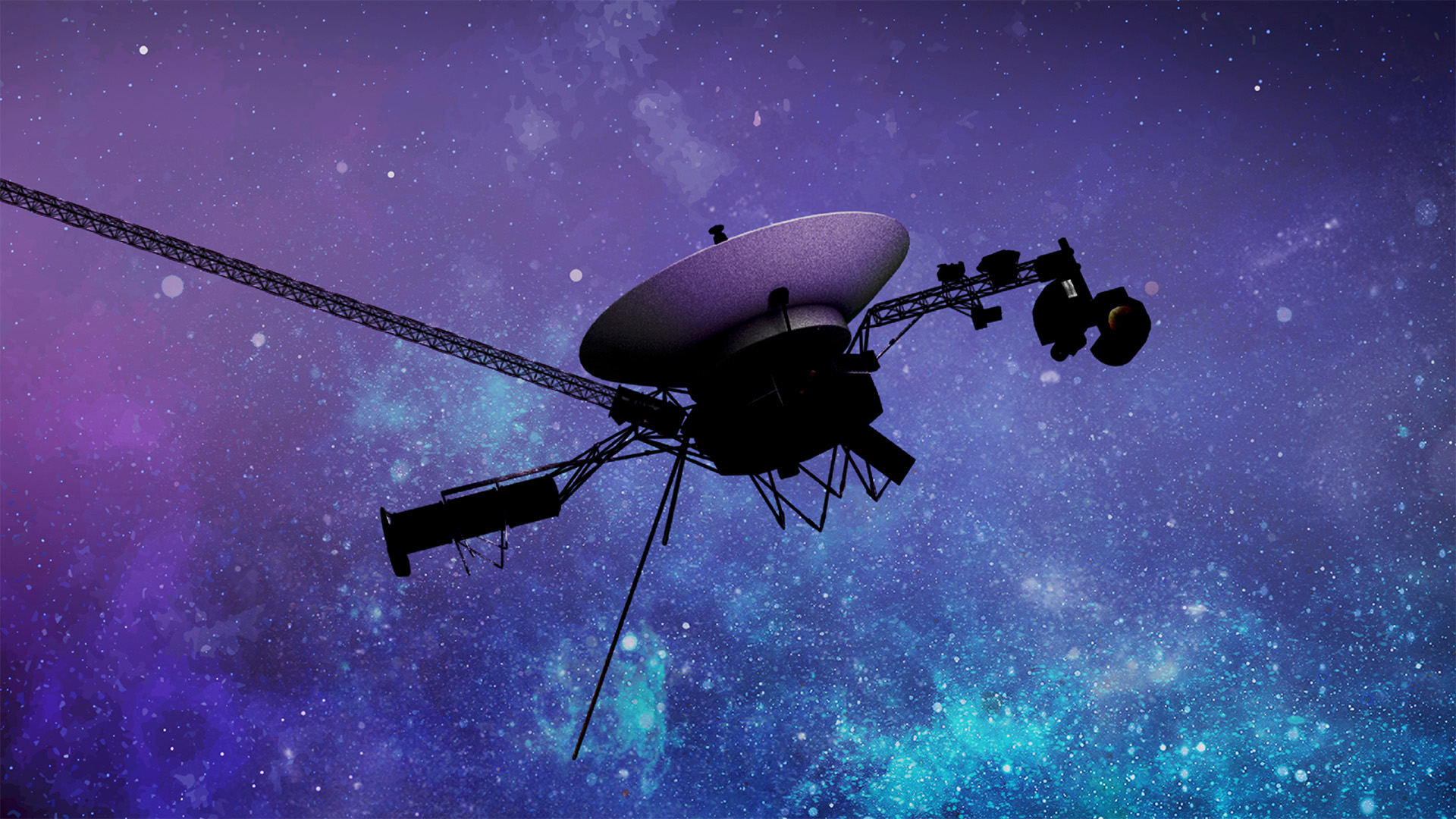
NASA’s Voyager 1 spacecraft is on track to set another historic record as its mission approaches the half-century mark. On Nov. 18 at 5:16 a.m. ET, the probe will reach a distance of one light-day from Earth, a journey of nearly five decades that places it farther from our planet than any human-made object in history. It’s quite an accomplishment for a spacecraft built in the mid-1970s One light-day is the distance that light travels in a single day at the speed of light, which is approximately 186,282 miles per second. That translates to 25.9 billion kilometers or about 16.1 billion miles in a single day. At an average human walking speed of 3 mph, it would take a human 612,015 years to walk that distance. Fortunately, Voyager 1 has been traveling a bit faster than that. It currently zips along the cosmos at a steady 37,763 mph, a speed it achieved in 1980 after a gravity-assisted Saturn flyby. It has been flying at that speed ever since. A journey wrought with peril Voyager 1 has traveled a long way with the help of gravity-assisted speed boosts from Jupiter and Saturn in 1979 and 1980.NASA The historic milestone isn’t without its drama. Voyager 1 has been in space for nearly half a century, and in that time, NASA’s Jet Propulsion Laboratory has done everything it can to extend the life of Voyager 1. That includes troubleshooting issues, performing maintenance and shutting down various systems to save power and extend the spacecraft’s life-span. Several of those efforts took place in 2026. The team running Voyager 1 spent weeks shutting down three devices and powering on three low-power alternatives to reduce overall power usage. This initiative, which was internally called The Big Bang, was also performed on Voyager 2. The transition was completed in early September, giving Voyager 1 more time with its dwindling power supply while also keeping it warm enough to continue operating in the frigid conditions of interstellar space. It was a tricky maneuver that required the team to simultaneously turn multiple instruments on and off. The difficulty of the maneuver was amplified by the fact that it took almost a full day for any signal to reach Voyager and another full day for Voyager to send a signal back, with hours of downtime while the spacecraft performed the operations. All of this took place several months after Voyager 1 experienced a sudden drop in power, which necessitated shutting off one of its three remaining instruments still in operation. Voyager 1 now has only two instruments still in operation. The end of an era Making it a whole light-day away from Earth is likely going to be Voyager 1’s final milestone while it still has enough power to communicate with Earth. Voyager 1 is powered by three radioisotope thermoelectric generators. They are essentially nuclear-powered batteries that generate energy by converting the steady heat from decaying plutonium-238. When Voyager 1 first launched, its radioisotope thermoelectric generators produced about 470 watts of power. But plutonium-238 doesn’t last forever, and after 50 years in space, the RTGs now produce about 215 watts of power, with an average loss of about 4 watts per year. Most of that power is used to keep Voyager 1 up and running, which is why NASA has shut down eight of the 10 instruments that Voyager had when it launched. At its current rate of usage and decay, Voyager 1 is expected to shut down its final science instrument in the 2030s and will eventually lose communication with Earth in 2036 due to insufficient power to send back a radio signal. The same fate is expected for Voyager 2, Voyager 1’s twin, which has also spent half a century in space. While it is labeled the sequel, Voyager 2 actually launched 16 days before Voyager 1, and the two have spent nearly identical amounts of time traversing the cosmos. Thanks to its slower speed and trajectory, it likely won’t reach the one light-day distance until after its instruments shut down. Thanks to the vastness of space, Voyager 1 will lose all of its power before it hits its next milestone, which is the beginning of the Oort Cloud, a vast, icy shell of comets at the edge of our solar system. It’ll take about 300 years for Voyager 1 to make it there. Thanks to the near-perfect vacuum of outer space, Voyager 1 will continue to fly at its current speed even after it shuts down entirely. So it’ll still hit that milestone; it just won’t be able to phone home to tell us about it.
NASA’s Voyager 1 to Cross Historic One Light-Day Milestone on Nov. 18
Full Article
Original Source
Read the full article at Cnet →KhanList aggregates and links to publicly available news content. We do not host full articles from third-party sources. Always verify important information with original sources.