
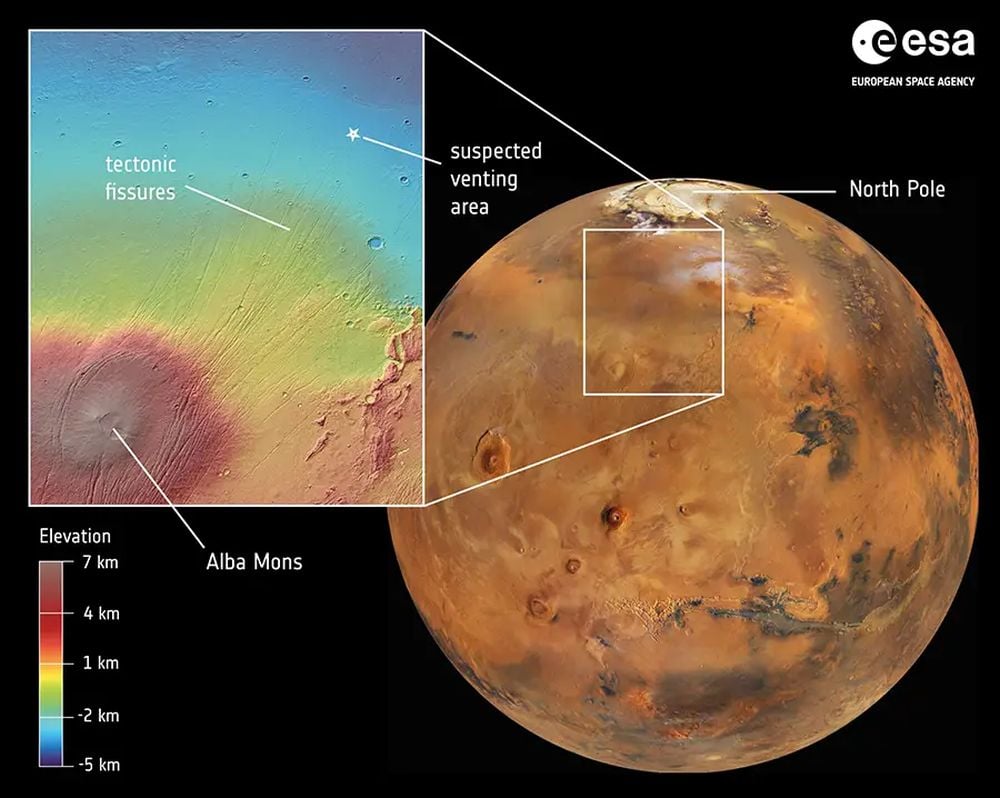
We'll never stop being fascinated by Mars. It's kind of like a failed Earth. It appears as if billions of years ago Mars was warm, wet, and habitable. That ended when its interior cooled and its geodynamo failed. When its geodynamo failed, its magnetic shield failed. The full force of the Sun bore down on the unfortunate planet, and its warming atmosphere was lost to space. The loss of atmosphere wasn't the only change. Mars had a powerful volcanic past, and the prominent volcanoes in Tharsis Montes prove that. But the planet is largely believed to have left its volcanic past behind as a consequence of cooling. But there's growing evidence that the planet isn't totally dormant. Recent evidence from missions like InSight and the ExoMars Trace Gas Orbiter suggest some ongoing activity. InSight detected more than 1300 Marsquakes, and the Trace Gas Orbiter detected hydrochloric acid. Hydrochloric acid (HCl) is a highly corrosive acid with multiple natural sources, including atmospheric ones. The ExoMars Trace Gas Orbiter (TGO) collected widespread observations of HCl in Mars' atmosphere at parts-per-billion levels, but initially, it was only detected during perihelion. The HCl detections were attributed to aerosol-atmospheric sources driven by greater warmth from the Sun, a naturally-occurring, seasonal pattern. But new research in Science Advances shows that not all of the TGO's HCl detections can be traced to perihelion. It's titled "Enigmatic HCl detections as a potential signature of igneous activity on Mars." The lead author is Alexander Trokhimovskiy from the Space Research Institute at the Russian Academy of Sciences. This Mars Orbiter Laser Altimeter (MOLA) image shows Alba Mons near the top, with the three Tharsis Montes volcanoes below it, and the massive Olympus Mons to their northwest. Though not as tall as Olympus Mons, Alba Mons is larger by area. The new HCl detections are curiously close to Alba Mons. Image Credit: NASA/JPL/GSFC The authors acknowledge that Mars is believed to be volcanically dormant, and that Marsquakes and other evidence of more recent volcanic activity is accumulating. However, there's no clear understanding of Mars' modern activity. For instance, many of the InSight lander's detections were attributed to meteorites. If we were to witness an actual eruption, and the gases that go with it, a new understanding of Mar's interior would arise. But that hasn't happened, and we have to rely on less obvious evidence for Mars' internal state. "While sulfur dioxide, so far undetected, could testify to ongoing eruptive activity, evidence of active magma chambers may be better identified by seepage of halogen gases, such as hydrogen chloride (HCl)," the authors write. "Here, we report HCl detections during the cold aphelion season that are isolated in the Alba Mons region." Could these new HCl detections be a window into Mars' interior? Olympus Mons is known as the largest volcano and the tallest mountain in the Solar System. But Alba Mons is actually the largest volcano by surface area. Like Olympus Mons, it's also in the Tharsis region. (And neither are part of Tharsis Montes, the iconic row of three volcanoes). Alba Mons' volcanic flows reach further than 1300 km from its central summit. One of Alba Mons most significant features is its enormous system of fractures. For multiple reasons, detecting HCl over Alba Mons is intriguing. "Strongly localized in space and time, aphelion HCl detections, amidst an otherwise absence of HCl at that season on Mars, exhibit marked contrast with prolonged and widespread detections at perihelion," the authors write. “Detections of HCl at low altitudes, unexplained by observed atmospheric state and models, together with the geological context of the region, hint at an igneous origin of this gas,” Trokhimovskiy et al. write. These most recent HCl directions were in 2025. This figure show HCl detections by the Trace Gas Orbiter. Blue ones represent perihelion detections, which can be explained by seasonal warming and atmospheric interactions driven by the Sun. Red ones are more enigmatic. They could come from tiny fissures near Alba Mons, almost directly under the detections. Image Credit: Alexander Trokhimovskiy et al. , Enigmatic HCl detections as a potential signature of igneous activity on Mars. Sci. Adv.12, eaeb9422(2026). The HCl detections alone may not be enough to oveturn the idea that Mars is dormant. As the authors say, they're just a hint. But there's more. "We also identify fresh and narrow (<1 meter) fissures in this area, which we interpret to be potential HCl pathways rooted into magmatic bodies at depth," the researchers explain. "These structures have not been identified on Mars in earlier works. For instance, systematic geomorphologic mapping of the northern hemisphere did not consider these landforms," the authors explain. These panels shows some of the important points in the research. (A) shows Alba Mons and the HCl aphelion detections in yellow. (B) is a CASSIS image from the TGO showing a fractured ridge, while (C) and (D) are HiRISE images from NASA's Mars Reconnaissance Orbiter showing smaller fissures the researchers identify as potential HCl sources. (E) and (F) are geological models that can explain HCl is seeping from these fissures. Image Credit: Alexander Trokhimovskiy et al. , Enigmatic HCl detections as a potential signature of igneous activity on Mars. Sci. Adv.12, eaeb9422(2026). The researchers calculated the seepage rate necessary to account for the HCl abundance in the aphelion detections. They compared it to the perihelion detections, and included the expected lifetime for HCl to persist in the Martian atmosphere. Their work rules out atmospheric-aerosol interactions as the source for the HCl detected during aphelion. But it also rules out those same interactions for the source of HCl detected during perihelion. That makes sense, since non-seasonal seepage from magma chambers would be happening no matter the season. "Thus, perihelion HCl is unlikely to be directly volcanic in origin," they write. There could still be a link between igneous HCl and perihelion HCl. "However, a connection between igneous and seasonal HCl may still exist via a mechanism complementary to heterogeneous production," the authors write. Planets are complicated, as we Earthlings know. Multiple interrelated factors contribute to the whole, and everything changes over time. This work further emphasizes how that's true, even on so-called dormant Mars. "The overall cycle of hydrogen chloride includes irreversible sinks," the authors write, and sinks have to be included in any modelling or understanding of Mars. "Introducing a volcanic source of HCl, we can propose that a fraction of the perihelion HCl observed in the Martian atmosphere is ultimately of igneous origin," the researchers explain. "Localized igneous sources may therefore act as continuous primary contributors of chlorine, which is subsequently redistributed between atmospheric and surface reservoirs." But despite the complicated picture of seasonality and surface sinks, their conclusion is clear: "Our results are best explained by ongoing igneous processes in the Martian interior."
Mars' Molten Heart is Long Gone, but Some Magma Chambers May Persist
Full Article
Original Source
Read the full article at Universetoday →KhanList aggregates and links to publicly available news content. We do not host full articles from third-party sources. Always verify important information with original sources.