
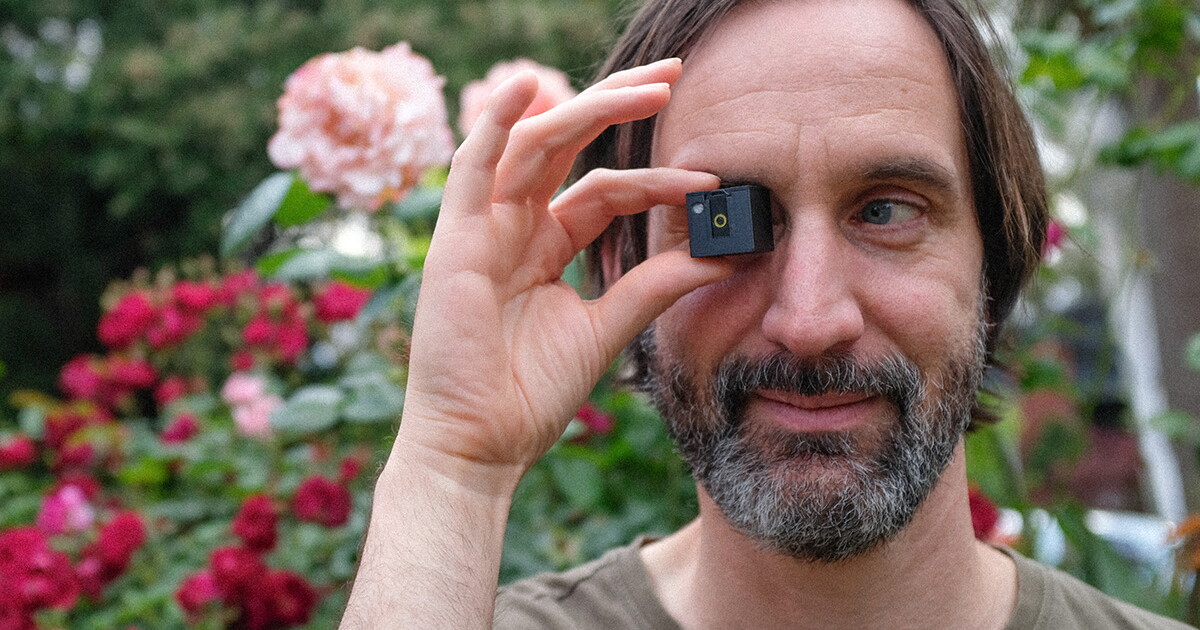
We've recently seen a bunch of cute little digital cameras that go on your keychain and serve up retro-style lo-fi photos. One man went a whole lot further in shrinking his photography gear and creating the smallest film camera ever made, using a 3D printer.Over the course of a year, Melbourne, Australia-based photographer and visual arts teacher Luke Fazelas devised and experimented with his idea for an impossibly tiny analog camera. His concept is based on the Kodak Brownie, a simple and relatively inexpensive carboard camera that first came out in 1900.The result is the Pocket Obscura, which measures 0.97 x 0.94 x 0.97 inches (2.48 x 2.41 x 2.48 cm), around the size of a US quarter) and produces stamp-sized negatives. You can see it in action in Fazelas' Instagram post below.This camera uses a pinhole aperture instead of a glass lens, and features a manual shutter. You literally have to pull the shutter up to expose the film, and drop it back down by hand to close it.Describing the shooting process to us, Fazelas explained, "With such a tiny pinhole aperture, very little light enters the camera, so exposures need to be relatively long, and the camera works best in bright, outdoor conditions. It is also best suited to stationary subjects, as anything moving during the exposure can appear blurred or disappear altogether. There is no focusing mechanism, zoom or viewfinder, so composition is a little more experimental. That said, I have a few tools and guides that I use to get as close as possible to the composition I am after." As you'd expect, the negative on photographic paper comes out tinyLuke Fazelas To be precise, Fazelas doesn't actually use conventional film rolls. "I use photographic paper, which I cut down to fit inside the camera," he told New Atlas. "Each piece is prepared and loaded individually under red safelight conditions, as the paper is sensitive to light other than red light.""The paper acts as the negative, capturing the image when light enters through the pinhole. Once the exposure is complete, I remove it and develop it using a traditional darkroom process. It is quite a hands-on approach, particularly given the tiny dimensions involved!I then scan the negatives and invert them digitally to produce positive images. This allows me to see the final photograph while retaining the unique characteristics of the original analog image." Believe it or not, this quarter-sized cube can capture photos on film like a regular analog cameraLuke Fazelas From what we've seen so far, the Pocket Obscura's images are soft, dreamy pictures with a unique look that you don't typically see from typical film cameras. Highlighting the unpredictability of the final output, Fazelas noted, "That is part of the appeal of pinhole photography: you surrender a little control and embrace the results." Photographer Luke Fazelas took this picture of a grater using the Pocket Obscura to demonstrate its results on filmLuke Fazelas The Pocket Obscura earned Fazelas a Guinness World Record for the smallest film camera. When he looked up the database, he realized no one had set this record yet, so he reached out to Guinness and received a measurement benchmark to work towards. Another shot of the grater reveals the wide depth of field you get from this pinhole cameraLuke Fazelas The hardest part, Fazelas said, was the three weeks it took to actually document the precise measurement of the camera with a qualified metrologist. You can actually order your own Pocket Obscura from Fazelas – but you might have a hard time finding and developing filmLuke Fazelas The best part about the Pocket Obscura, though, is that you can actually get one for your own photography projects. Fazelas has it listed on his website at US$45, though you'll need to wait until December before you can place an order for the next batch.Find the Pocket Obscura, as well as Fazelas' photography, on his site.
This 3D-printed cube is officially the smallest film camera ever made
Full Article
Original Source
Read the full article at Newatlas →KhanList aggregates and links to publicly available news content. We do not host full articles from third-party sources. Always verify important information with original sources.