
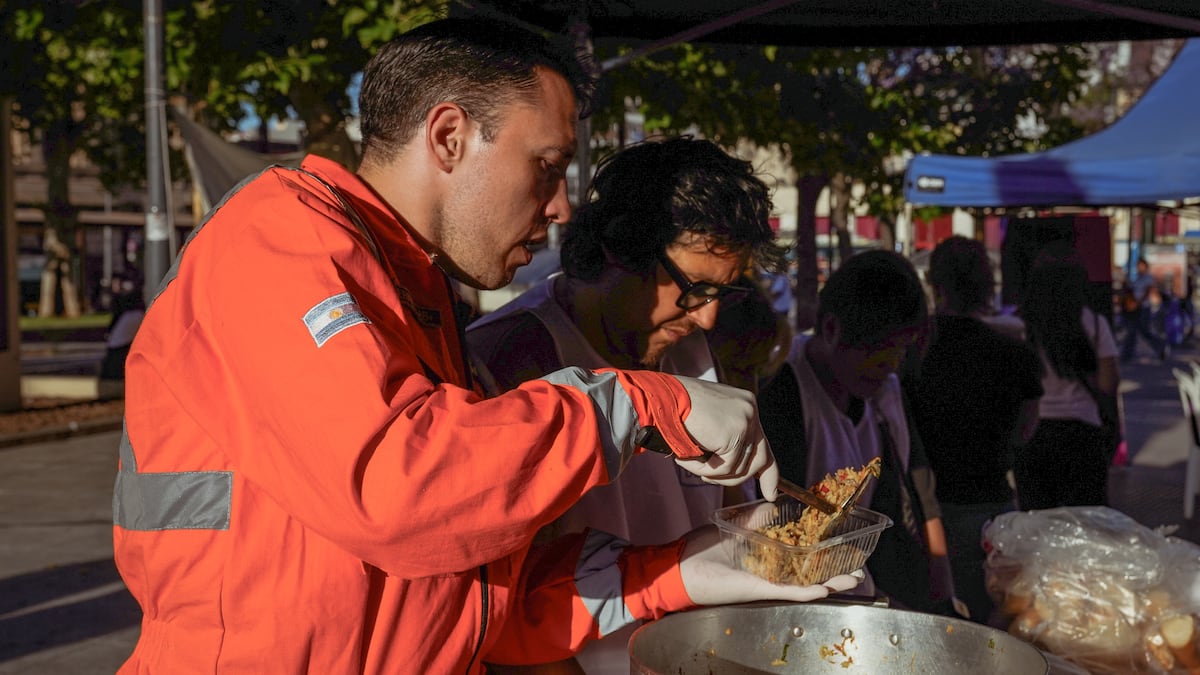
The Buenos Aires city government’s efforts to prevent people from sleeping on the streets are coming up against reality. According to official data, some 5,100 residents of the capital are homeless; according to social organizations, the actual figure is two to three times higher. The situation has worsened in recent months, as the Argentine economy has slipped back into recession, far from the growth expectations that Javier Milei’s administration projected at the beginning of the year. This Tuesday, among the dozens of people lining up in Once Square to receive a hot plate of rice and beef, there were many who had recently become homeless. They report that adapting to their new situation is made even more difficult by police harassment.“When [Jorge] Macri came, they hid us; they told us we had to leave,” says 73-year-old retiree Graciela Lubo González, referring to the recent visit by the mayor of Buenos Aires to the Once neighborhood, the capital’s wholesale trade hub. González was evicted from the room she had been living in two years ago because she could not pay the rent and ended up on the street.Under Macri’s administration — the mayor is a cousin of former President Mauricio Macri and a member of the same party, the Pro — the municipal government has raised the banners of “law and order” and “order and cleanliness” to launch numerous operations to evict protesters blocking streets, street vendors (known as manteros), informal parking attendants who ask for money in exchange for helping to park and watch over a vehicle, and homeless people sleeping outdoors in the city. These measures are applauded by many of its voters but increase the vulnerability of society’s most marginalized members.6.3% of the population is extremely impoverishedAccording to the latest official data from mid-2026, 22% of Buenos Aires’ residents are poor, and 6.3% are extremely impoverished — meaning they do not even have enough income to buy food. In absolute terms, that amounts to about 193,000 people.The government operates a network of shelters that offer a place to spend the night to those who lack one, but many people, like González, end up leaving. This retiree recalls that she couldn’t sleep because one woman screamed until dawn, another became ill and didn’t clean up the feces she left in the middle of the room, and a third fell ill and was sent to the hospital alone. “If I had stayed, I would have either gotten sick or gone crazy,” she says.González explains that she worked “her whole life, starting as a teenager,” but none of the employers at the homes she cleaned ever gave her a contract, which is why she now receives the minimum retirement pension, equivalent to about $220. Her case is no exception: only one in 10 Argentine women reaches the 30 years of social security contributions required by law upon reaching retirement age.“I’d keep working, but no one will hire me at my age,” she laments. A portion of her pension is deducted to repay a loan she took out in late 2024 and has had to keep refinancing — each time with higher interest rates — because she cannot pay it back. Unpayable debts have become one of the biggest economic problems facing Argentine households in recent years, with record-high levels of delinquency.Job insecurityNext to her is Hilaria Balza Ugarte, a Peruvian national. She has spent nearly half of her 56 years in Argentina, a country that offered her as many economic opportunities as it is now taking away. “For years I saved and lived well. I didn’t care which corrupt government was in power, because I didn’t live off the state — I lived off my work,” says Ugarte, who was employed at a private school for 23 years. “I voted for Milei because I thought things would get better, but look — I lost my job and ended up homeless, just before retiring,” she laments.The school’s owner stopped paying them for three months and then told them that he would be closing up this December because he can no longer keep it open and the tax authorities are pursuing him over a debt.“I had to take a job caring for some elderly people on the weekends for half of what I would have accepted before. With the pittance they pay me, I couldn’t afford the rent, which kept going up every six months,” adds Ugarte. “Luckily, there’s a lot of solidarity on the streets and many organizations that hand out food and clothing like this one,” she says, pointing to the cooks from Barrios de Pie, who are behind the soup kitchen.Fabián, 44, prefers not to give his last name. He still has a hard time accepting that he’s on the street; he’s been homeless for only two months. A kitchen assistant, he has worked in numerous restaurants, each time for a lower salary. He believes that the current situation is even worse than during the pandemic, when the place where he worked reinvented itself by selling takeout to its customers. The last restaurant that hired him closed its doors for good a few weeks ago, and he hasn’t found a job since then.“I’d moved to the countryside so the rent would be cheaper, but they raised it all of a sudden and I couldn’t afford it anymore. I’m going through the worst time of my life. I lost my job, my home — what else do they want to take from me?” he asks, after explaining that the police took the mattress he slept on and the socks that a friend of his was selling near the plaza.Fabián, who has been separated for three years, says that when he lands a temporary job, he rents a room by the day so he can be with his children.According to a UNICEF survey, the number of families with dependent children who reported having insufficient income to cover their expenses increased by 10 percentage points in one year. In total, there are about 2.7 million households in Argentina in this situation. Among them, 43% cut back on food purchases, and 36% postponed medical appointments due to lack of money.Tuesday’s soup kitchen has special visibility because it is part of a campaign organized by some 30 organizations. “Just as the Buenos Aires government promotes Museum Night, Pizza Night, and Ice Cream Night… we decided to hold Soup Kitchen Night and draw attention to police harassment in public spaces,” says Sol Lacava of Barrios de Pie. “We’re not doing anything illegal; we don’t cook on the street — we bring the food prepared already and distribute it — but they don’t want people gathering in public spaces, so they’re asking us for a permit that doesn’t exist just to hand out food. They’ve even arrested some of our comrades for complaining,” Lacava denounces.This activist says that more and more people are coming to ask for a meal. “There were 12,000 homeless people, according to the latest community census, and today that number must be around 18,000,” she says, noting that the policy against street vending has left many people without enough income to even pay rent for a room.Police violence on the streets often goes unnoticed when it’s directed at low-income people. This Wednesday, however, images of uniformed officers forcibly evicting customers from a café in a middle-class neighborhood sparked a wave of outrage.Social activist Juan Grabois used the controversy to denounce the normalization of police repression in other areas: “That state violence against residents, children, and the elderly that you see today in Caballito — and which moves you — happens every day in working-class neighborhoods, multiplied tenfold. A big guy in uniform took that little girl’s orange-colored toy away; in poor neighborhoods, they kick their way in to take away the pelopinchos (inflatable pools). They broke this shopkeeper’s deck; in the neighborhoods, they come in every day to destroy market stalls. In cafes, they used to lift the tables right out from under customers while they were still eating; in the neighborhoods, they lift up their mattresses and the few belongings they have.”The official response to the police officers’ actions was very different from the response to evictions targeting street vendors and homeless people. The municipal government has disciplined the officers and launched an investigation.Sign up for our weekly newsletter to get more English-language news coverage from EL PAÍS USA Edition
Soup kitchens to fight hunger in Buenos Aires: ‘I lost my job, my home — what else do they want to take from me?’
Full Article
Original Source
Read the full article at English →KhanList aggregates and links to publicly available news content. We do not host full articles from third-party sources. Always verify important information with original sources.