
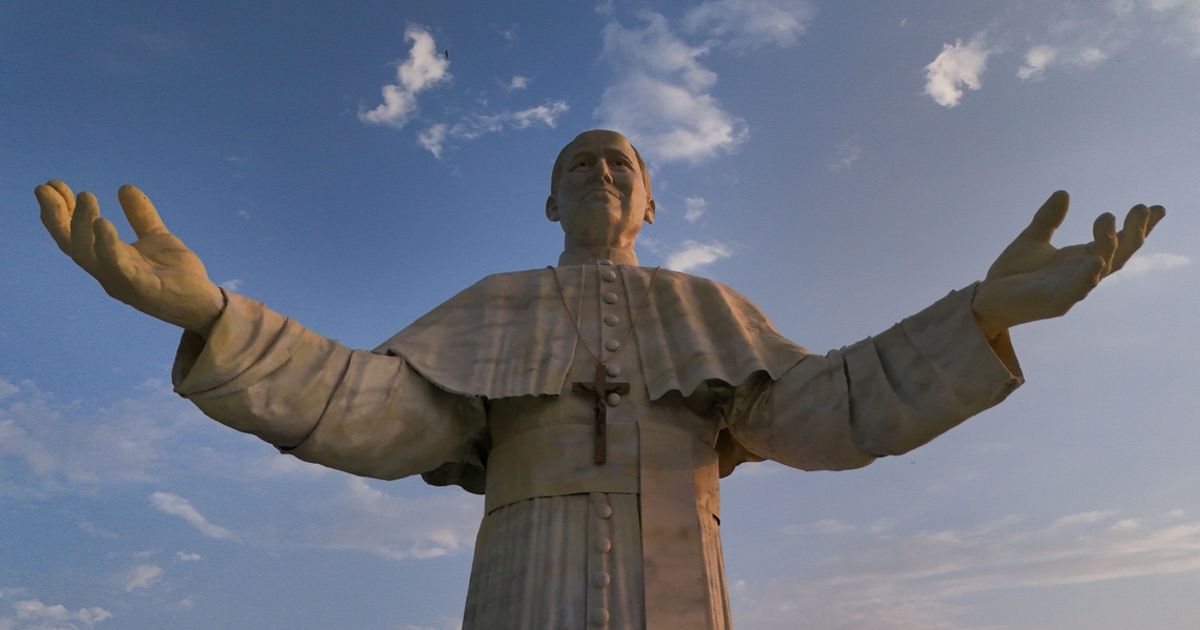
CALLAO, Peru, Nov 27 - A gleaming white statue of Pope Leo towers over a park in Callao, the gritty port adjoining Peru's capital Lima, its arms stretched toward the city. Tanker trucks water freshly planted grass around the monument, tourists stop for selfies and colorful murals brighten nearby walls after a makeover for the pope's recent homecoming.A few streets inland, the sheen quickly fades. Maykell Rodríguez, 45, stood with a friend behind a folding table piled with raw chicken, selling to passersby from a business already uprooted once by extortion from criminal gangs.Rodríguez said the sellers scattered from their previous location a few weeks ago when demands for protection money became unbearable. Even on their new corner, women who welcomed them warned that young men might eventually arrive asking for money.For the chicken seller, the nature of crime in Peru has changed.“Before, you heard more about robberies,” he said. “Now what you hear more about is extortion and demands for protection money.”Just over 100 days after President Keiko Fujimori took office on July 28 promising a “frontal war” on crime, killings and extortion are testing a presidency built in part around pledges to restore order. During the campaign, she invoked the security legacy of her father, former President Alberto Fujimori, comparing today's criminal gangs with the Shining Path insurgency his government fought in the 1990s.The early numbers are uneven. Government data show homicides nationally falling from 178 in August to 158 in September before rebounding 22% to 192 in October. Public safety remains Peruvians’ top concern.Extortion has proved more stubborn. Government survey data show 1.5% of people on Peru's urban coast experienced extortion or attempted extortion in the six months through September, unchanged from a year earlier. Monthly complaints reported to the police have multiplied fivefold in five years, according to BBVA Research, with transport operators, shopkeepers and other businesses particularly exposed.Fujimori has responded with arrests, weapons seizures, emergency measures and a joint police-military command, while tightening controls aimed at preventing crimes from being coordinated from prisons.In late October she visited El Salvador’s maximum-security Terrorism Confinement Center, signaling interest in President Nayib Bukele’s hardline approach to fighting crime.Martin Cassinelli, an analyst at the Atlantic Council think tank, said it was too soon to know whether broader reforms in Peru to the police, courts and prisons would work. For those being extorted, he said, that wait can be punishing.“The timeline may not match that of the bus driver or shop owner who is paying a daily extortion fee on increasingly lower savings,” he said.Cassinelli said modest declines in homicides would mean little if extortion remained commonplace. For Fujimori, the more meaningful test was whether Peruvians felt safer than before she took office, he added.A Datum Internacional poll underscored that challenge: just over two-thirds of Peruvians surveyed at the end of October said Fujimori's government had made no progress in reducing insecurity during its first 100 days.Her broader honeymoon is also fading. Datum put Fujimori's approval at 38% in November, down from 60% in August, while her disapproval rating almost doubled over the same period.Interior Minister César Astudillo said this week that the government was making progress in reducing crime and that homicide rates were falling, though the ministry did not provide figures. He acknowledged, however, that public perceptions of the police remained negative and proposed introducing life sentences for police officers found to be members of criminal gangs.FEAR BECOMES ROUTINEIn Callao, where voters gave Fujimori a commanding mandate in the runoff vote in June, the gulf between incremental progress and feeling safe is measured in daily decisions, from when to leave the house to whether to carry a cellphone.Official data show homicides of Callao residents jumped 41% from 137 in 2024 to 193 in 2025. Authorities had registered 167 killings through November 23 this year, putting 2026 on pace to finish only slightly below last year’s elevated level.A few streets from Rodríguez's chicken table, Elmer Quiroz, 60, a retired police officer, sat with his brother outside a neighborhood store selling drinks and snacks. He said shootings had become an almost nightly occurrence.A few weeks earlier, Quiroz said his niece had been riding in a minibus when its driver was shot, forcing her to throw herself to the floor.“You’re afraid your children will go out and not come back,” Quiroz said.A few blocks away, Violeta López, 39, sat beneath another shop, where pastries filled a glass display case.“Before, you didn't see people walking around the street with guns,” López said. “Nowadays even very young people have guns. It's practically something normal now.”A few streets away, the new statue of Pope Leo still gazed inland over Callao. The pope’s visit, a homecoming after decades spent working in Peru, briefly focused global attention on communities where residents are still waiting for more lasting change.For all the fear that had reshaped his work and his nights, Rodríguez was unwilling to give up on the port where he grew up.“These are good-hearted people,” he said.His request to Leo was simpler still: “Pray for us." REUTERS
In Peru’s Callao, Fujimori’s war on crime meets a gritty reality
Full Article
Original Source
Read the full article at Straitstimes →KhanList aggregates and links to publicly available news content. We do not host full articles from third-party sources. Always verify important information with original sources.