
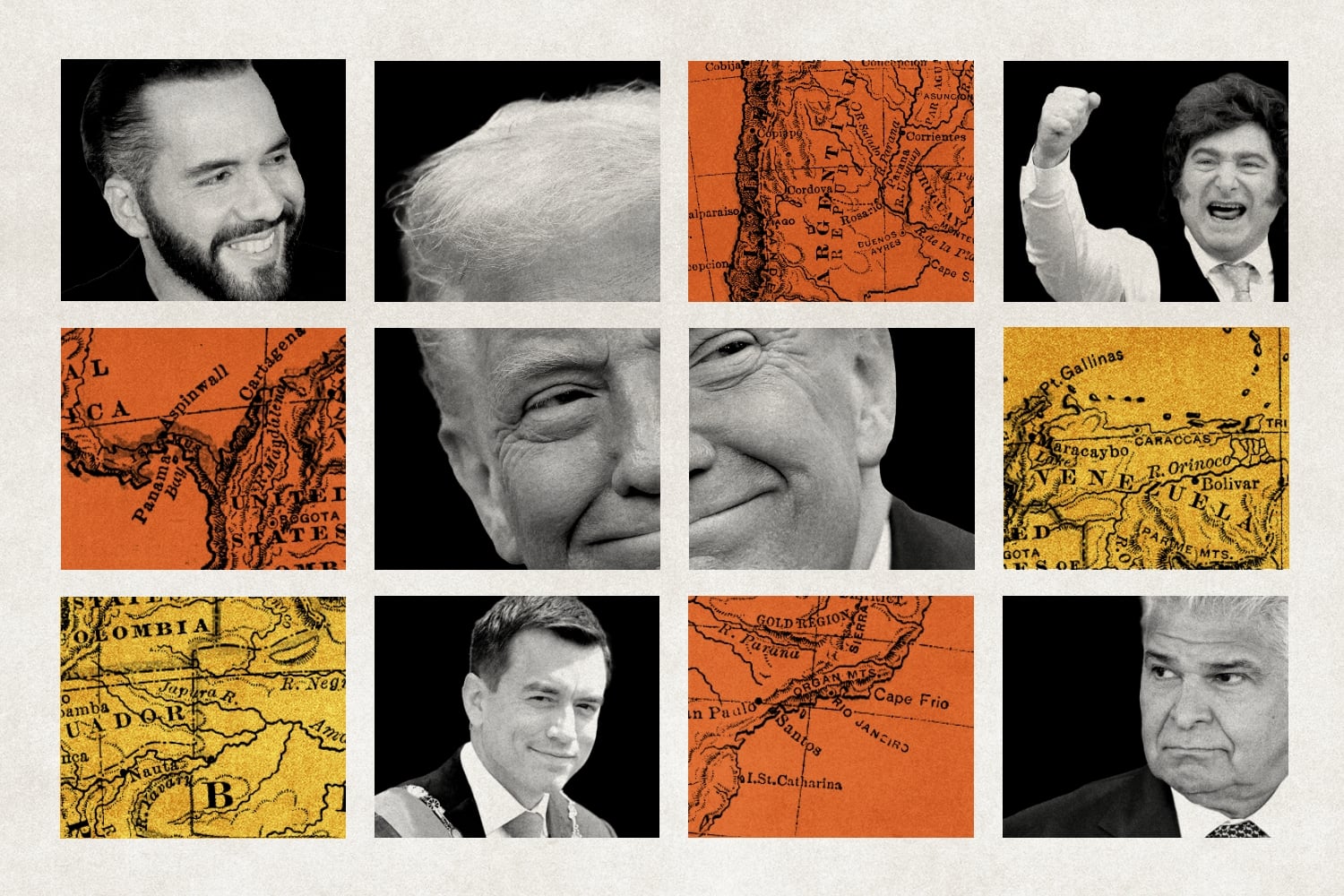
In Argentina, a giant Chinese-backed telescope project at the base of the Andes has sat partly built for more than a year, after authorities paused construction in mid-2025. In February, the Panamanian government ejected a subsidiary of a Hong Kong-based company from two ports on either side of the Panama Canal. And Mexico has imposed tariffs of up to 50 percent on many Chinese imports since January. At first glance, these shifts seem to show the success of U.S. President Donald Trump’s aggressive push against Chinese influence in the Americas. His 2025 National Security Strategy pledged to “deny non-Hemispheric competitors” the ability “to own or control strategically vital assets” in the region. Allowing “incursions” by such competitors “without serious pushback is [a] great American strategic mistake of recent decades,” it added. While Trump has faced resistance to his agenda in Canada and Brazil, much of the hemisphere is led by recently elected right-wing presidents who claim to be allied with Trump. It’s in many of these so-called orange-wave countries—such as Argentina and Panama—that the Trump administration’s warnings about dealings with China have appeared to lead to setbacks for high-profile Chinese investments. But optics are not the whole story. In many Latin American countries, ties with China have continued to move forward during the Trump years, according to key metrics such as trade flows, visits by high-level officials, and public opinion surveys. Some analysts even argue that the United States’ claim to a sphere of influence in the Americas may be a strategic blunder that could benefit China. “I think if the Americans choose the path of coercion to try to reach their goals in the region,” said Sebastián Hurtado of Ecuadorian consultancy Prófitas, “it’s going to backfire.” Two men in suits sit side-by-side at a table in front of national flags, looking down as one reads and turns the page of a paper document. U.S. Secretary of Defense Pete Hegseth (right) signs a bilateral agreement with Panama’s President Jose Raul Mulino in Panama City on April 9, 2025. Franco Brana/AFP via Getty Images Trump’s anti-China push in the Americas has so far targeted—or voiced plans to target—a vast swath of economic activity, including investments in ports, the oil sector, critical minerals, and communications infrastructure. U.S. officials have argued that these assets could be used for Chinese military purposes or that they are needed for U.S. security reasons. Beijing has retaliated to some of these moves. After Panama’s Supreme Court booted the subsidiary of a Hong Kong-based company out of two ports following Trump’s complaints, China upped maritime detentions of Panama-flagged ships. In Paraguay, China sanctioned a sitting government official for the first time ever: the information technology minister, after Paraguay affirmed ties with Taiwan and blocked Chinese companies from building the country’s 5G network. Even so, it’s noteworthy that Beijing has chosen a more muted response to other aggressive U.S. moves in the region, experts say. The U.S. apprehension of President Nicolás Maduro of Venezuela—a country that China has dubbed an “all-weather strategic partner”—in January triggered verbal condemnations but no major retaliation. Beijing also showed restraint after Mexico levied steep tariffs on Chinese goods following the United States’ urging. On Venezuela, Chinese officials “haven’t made a huge scandal, and they could have,” said Francisco Urdinez, an expert on China-Latin America relations at the Pontifical Catholic University of Chile. Urdinez argued that in general, “China always understood that the hemisphere is a natural sphere of influence for Washington,” adding that the United States “exerts absolute hegemony in military aspects.” Beijing’s core interests in the region are mostly economic—maintaining access to food and commodities exports and some big-ticket investments—as well as the fact that the region contains the largest share of countries in the world that officially recognize Taiwan, he said. Many of these economic links are hard to undo because they are governed by long-term contracts. Often, there’s no easy replacement for Chinese buyers. Chile, for example, exports most of its copper and lithium to China rather than the United States in part because China has refining capacity that the United States lacks. The Trump administration has generally been slow to offer Latin American countries alternatives to doing business with China. Though Ecuadorian President Daniel Noboa is a vocally pro-Trump president, his country’s “trade and investment relationship with the United States is stagnant,” Hurtado said. Chinese trade and investment jumped after a free trade deal took effect in 2024, and Chinese demand has helped boost Ecuador’s shrimp industry to become its top export. Noboa has visited China twice during his current term. These economic realities help explain why Beijing has sometimes chosen restraint in response to Trump’s so-called Donroe Doctrine. A “couple of wins … lets the administration maybe rest on its laurels a little bit and then get distracted from the broader economic trends that fundamentally haven’t changed,” said Audrye Wong of the American Enterprise Institute. A crowd of people cheer behind a white vehicle in a manufacturing facility, with two men in the center raising their clasped hands in celebration. Brazil’s President Luiz Inacio Lula da Silva (left) and China’s Great Wall Motor CEO Mu Feng (right) raise their hands during the inauguration of the GWM automobile factory in Iracemapolis, Brazil on Aug. 15, 2025.Nelson Almeida/AFP via Getty Images China might have already treated the Americas as a de facto sphere of U.S. military influence before Trump took office. But his administration’s public acknowledgement of the idea has triggered a series of debates in the Chinese, Latin American, and U.S foreign-policy communities over whether China and Latin American countries would welcome explicit spheres of influence. While right-wing Latin American presidents have gone along with some of Trump’s priorities, especially regarding crime and immigration, they’ve shown unease with full alignment when it comes to China. Many, like Noboa, have continued robust trade with China. Brazil’s newly reelected left-wing president, Luiz Inácio Lula da Silva, puts things more bluntly: “Dividing the world into zones of influence and making neocolonial incursions for strategic resources are anachronistic moves,” he said at the United Nations General Assembly in September. In official statements, Beijing says it rejects spheres of influence. But some observers of Chinese foreign policy, including Latin American officials who’ve dealt with Chinese counterparts, have argued that Beijing would be open to the idea—especially if it means the United States staying out of the Asia-Pacific. “China has no problem with the world being divided into spheres of influence” because “it reveals weakness in the idea that the U.S. is the global superpower,” said Hussein Kalout, a former senior Brazilian foreign-policy official. “I think China would be very satisfied if the world were divided the way it is in Trump’s head,” said Igor Patrick, the Latin America correspondent for the South China Morning Post, based in Rio de Janeiro. “But there’s an issue beyond the geopolitics of military interests, and that’s Chinese investment,” he added. Construction workers stand on pavement in the foreground of a busy shipping port filled with stacked shipping containers and tall cargo cranes under a partly cloudy sky. A construction project at the Port of Balboa, managed by CK Hutchison Holdings based in Hong Kong, at the entrance to the Panama Canal in Panama City on Feb. 23. Martin Bernetti/AFP via Getty Images Latin American and Caribbean countries have received more than $200 billion in Chinese investment since 2000, according to researchers at the National Autonomous University of Mexico. Many of those investments support the flow of critical minerals back to China, like iron and copper mines, or the global sales strategy for Chinese goods, like electric car factories. But China’s economic relationships—and its economic influence—are not uniform across the region. Mexico and Central American countries like Panama remain more deeply integrated with the U.S. economy than with China. And it is there that the Trump administration has generally been more successful at pressuring Chinese business to leave. Trump has had less success in Brazil, the world’s top recipient of Chinese investment in 2025. At a Johns Hopkins University roundtable on Chinese foreign policy earlier this year, multiple speakers brought up another obstacle to a system based on spheres of influence: Beijing does not trust the United States enough to know that any hypothetical deal to respect spheres of influence would endure. Shiao Wang, an assistant professor at Fudan University who researches Latin America, wrote in an email that she “would be cautious about interpreting China’s responses to particular U.S. initiatives as evidence that a particular geopolitical arrangement was accepted.” She added that Latin American countries’ own economic needs help explain China’s relations in the region. For now, rather than being traded as part of a grand bargain between the United States and China, Latin America finds itself in the middle of an uncomfortable tug-of-war. Protesters in a crowd hold up signs displaying the text "Somos un pueblo digno y soberano," "Petro no está solo," and "Yankees go home." Demonstrators during an anti-Trump protest in Bogotá, Colombia, on Jan. 7.Andres Rot/Getty Images It’s unclear how much Chinese business Trump will manage to push out of Latin America during his term. But one trend is emerging: Throughout the region, public opinion of China is improving relative to that of the United States. Earlier this year, respondents to a Pew poll in five out of six Latin American countries said that their views of the United States had worsened. Views of China largely remained steady. A Latinobarómetro survey found that since 2024, opinions of China have improved, and opinions of the United States have declined in 15 out of 17 Latin American countries. It was the first time that more people in the region told Latinobarómetro that China was a positive influence than was the United States. “China is not applying sanctions, going to war, or harming its friends,” Kalout said of the shift, adding that U.S. tariffs and immigration restrictions also took a toll. Urdinez, who studies public opinion about China in the region, cautioned that it has historically been volatile. He said that China’s bump is mainly due to its contrast with Trump’s foreign policy. Still, he added, China has been attracting some popularity on its own terms through the provision of high-tech goods like BYD cars, which are increasingly common in the region. “Ecuadorians view China as a country that has quickly taken off. And before, we saw the United States like that,” Hurtado said. For Urdinez, monitoring these public opinion shifts is part of tracking a long-term influence game. Beyond the question of who controls a specific mine or port, he argued that bigger issues are at play—such as whether Latin American countries ultimately align with China’s worldview in global forums like the U.N. If they do, it suggests that China has translated its economic ties into more holistic geopolitical influence in the region, even despite the ubiquity of hard U.S. military assets. Speaking about Brazil, Kalout said people “prefer the United States over China due to cultural relations, values, economic ties, and related secular traditions.” But whether that relationship proves more durable “depends a lot on how the United States acts in the coming decades,” he said.
Latin America’s ‘Orange Wave’ Is Not Spurning China
Full Article
Original Source
Read the full article at Foreignpolicy →KhanList aggregates and links to publicly available news content. We do not host full articles from third-party sources. Always verify important information with original sources.