
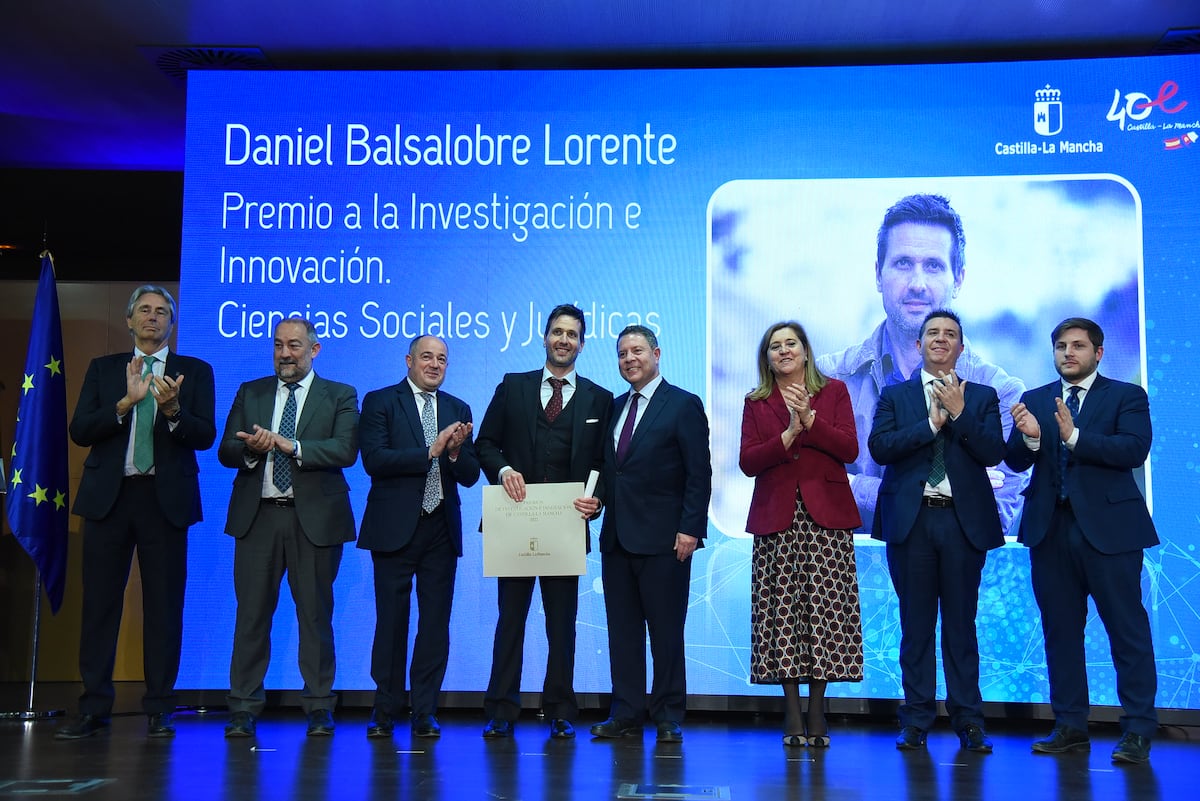
Three different scientific journals have retracted a total of six studies by Professor Daniel Balsalobre, an expert in environmental economics and one of the most cited scientists in the world, over irregularities. Publishers are citing bad practices, including manipulating citations of his work and concealing conflicts of interest. Balsalobre, born in Barcelona 48 years ago, produced only a couple of studies a year in 2015, but his record swelled explosively after the Covid pandemic and he reached a pace of one paper every five working days in 2023. His papers have been cited more than 25,000 times in record time, mostly in research work produced by Chinese, Pakistani, Indian, Saudi and Malaysian scientists. Thanks to those citations, the professor at the University of Castilla–La Mancha ranks number one in Spain in Research.com’s Best Rising Stars of Science in the World Ranking.Balsalobre defends his honesty. “I have never intentionally done anything that, to my way of thinking, would be unethical,” he says in a telephone interview with EL PAÍS. The scientist says that early in his career he collaborated with a few Spanish researchers, but his trajectory changed when he decided to contact one of the two most cited professors in the world in environmental economics: the Pakistani researcher Muhammad Shahbaz. They began publishing together in 2017 on economic models linked to greenhouse gas reductions. “That led people from other countries, like Pakistan and China, to start emailing me: ‘Daniel, I want to work with you,’” he says.Balsalobre’s network of collaborators is striking. Of more than 100 million scientists analyzed worldwide, 99.8% have no retracted studies, according to Argos, a tool for monitoring scientific integrity. Yet Balsalobre has coauthored papers with many colleagues who have had papers retracted for irregularities, such as Muntasir Murshed of Bangladesh (eight retractions), Abdelmohsen A. Nassani of Syria (another eight), Tomiwa Sunday Adebayo of Nigeria (seven) and Atif Jahanger of Pakistan (three). Within that suspicious network, members cited one another and managed to infiltrate the coveted rankings of the world’s most cited scientists. One striking figure: 170 papers that cited Balsalobre have already been retracted for irregularities.The Spanish economist admits he increased his publication rate to obtain a full professorship, a goal he achieved in 2024. “Since then I have been more careful. At the time I may have been a bit careless, too trusting, or something may have gone wrong in the whirlwind of working and producing. I won’t deny that, honestly. Did I do it on purpose? I didn’t need 20,000 citations to achieve my modest academic career,” he says. After appearing in the rankings, Balsalobre received the Castilla–La Mancha Research Award in March 2023, presented by the regional premier Emiliano García-Page, of the Spanish Socialist Party (PSOE).Balsalobre teaches at the University of Castilla–La Mancha School of Social Sciences in the city of Cuenca. Climbing the rankings has put him in the local news as one of the best scientists in the world (“I am proud to put Cuenca on the international research map,” was the headline of an interview in the local newspaper Las Noticias de Cuenca). It has also opened a new income stream through collaborations with other universities. In a 2025 study on the use of artificial intelligence in the renewable energy sector, Balsalobre is listed as a researcher at the University of Castilla–La Mancha and at three other institutions: Ecotec University, Samborondón (Ecuador); Azerbaijan State University of Economics; and Western Caspian University, also in Azerbaijan. Another recent affiliation is the Czech University of Life Sciences.International institutions compete to recruit the most cited scientists because those hires help them gain points and move up in some world university rankings. The professor says he has signed a collaboration agreement with the Azerbaijan State University of Economics. “If I ever ask them for a database or, at some point, tell them: ‘Hey, I need a computer, can you send me a computer?’, they send it. Or they say: ‘Come, we will invite you, we will give you something,’” he says.Balsalobre has been among the world’s most highly cited scientists since 2022, according to a ranking compiled by Stanford University. Until 2023 he was also listed in another leading ranking produced by Clarivate, but, he says, he was removed following anonymous complaints. Asked about the case, a Clarivate spokeswoman told this newspaper that they do not comment on individual cases, but stressed that they have tightened criteria to exclude scientists involved in bad practices.Balsalobre has had one paper retracted every month since August, and criticism of his work is growing. María de los Ángeles Oviedo, a professor at the University of Seville, accuses the economist of exploiting the system’s flaws by carrying out “coercive citation manipulation.” In today’s science environment, researchers are virtually obligated to publish their results in a specialized journal. Before publishing, the publisher asks other experts to peer review the paper free of charge for possible errors. Balsalobre accepted more than 650 review invitations—an entirely unusual number. The professor used some of those peer reviews to suggest that authors include citations to his own work, he admits. In an insubstantial paper on the use of ChatGPT in higher education, Balsalobre urged the two Indian authors to cite seven of his own environmental economics papers. “Is he one of the most cited scientists thanks to coercive citations?” Oviedo asks.The University of Castilla–La Mancha is examining the case, says its rector, the veterinarian Julián Garde. “Our alarms went off about a month ago. We have asked our research ethics committee to prepare a report and, based on that, we will make decisions if any need to be made,” explains Garde, who has been president of the Conference of Rectors of Spanish Universities (CRUE) since May.The case exposes a murky underworld in the international science system. Philippe Garrigues, editor-in-chief of Environmental Science and Pollution Research, said last year that his journal had been overrun by groups of researchers who cite one another and by stream-produced, insubstantial papers whose authorship was sold to the highest bidder. The rot, Garrigues warned, was concentrated in the journal’s green-economy section, with papers full of absurd sentences, irrelevant citations and corrupted peer-review processes. Up to December 2024, the title had retracted nearly 250 papers, more than 90% of them in green economics, “a highly risky topic and an area of focus for paper mills and citation cartels,” Garrigues said.The journal has already retracted four of Balsalobre’s studies, on topics such as CO₂ emissions in Pakistan and tourism’s environmental impact, after finding the peer-review process had apparently been manipulated. The professor has published 26 of his more than 230 papers in that journal, and he knows his seventh retraction is likely to follow soon. Environmental Science and Pollution Research belongs to the publishing giant Springer Nature. Its head of research integrity, Tim Kersjes, says the clean-up process continues. “We can’t comment on individual cases, but we can confirm that we are continuing to investigate some papers at the journal, based on leads from previous cases,” Kersjes tells this newspaper.Daniel Balsalobre has signed papers with some 400 co-authors. “Have some I collaborated with turned out to be bad actors? Yes—Muntasir Murshed, for example,” he says, referring to the Bangladeshi researcher with eight retractions, with whom he has worked on more than a dozen articles. “The day I found out he was asking for money to publish [selling coauthorships on prefabricated papers], I blocked him immediately,” he says.Balsalobre presents himself as a victim and attributes the criticism to the jealousy stirred by his inclusion on Clarivate’s Highly Cited Researchers list in 2022: “It’s Spanish envy, as [philosopher José] Ortega y Gasset said. I’ve never experienced it: they don’t want to have what you have, they just want you not to have it.”Sign up for our weekly newsletter to get more English-language news coverage from EL PAÍS USA Edition
Six studies by Daniel Balsalobre, Spain’s ‘number 1’ emerging scientist, are retracted due to irregularities
Full Article
Original Source
Read the full article at English →KhanList aggregates and links to publicly available news content. We do not host full articles from third-party sources. Always verify important information with original sources.