
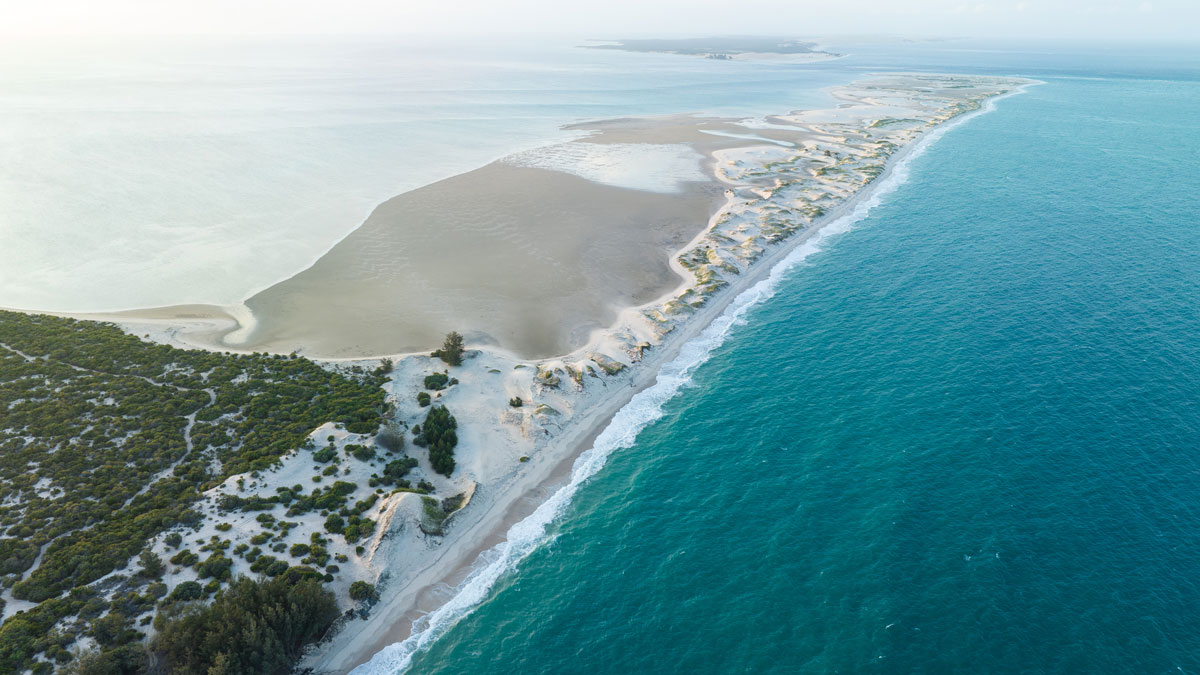
On an otherwise sandy ocean floor, sea life thrives on hard substrates, like peat reefs. Credit: Bazaruto Center for Scientific Studies (BCSS) Off the coast of Mozambique, the Bazaruto Archipelago is known for picturesque striations of white sand that streak through shallow, aquamarine water. Onshore, low vegetation clings to sand dunes, never much taller than the elephants that wander the mainland about 20 kilometers (12.6 miles) away. But thousands of years ago, these coasts were covered in sprawling peat swamps and forests of trees, and scientists have discovered that the remains of those ancient forests now make up a thriving underwater habitat. Only a handful of such habitats, called peat reefs, have been documented across the globe. They form when the organic material from submerged trees is broken down over time to provide a carbon-rich substrate for ocean life along an otherwise sandy coastline. A new study in Scientific Reports documents what researchers call an ecological reinvention of peat reef habitats. “We believe this is the first ecological study of peat reefs anywhere in the tropics,” said Mario Lebrato, a marine biogeoscientist at the Bazaruto Center for Scientific Studies. The Bazaruto Archipelago’s sandy shores were once home to ancient forests. Credit: Bazaruto Center for Scientific Studies It’s not just their history that’s significant. The Bazaruto peat reefs are also teeming with life. So much life, in fact, that they are comparable with their coral reef neighbors. The reefs are raising questions about whether they’re holding or releasing carbon—and what that could mean for global climate. History Peats Itself Peat itself is difficult to describe. “We are still debating, internationally, how to define peat,” said Richard Lindsay, a peatland ecologist at the University of East London who was not involved with the research. It is mostly decomposed organic matter, meaning it is rich in carbon, but some researchers still disagree about what can and cannot be classified as peatland. The team in Mozambique, in fact, wasn’t seeking out peat but instead happened upon it. “We kept seeing marine life on dark, firm platforms that didn’t fit any habitat we knew,” Lebrato said. The researchers sampled material from the reefs and recorded up to 40% carbon by dry weight, an indicator that these reefs may have once been forests. According to the U.S. Department of Agriculture, trees’ chemical composition, on average, is about 50% carbon by dry weight. The reefs host no coral but are instead inhabited by seagrass, microalgae, and sponges that use the peat as substrate. These organisms provide protection for juvenile animals and other small residents. “A former forest floor has become a nursery for reef fish,” said Lebrato. A constellation of reef fish gathers atop the peat reefs of Mozambique. Credit: Bazaruto Center for Scientific Studies Invertebrates, fish, and even turtles and sharks were found on Bazaruto’s peat reefs, which are part of the marine protected area of Bazaruto Archipelago National Park. “That’s striking for a habitat just 2–4 meters deep, with some areas periodically exposed by the tides and regularly broken up by storms,” Lebrato said. The reefs’ history was uncovered through radiocarbon dating, which revealed the submerged structures could be anywhere from 300 to 5,000 years old. This mid- to late Holocene origin dates to a time when ice caps held significant water—before a warming world saw the global sea level rise that submerged the Bazaruto coastlines and forests. “A 30-centimeter-thick layer of peat over an area of a hectare can contain as much carbon as a hectare of rainforest.” The Blue Economy Peat reefs are often left out of climate models. They’re rarely mapped, in part because they can appear and disappear as sand moves. “They still represent a huge carbon store,” said Lindsay. “A 30-centimeter-thick layer of peat over an area of a hectare can contain as much carbon as a hectare of rainforest.” There is evidence of other peat reefs around the world, largely in Europe, but also in the United States and Southeast Asia. But if these reefs continue to be overlooked, destructive activities like trawling or deep-sea mining could release carbon and destroy these humming biodiversity centers along the way. At low tide, parts of the peat reefs are exposed, allowing researchers to further study and sample them. Credit: Bazaruto Center for Scientific Studies Because of this threat, understanding peat reefs is crucial. The researchers haven’t yet quantified how much carbon the reefs hold or whether that carbon is being stored or released. “For the blue economy, the first step is simple: Put peat reefs on coastal maps and into conservation plans and policy, so they’re not lost before we understand their full value,” said Lebrato. —Ryan Green, Science Writer Citation: Green, R. (2026), Scientists have discovered a thriving reef that was once an ancient forest, Eos, 107, https://doi.org/10.1029/2026EO260368. Published on 17 November 2026. Text © 2026. The authors. CC BY-NC-ND 3.0Except where otherwise noted, images are subject to copyright. Any reuse without express permission from the copyright owner is prohibited.
Scientists Have Discovered a Thriving Reef That Was Once an Ancient Forest
Full Article
Original Source
Read the full article at Eos →KhanList aggregates and links to publicly available news content. We do not host full articles from third-party sources. Always verify important information with original sources.