
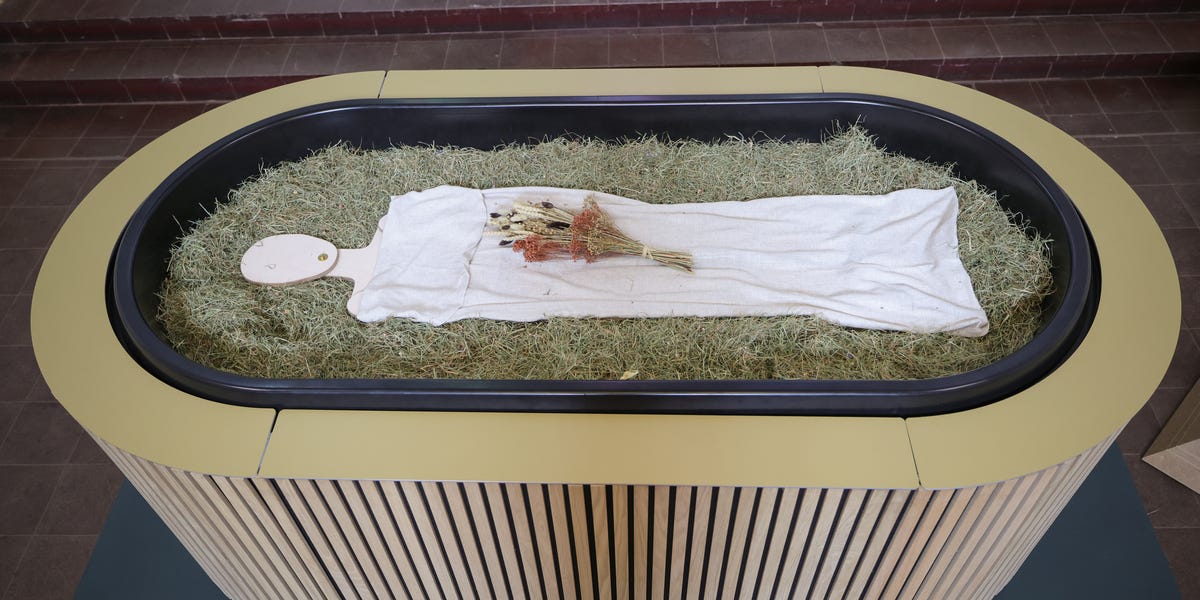
3 min readWhen someone dies and is buried, it’s often described as “returning to the Earth,” and strictly speaking, that’s true. A body, typically pumped full of preservatives and chemicals in a traditional burial, is lowered into a perplexingly ornate casket, where it can take upwards of 15 years to fully decompose. However, a new kind of burial known as “terramation” or “human composting” does away with these attempts at preserving the body. Instead, it leans into the opposite strategy by creating favorable microbial environments that can decompose human flesh in just a month. The result is a more eco-friendly end of life that doesn’t pollute the air like cremations, or leach chemicals into the ground as decomposing caskets do.This new approach to the afterlife is currently legal only in a dozen U.S. states, parts of Germany, and New South Wales in Australia. But France may be next, thanks in part to a strange experiment unfolding at a cemetery in Les Ulis. It’s here that Damien Charabidzé, an entomologist at the Université de Lille, is studying two types of burials side-by-side using sheep corpses. Last summer, Charabidzé teamed up with Humo Sapiens, a group campaigning to legalize terramation, to bury sheep in eight pits. Four sheep went straight into the soil, and four were packed in shredded plant matter.“It's the same principle as composting,” Charabidzé said in a press release for the French National Center for Scientific Research (CNRS). “You need to strike a balance between a nitrogen-rich material to be broken down (in this case, a corpse) and carbon (wood shavings) through which oxygen can circulate.”Then the team waited a year and returned on a sweltering summer day to unearth their decomposed specimens. In the pits filled with plant material, no odors issued forth when the burials were exhumed. Only bones remained in the graves, with all organic material transformed into humus—stable soil organic matter. The same could not be said of the other pits. There, the sheep had only lost only a quarter of their mass and many of them were in the process of saponification, in which fats from the body turn into a kind of wax (often referred to in human burials as “grave wax”).“The flesh practically stops decomposing,” Charabidzé said in a press release. “And nothing grows above the pit….We don’t know to what extent this natural phenomenon is exacerbated by embalming fluids, by the ingestion of food packed with preservatives during life, or by the deterioration of the soil in cemeteries.”Terramation solves several problems at once. Cremating a single body has roughly the carbon footprint of a round-trip flight, according to researchers, and composting could largely eliminate those emissions. It also keeps embalming chemicals out of the soil and takes up no permanent cemetery space. That matters because as land prices soar worldwide, burial leases are getting shorter, making a grave a less attractive way to ride out eternity. Terramation also has a spiritual appeal. Instead of harming the planet that sustained us, our final act can be a gift back to it.Mortality is undergoing a reexamination of sorts as the ultra-rich are trying to cheat death, and AI companies are selling digital avatars of the dead. Terramation offers something humbler: a way to die that actually helps the planet.Darren lives in Portland, has a cat, and writes/edits about sci-fi and how our world works. You can find his previous stuff at Gizmodo and Paste if you look hard enough.
Scientists Buried Sheep in a French Cemetery for a Year. What They Dug Up Could Change How We Bury Humans.
Full Article
Original Source
Read the full article at Popularmechanics →KhanList aggregates and links to publicly available news content. We do not host full articles from third-party sources. Always verify important information with original sources.