
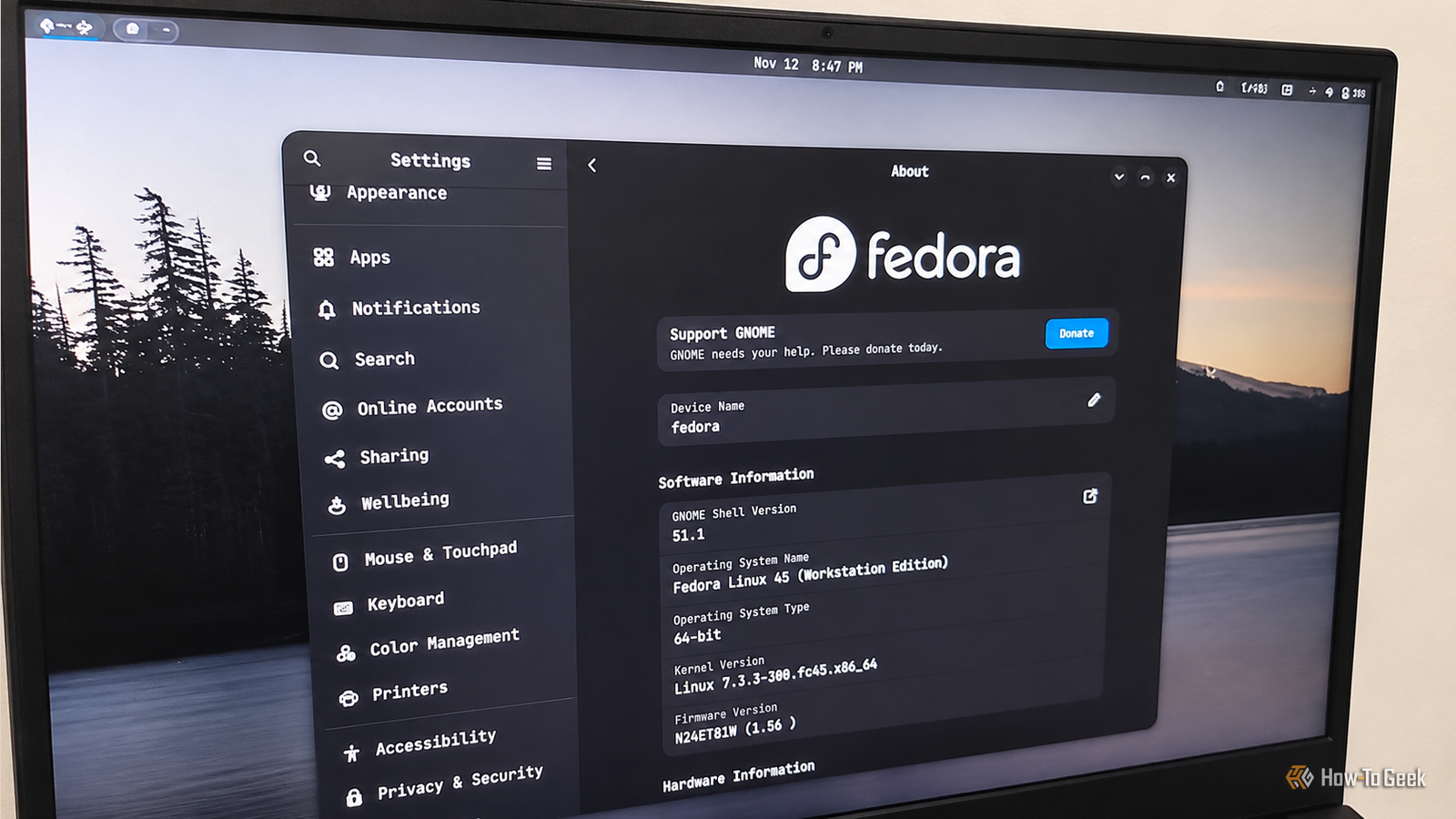
Published Nov 12, 2026, 4:00 PM EST Umair Khurshid is a technology writer and developer with a strong focus on Linux, FreeBSD, cloud infrastructure, and automation. Before focusing on writing, Umair worked as a developer and DevOps engineer building and automating cloud-native systems. I have been using Fedora as my daily driver for years now. In fact, it's been so long that I don't even remember exactly when I switched to it, and I really like it. I have tried several Linux distros over the years, including Ubuntu, but I always find myself coming back to Fedora. Part of that comes down to personal preference. I have always felt that Ubuntu is a little bloated, and even when I tried it again recently, I couldn't quite shake that feeling. Fedora just feels cleaner to me, particularly in how it handles the GNOME desktop. However, personal preferences aside, I think there's a more interesting question worth asking now that Fedora 45 is here. Fedora has traditionally been the distro you choose when you want newer software, the latest desktop technologies, and a more upstream Linux experience, but with Ubuntu 26.10 catching up in several important areas, I'm beginning to wonder just how much of that advantage Fedora still has. Ubuntu has caught up to where Fedora used to lead The latest kernel and GNOME are no longer exclusive advantages Fedora 45 was finally released on November 3, 2026, following a couple of delays. It comes with GNOME 51 on its flagship Workstation edition, KDE Plasma 6.8 on the KDE edition, and Linux kernel 7.2 in its initial release. There's also a welcome addition to the installer, which now supports installing Fedora onto Stratis-managed storage. These are all good improvements, but there's something interesting about this release. Ubuntu 26.10, which came out a few weeks earlier on October 15, already ships GNOME 51. It also launched with Linux kernel 7.3 (release candidate), making its initial kernel version newer than Fedora 45's. Of course, Fedora updates its kernel frequently, and kernel 7.3 just made its way through Fedora's updates. So this isn't necessarily a lasting advantage for Ubuntu. Still, I think it says something about how much things have changed. One of Fedora's biggest selling points used to be that you could get the latest GNOME desktop and newer kernel features without waiting for Ubuntu to catch up. These days, at least when comparing their regular six-month releases, that distinction is much harder to make. Ubuntu has also been making some interesting changes of its own. Ubuntu 26.10 completes its transition to Rust-based coreutils, replacing the remaining GNU implementations of commands such as cp, mv, and rm with their Rust-based equivalents by default. It also introduces Myna, an optional on-device speech-to-text feature that processes audio locally. These are fairly substantial changes to a distro that people sometimes characterize as conservative. I wouldn't go as far as saying Ubuntu has become more cutting-edge than Fedora. However, I do think it's becoming increasingly difficult to recommend Fedora solely because it ships newer software. Fedora still does a few things differently Its upstream-first approach is what keeps me coming back While Ubuntu has caught up in terms of several major components, Fedora still has an advantage in how it approaches the Linux desktop. Fedora generally stays closer to upstream projects. The GNOME desktop is a good example. When you install Fedora Workstation, you get an experience that closely resembles what the GNOME developers intended. Ubuntu, on the other hand, makes several customizations, including its dock, themes, and other desktop integrations. Now, there's nothing inherently wrong with Ubuntu's approach. In fact, many people probably prefer having a familiar desktop layout immediately after installation. I just happen to prefer Fedora's implementation. The same goes for software packaging. Fedora generally favors Flatpak for desktop applications, while Ubuntu has invested heavily in Snap. Both have their advantages, but I personally prefer Flatpak, particularly because of its broader adoption across Linux desktop environments and the flexibility of tools like Flatseal. Fedora also defaults to SELinux, whereas Ubuntu uses AppArmor. I wouldn't necessarily call one distro more secure because of this difference alone. However, Fedora's SELinux integration is particularly useful if you work with systems and technologies from the Red Hat ecosystem. Another thing I appreciate about Fedora is that it usually adopts newer versions of development tools relatively quickly. If you are a developer or someone who regularly experiments with Linux technologies, this can make a difference. Fedora 45 also introduces additional security hardening, including stricter RPM package signature verification and restrictions on unprivileged process tracing. I think this is where Fedora's real advantage lies today. It's less about winning a race to ship the newest kernel and more about the overall experience it provides. Ubuntu still has some very practical advantages Better third-party support and a much longer maintenance option As much as I prefer Fedora, there are situations where I would recommend Ubuntu without much hesitation. The biggest advantage is support. Fedora releases are maintained for approximately 13 months, which means you will need to upgrade reasonably frequently. You don't necessarily have to upgrade every six months, but you cannot stay on the same release for several years and continue receiving security updates. Ubuntu's LTS releases are a different story. Ubuntu 26.04 LTS receives five years of standard security maintenance, making it a much more attractive option for someone who wants to install an operating system and keep using it without worrying about major upgrades. It's worth mentioning that Ubuntu 26.10 only receives nine months of support. So if you are comparing Fedora 45 directly against Ubuntu 26.10, Fedora actually has the longer maintenance window. Ubuntu also benefits from much broader third-party software support. Plenty of AI stuff, commercial apps, proprietary drivers, and developer tools offer Ubuntu-specific installation instructions or Deb packages. When you are following a Linux tutorial online, there's a good chance the instructions were written with Ubuntu in mind. Fedora can run most of the same software, but you may occasionally need to find alternative installation methods or make adjustments. This is particularly noticeable with proprietary drivers. Ubuntu has generally made installing drivers such as NVIDIA's fairly straightforward, and Ubuntu 26.10 improves the process further with a dedicated driver management page in its App Center. Another consideration is hardware and software compatibility. Many vendors explicitly test their products against particular Ubuntu releases. That doesn't mean Fedora won't work, but official support can save considerable time when something goes wrong. For someone who simply wants a dependable desktop with minimal maintenance, I can understand why Ubuntu might be the more practical choice. So, does Fedora 45 still have an edge? If you are choosing between Fedora 45 and Ubuntu 26.10 because you want the latest software, the differences aren't nearly as significant as they used to be. I think Fedora's edge over Ubuntu has narrowed considerably. There was a time when recommending Fedora for newer software was an easy argument to make. Does that mean that I am going to jump ship and switch to Ubuntu? No, and I suspect that's the case for a lot of people who have been using their preferred Linux distro for years. For me, there's also the familiarity factor. I have spent years managing CentOS, RHEL, and more recently, AlmaLinux and Rocky Linux servers. I have certainly worked with Debian servers too, but most of my professional experience has been with the Red Hat ecosystem. So naturally, Fedora feels more familiar to me. I know my way around it, I'm comfortable with its tools, and I don't see much reason to change that. And I think the same is true for many Ubuntu users. If you have spent years working with Ubuntu and Debian-based systems, you are probably going to feel more comfortable with Ubuntu, even if Fedora happens to offer a few technical advantages. At some point, the differences between two mature Linux distros become small enough that your existing experience matters more than whatever new features the latest release brings. That's probably where Fedora and Ubuntu are today, but I also think it's important to separate what I personally enjoy from what makes sense for other users.
Fedora 45 is here, but does it still have an edge over Ubuntu?
Full Article
Original Source
Read the full article at Howtogeek →KhanList aggregates and links to publicly available news content. We do not host full articles from third-party sources. Always verify important information with original sources.