
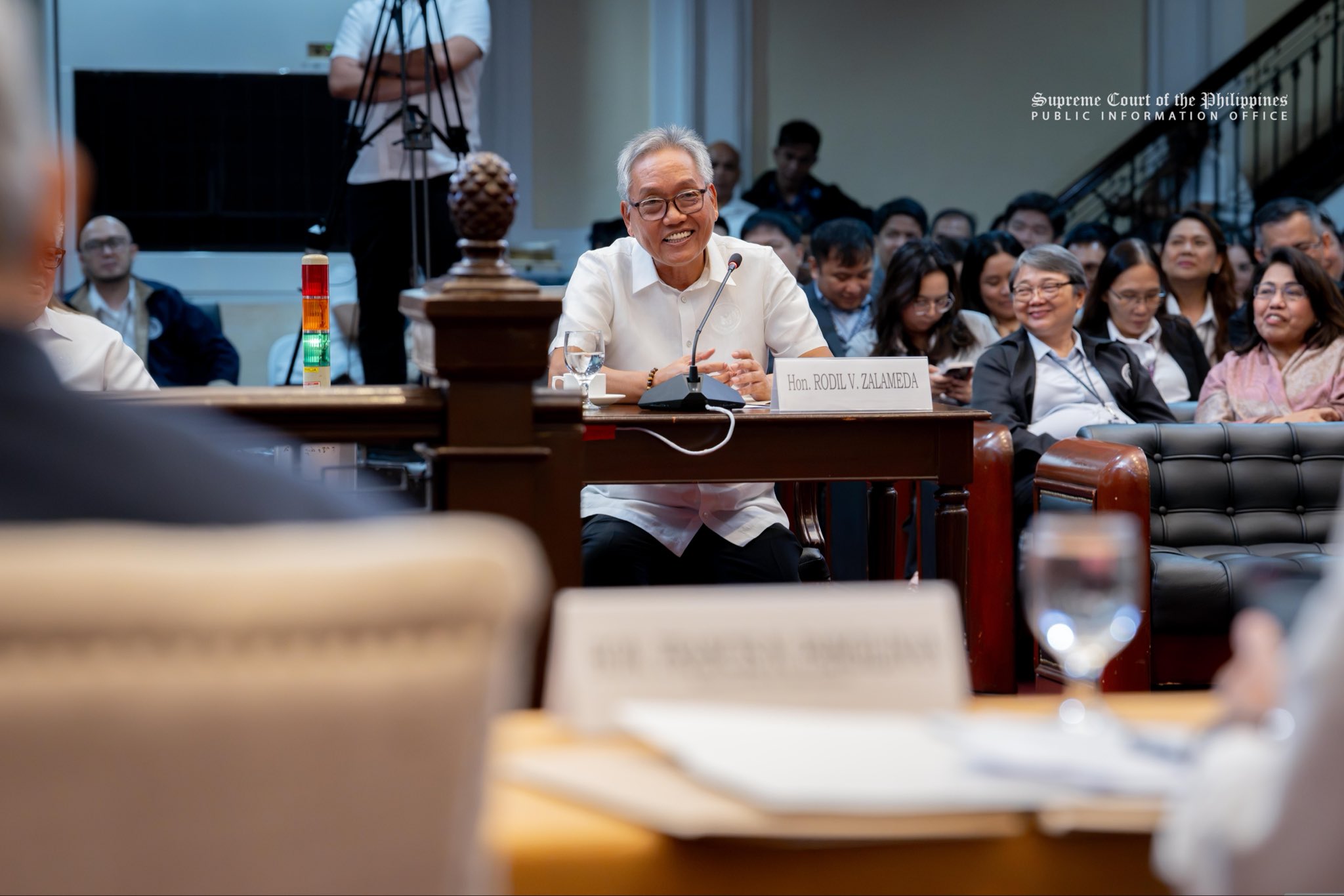
FOR CJ. Associate Justice Rodil Zalameda during the Judicial and Bar Council's public interview for chief justice on Monday, October 26. Supreme Court of the Philippines 'We have to gain the trust of the people in the domain of justice. I want a Supreme Court which is being seen by the people as their last bastion,' Associate Justice Rodil Zalameda says Associate Justice Rodil Zalameda aims to prioritize the welfare of court employees and address disparities in benefits if appointed as the next Chief Justice of the Philippines. He plans to tackle case backlogs by building more courthouses, utilizing technology for efficiency, and ensuring equitable distribution of cases among judges based on complexity. Zalameda emphasizes the importance of collegiality within the Supreme Court and advocates for transparency in the judiciary to build public trust and minimize corruption. This is AI-generated. Read the article for full context. Report any errors. MANILA, Philippines – Associate Justice Rodil Zalameda says he knows the plight of ordinary employees so he intends to focus on their welfare – among other innovations in the judiciary – should he become the country’s 28th Chief Justice. “After passing the Bar in 1988, I began my career as a branch clerk of court of the Regional Trial Court of Makati. This gave me an appreciation of the challenges faced by our court employees,” Zalameda said during his public interview with the Judicial and Bar Council (JBC) on Monday, October 26. “The Judiciary is often spoken of in terms of judges, justices, decisions, and jurisprudence. But behind every decision are countless employees who perform their duties quietly and without recognition. I understand their challenges because I have been where many of them are,” he said. Zalameda is one of the five candidates for chief justice, vying to replace Chief Justice Alexander Gesmundo, who will retire on November 6. The aspiring chief justice currently holds seat No. 7 at the High Court. After serving for years at the Court of Appeals, he was appointed to the Supreme Court (SC) by then-president Rodrigo Duterte in August 2019. After the public interviews, the JBC will send a short list of nominees to President Ferdinand Marcos Jr., who has the power to make the appointment. If chosen, Zalameda will serve for around seven years or until 2033. During the Monday interview, JBC members asked Zalameda how much would be a workable budget for him if he is ever appointed as chief justice. He said any increase in the Court’s budget “will be greatly appreciated.” They then asked him, if given additional funds, what would be his top priorities. Zalameda said he will focus on building additional courthouses to address delays in dispensing cases, using technology for more efficient processes, and increasing the benefits of judiciary employees. “The judiciary must also confront delays that continue to burden litigants. I recognize that not all cases require the same amount of time and effort. We must consider their nature and complexity, the number of parties and witnesses, the volume of evidence, the length of proceedings, and the issues that must be resolved,” he said. Zalameda also explained that there’s a discrepancy between the benefits that appellate court employees and lower courts employees receive. He said a study should be done to look into this disparity. “I just want to cite an example: There is a perennial problem here with respect to the discrepancy between the allowances given to the appellate court employees and those in the trial courts. There was a time that the difference was I think more than 50%,” the aspiring chief magistrate explained. “I think we have to review this and if we could get some funds…to supplement their budget for their allowances. That would be a good idea,” he added. What type of justice will Zalameda be? Zalameda said he strongly believes in separation of powers, and that each branch of the government — executive, legislature, and the judiciary — is by bound by its own constitutional mandate. He explained that he is a follower of the Constitution and always follows his conscience. For him, a chief justice must be a servant of the judiciary and should work with litigants, lawyers, court staff, judges, and with fellow justices. “The role is to create an environment where problems are heard, solutions are developed, good ideas are supported, and people are given the tools to fulfill their responsibilities. Leadership is ultimately about service, accountability, and enabling others to succeed,” Zalameda said. As the chief magistrate, Zalameda said he also intends to lead with collegiality. He said he will respect his fellow members of the SC en banc. “Collegiality does not mean the absence of disagreement. It means we can disagree without becoming disagreeable, and remain, after the debate and the vote, members of one Court serving one Constitution. This is the kind of collegiality I hope to strengthen – one built on mutual respect, professional trust, and a shared commitment to the institution,” said Zalameda. More tangible changes To address case backlogs, apart from building more courthouses, Zalameda said there should be equal distribution of cases among judges based not on quantity, but based on the nature of the case, their complexity, and the parties involved. The justice said he will launch a study to address this matter. The Office of the Court Administrator could be the office assigned for this, he explained. Zalameda said he also believes that courts should be more transparent to minimize graft and corruption. “We have to minimize also graft and corruption and the trust of the court should be established so that we can have later on high respect for the nation,” he explained. “I think we have to gain the trust of the people in the domain of justice. I want Supreme Court which is being seen by the people as their last bastion.” He also explained that his judicial philosophy — the principle that guides him in deciding cases — is legal pragmatism. Zalameda said he believes that decisions should have real-life impact. “In this principle of first prudence, you use the law as a tool to decide on cases, but we have to consider the realities, the cause and effect, that may result, and the effect on the people with respect to the decision which we made,” he said. – Rappler.com How does this make you feel? Loading
Zalameda’s promises as chief justice bet: Solve case delays, more benefits for court staff
Full Article
Original Source
Read the full article at Rappler →KhanList aggregates and links to publicly available news content. We do not host full articles from third-party sources. Always verify important information with original sources.