
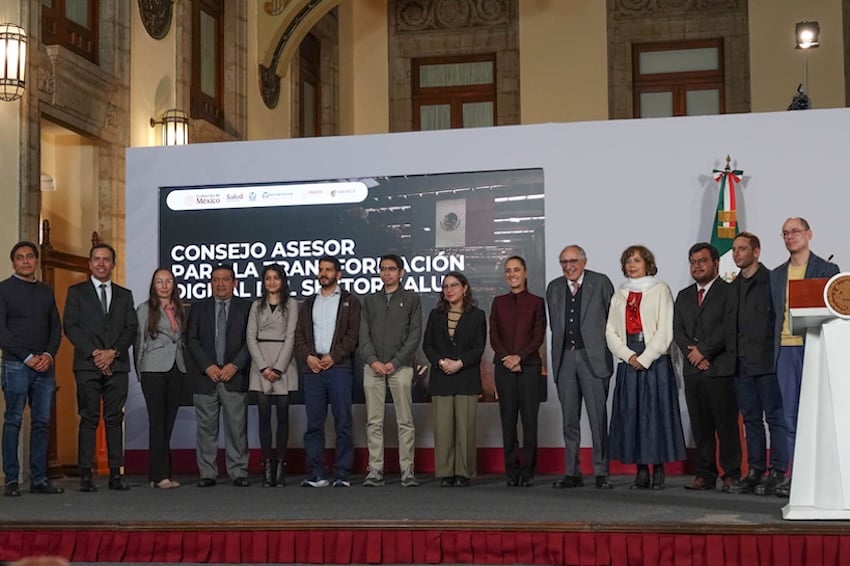
President Claudia Sheinbaum has introduced an Advisory Council for the Digital Transformation of the Health Sector, aimed at improving control, storage and distribution of medications. The move was in response to supply shortages publicized during recent mobilizations by Mexican Social Security Institute (IMSS) workers. The president has acknowledged the legitimacy of the complaints. One outcome of the recent mobilization by aggrieved IMSS workers is a greater public awareness of the problem of medical supply shortages in public hospitals and health centers. (Estrella Josento/Cuartoscuro) According to an announcement made during Sheinbaum’s morning press conference on Friday, the council will be divided into two groups of experts. The first group will be the Advisory Board composed of four researchers specializing in logistics, engineering, information systems, and resource distribution, while the second group — dubbed the Youth AI Team — will be made up of five individuals specialized in Artificial Intelligence. The project will use digital tools and AI to detect medication shortages, track warehouse inventory and expedite delivery to public hospitals and health centers. “What we want is to modernize the system to ensure that the entire process — from procurement, warehousing and arrival at the hospital pharmacy, to distribution across various hospital departments and delivery to patients — is automated, so that we know the exact traceability of every medication,” Sheinbaum said on Friday. Members of the council are expected to present their initial projects in November. The federal government plans to begin implementing the new system in January 2027. Deputy Health Minister Eduardo Clark said the program aims to identify medication needs in real time, improve inventory management, and optimize distribution routes to reduce both time and costs. If a medication is unavailable at one pharmacy, healthcare staff would be able to determine whether it is in stock at another health facility or warehouse and arrange for its delivery. Public healthcare workers plan more protests this week to demand better pay and working conditions The scale of the program’s challenge, however, is considerable. According to figures presented by Clark, the health sector uses approximately 3 billion units of medicines and medical supplies each year. The products must be distributed among more than 1,000 hospitals and nearly 15,000 health centers and primary care units. Sheinbaum explained that the lack of medication does not always stem from non-procurement. She noted that there are instances when medications have been purchased but fail to reach medical facilities on time, due to difficulties in the processes of storage, distribution and delivery. Also, Sheinbaum’s administration recently said it has identified practices in which medications from the public sector end up being sold privately and, in some cases, outside of hospitals. With reports from Latinus, Eje Central, La Silla Rota and Infobae
Government turning to AI to solve the acknowledged problem of medication shortages
Full Article
Original Source
Read the full article at Mexiconewsdaily →KhanList aggregates and links to publicly available news content. We do not host full articles from third-party sources. Always verify important information with original sources.