
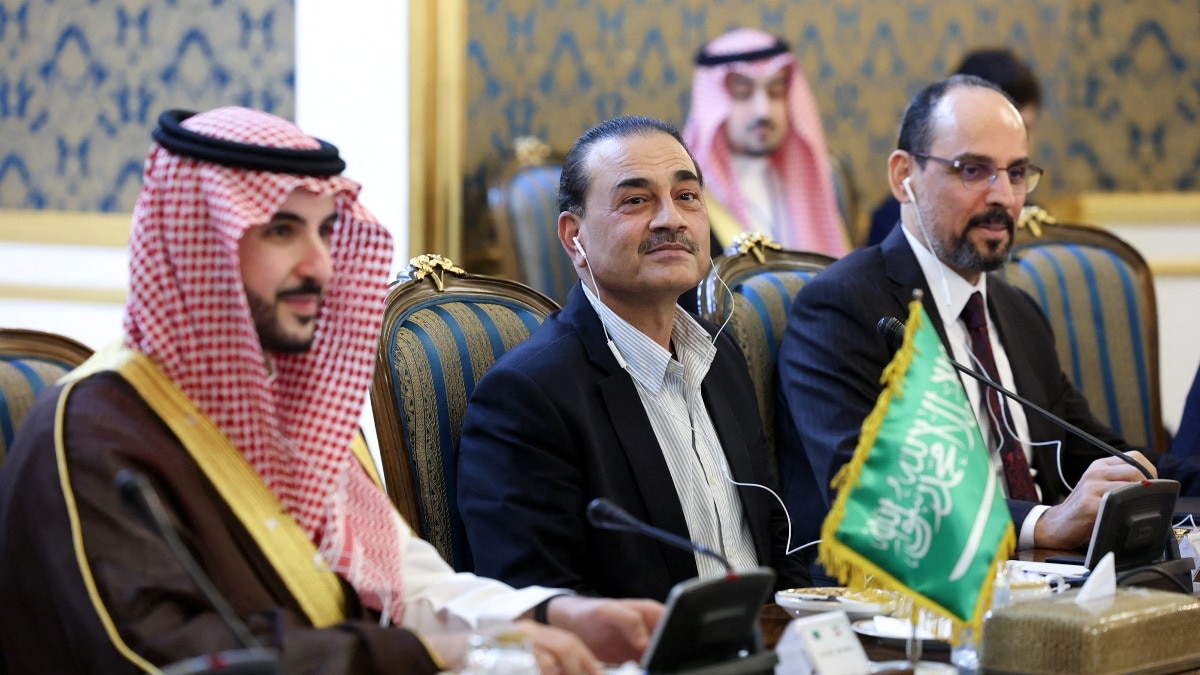
Saudi, Turkish and Pakistani officials met Iranian leaders in Tehran to pursue de-escalation. The talks unfolded amid Houthi attack claims and Egypt's approval of military support for Riyadh.Saudi Arabia's Defence Minister Prince Khalid bin Salman, chief of Defence Forces of Pakistan, Field Marshal Asim Munir and Turkish intelligence chief, Ibrahim Kalin during a meeting with Iranian President in Tehran, Iran. (Photo- Reuters)Top officials from Saudi Arabia, Turkey and Pakistan met Iranian leaders in Tehran on Monday in a bid to de-escalate the widening Middle East conflict, as Yemen's Houthi rebels claimed fresh attacks on Saudi Arabia and Egypt approved military support for the Gulf kingdom.The talks marked the first high-level engagement between Iran and the three countries since they signed the Mecca mutual defence pact in August. The conflict, which began with US and Israeli strikes on Iran, has expanded to involve Saudi Arabia and Yemen, opening new fronts across the region.Saudi Arabia said the visit was aimed at opening negotiating channels to "prevent the return of military escalation". The Saudi delegation was led by Defence Minister Prince Khalid bin Salman, the younger brother of Crown Prince Mohammed bin Salman. Pakistan was represented by Army Chief Field Marshal Asim Munir, while Turkey's delegation included intelligence chief Ibrahim Kalin.Iranian state media released photographs of President Masoud Pezeshkian, Foreign Minister Abbas Araqchi and senior security official Mohsen Rezaei attending the meetings. Following the talks, the four countries agreed to continue discussions to strengthen regional cooperation on peace and security. Pakistan and Qatar have spearheaded mediation efforts in the conflict. Earlier diplomatic initiatives helped secure an interim peace agreement in June, but fighting between Iran and the US subsequently resumed. Tensions later escalated between the Iran-aligned Houthis and Saudi Arabia, a US ally.US AND IRAN EXCHANGE FRESH THREATSThe expanding conflict has disrupted shipping through the Strait of Hormuz, a critical global energy route, driving up oil and gas prices. Gulf countries have faced missile and drone attacks, while the fighting has intensified Yemen's humanitarian crisis. Tensions between Washington and Tehran have risen in recent days, with US President Donald Trump saying on Friday that the US could strike Iran again. Iranian security officials told Reuters that Tehran had drawn up detailed plans to target undersea cables in the Gulf if the US and Israel launched further attacks.The war has also reignited fighting between Israel and the Iran-backed Lebanese Hezbollah militia, adding to regional instability. The conflict has become a political challenge for Trump ahead of the US midterm elections, which will determine control of Congress.Iranian security official Mohsen Rezaei said the visit by the three countries demonstrated that "American threats have little impact on countries around the world". He also described the regional situation as having entered a "new and positive atmosphere".Iranian Foreign Ministry spokesperson Esmaeil Baghaei had earlier said the meeting, proposed during Munir's visit to Tehran last week, could mark an initial step towards establishing regional security mechanisms.A senior Pakistani security official said the discussions focused on creating a regional non-aggression network. The agenda also covered possible US-Iran negotiations, Houthi attacks on Saudi Arabia, the Strait of Hormuz and the US blockade of Iranian ports.Another Pakistani official said Munir had presented Tehran with a proposed solution to the conflict, with Trump's approval for diplomatic efforts. The proposal was intended to offer something to both Washington and Tehran, the official said, without disclosing further details.The Mecca pact's signatories and Qatar could act as guarantors if the proposal were accepted, the official added.An Iranian official had earlier said Tehran would not discuss its nuclear programme at Monday's meeting until its demands for ending the war were met. These include the lifting of the US blockade of Iranian ports and sanctions on Iranian oil exports. US Vice President JD Vance, meanwhile, has said Iran must reduce its nuclear enrichment to bring the conflict to an end.EGYPT APPROVES MILITARY SUPPORT FOR SAUDI ARABIAThe diplomatic efforts came as Saudi Arabia intensified its campaign against the Houthis following their capture of strategic areas along Yemen's Red Sea coast last month. The advance has put Saudi-backed government forces under pressure, while the Houthis have targeted Saudi airports, ports and oil infrastructure.On Monday, the Houthis claimed they had attacked pumping stations along Saudi Arabia's East-West oil pipeline and Riyadh airport. The airport had announced a day earlier that operations at two terminals had resumed. Saudi authorities had not immediately confirmed the latest reported attacks.In a significant development, Egypt's parliament on Monday authorised the country's military to assist in defending Saudi Arabia. Cairo, a major financial and political partner of Riyadh, has also indicated that it is considering joining the Mecca mutual defence pact.The agreement requires signatories to use "all necessary means" to eliminate threats to one another's territorial integrity, sovereignty and internationally recognised borders, according to the pact's text reviewed by Reuters.The pact's members held an emergency meeting in Riyadh earlier this month, agreeing to ensure the "rapid deployment" of military forces and capabilities in Saudi Arabia.Pakistan approved the agreement last week, while Turkey's parliament began the ratification process last week, with proceedings still underway.- Ends
Saudi Arabia, Pakistan and Turkey hold talks with Iran to de-escalate war
Full Article
Original Source
Read the full article at Indiatoday →KhanList aggregates and links to publicly available news content. We do not host full articles from third-party sources. Always verify important information with original sources.