
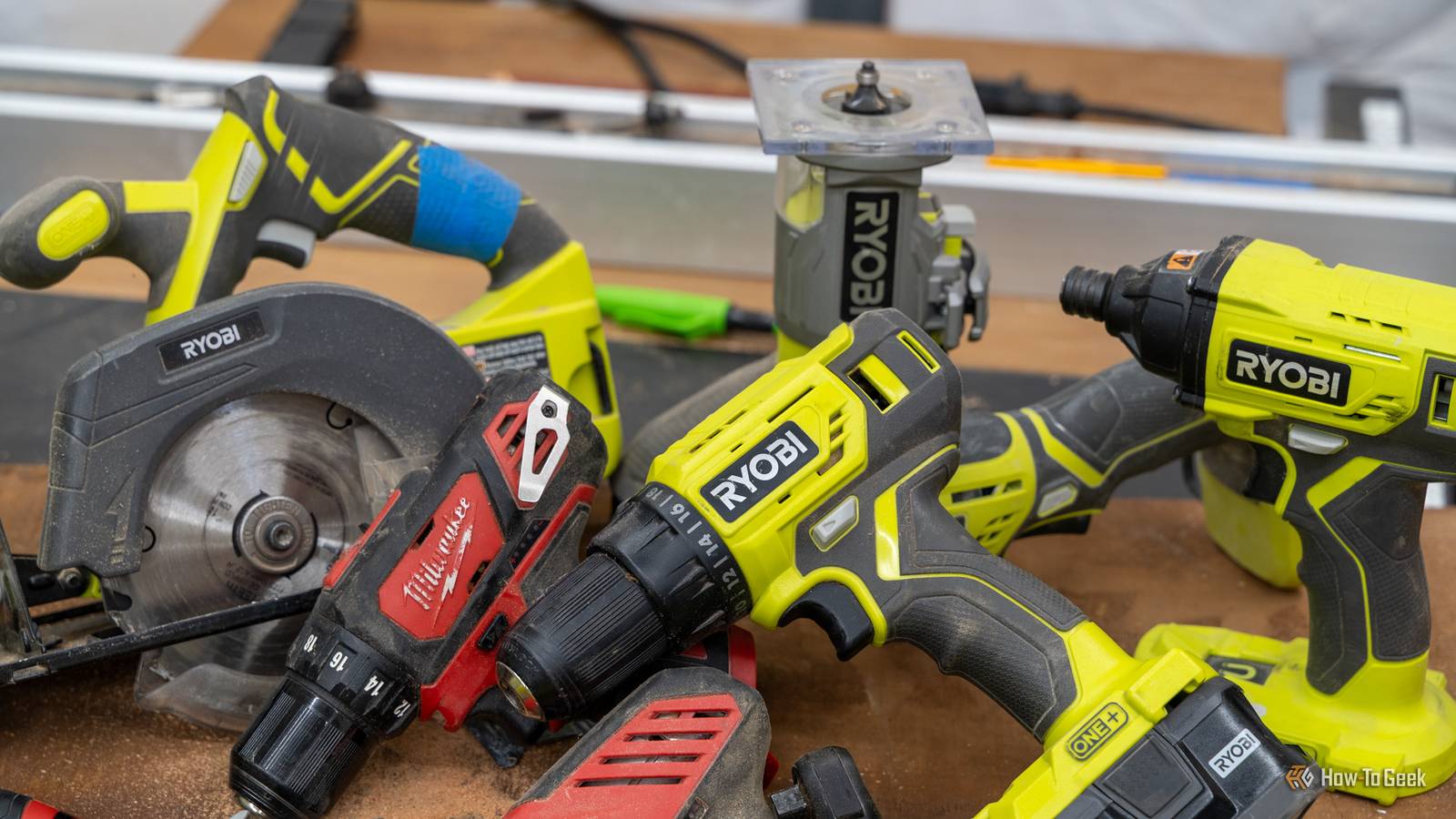
Published Nov 16, 2026, 7:31 AM EST Steve has been editing and writing content for almost two decades, including product reviews, tech news, how-to guides, and even lifestyle and health topics. He’s served as chief editor for publications like Tech Junkie and Alphr, and has written and edited content for many other tech-related sites. His expertise in Windows, Android, iOS, Mac, and Linux simplifies the gadget and computer world for others, enabling them to shop, connect, learn, tweak, and optimize devices and software to suit their needs. When he’s not writing or editing content, he enjoys repairing and optimizing devices (and game consoles), watching movies, golfing, and spending time with the family. Ryobi and Milwaukee are two very different but popular tool brands in the home improvement and household project arena. Milwaukee is geared more towards commercial jobsite audiences, but also very popular amongst homeowners and DIY professionals. Ryobi is more targeted to consumers, although they have continued to innovate and design some pretty durable tools, and some contractors actually swear by them. Regardless of who uses these two tool brands, it is possible to use a Ryobi battery on a Milwaukee drill, but you can’t attach it directly, mainly because the attachment design differs greatly. Ryobi uses an upright design with terminals, while Milwaukee is based on a sliding rail system. To make the connection work, you’d need a special adapter that connects to the Ryobi battery and then slides into the Milwaukee tool. But it isn’t that simple, and there are risks in using such aftermarket adapters. Here’s why you shouldn’t do it. ONE+ batteries push in rather than slide in like M18 batteries The only way to connect a Ryobi ONE+ battery to an M18 tool is to use an adapter. It has an opening where you push the ONE+ battery in and a track to slide into your Milwaukee M18 tool. It’s a fairly easy process that sounds convenient and cool, but it does have risks. If you’re considering buying a One+ battery-to-Milwaukee M18 tool adapter, most third-party adapters have cheap components and materials. They can fail at any time and overheat the tool or the battery, possibly causing damage or fire. A good one should have some built-in protection, but it will never compensate for proper tool-to-battery communication and management. It must include a circuit to bypass the 3V pin that controls power when you squeeze the trigger on an M18 tool and when you release it. Without that, the tool will never start. The adapter should be made of ABS, not the 3D-printed material cheap adapters may use. Contacts should be copper, not metal, to reduce heat and resistance from the extra connections in the power flow. If you find one with all the above features (very slim chance), note that there are risks and the potential to reduce the life of your drill or batteries. Since it breaks the proper communication and circuitry between the tool and its actual battery, things won’t work like they are supposed to. It will work, but it can fail and can gradually damage the battery or tool. I cannot recommend a specific product because I couldn’t find one. They were all cheaply made imports, and specs were very limited, not to mention spelling and grammar. In fact, many were essentially the same thing. This occurs because you technically shouldn’t use one, so a reputable company won’t offer it. Videos and images can be convincing, but that's because they want to sell the product. What I can say is that some people find them useful and say they work great, but most use their adapter only as a backup option, which is another thing you should do. I would never rely on a ONE+ battery-to-M18 tool adapter for constant use. The potential to overheat or explode is possible The microprocessors in Ryobi ONE+ batteries use an analog communication system, which is incompatible with Milwaukee’s digital REDLINK technology. Ryobi’s power and heat control is built into each ONE+ battery. They do it so older tools can use newer batteries, and vice versa. That’s pretty clever, if you ask me, but I can definitely see the drawbacks, mainly the lack of power control for the motors and the tool’s health. At least ONE+ batteries have thermal, short-circuit, and high-discharge protection. Milwaukee M18 batteries have only part of the protective circuitry, while the rest is in each tool. They communicate to control heat, power, and discharge. If you use a ONE+ battery on a Milwaukee tool, the battery handles all the protection with its built-in circuitry. That may sound great, but in the meantime, Milwaukee's tool is trying to communicate when it detects a problem, but the other half is missing. It also cannot manage power delivery or heat regulation because of it. Never charge the Ryobi battery with the adapter. Almost all manufacturers specify this as it could damage the charger or battery. ONE+ needs a direct connection, and the pins, along with the internal MOSFET circuits, help protect the battery from overheating or short-circuiting. The tool demands more power than the battery can provide Milwaukee M18 tools use digital communication and control between the battery and the tool to manage power delivery optimally. This prolongs the battery’s lifespan while protecting the tool. Battery technology in power tools varies by brand. M18 batteries are also designed to prioritize high-drain demand, which makes sense since the same batteries are used on low- and high-power tools. A ONE+ battery may not keep up with the tool's demands, but that also depends on the battery (and the M18 tool) you use. Ryobi has 2Ah, 4Ah, 6Ah, 8Ah, and 12Ah batteries. Higher-amp models have more muscle to drive the tool, but when demand increases and the discharge rate rises, the ONE+ will cut power using its internal MOSFET circuits. An adapter can't control this. As you keep using the ONE+ battery with the adapter, you can reduce the battery's life by repeatedly stressing it. What does the battery do? It dies (discharges) faster, and the MOSFETS also cut power more frequently due to high-demand loads. This can be annoying and frustrating. You may never know whether the battery is dead and needs charging or if the protective MOSFET circuits just cut it off. But you’d also have to charge the battery more frequently, reducing its number of charge cycles before it completely dies (life). An adapter adds resistance and generates more heat because of the extra connections between the battery, adapter, and the tool. Copper terminals help reduce heat and resistance. If you decide to use an adapter, use a higher amp-rated battery to at least meet the tool's draw. M18 power drills, jigsaws, and ratchets may handle lower-amp batteries better, but grinders, blowers, chainsaws, wet/dry vacs, and circular saws will definitely be high-demand tools. Using Ryobi ONE+ batteries on a Milwaukee M18 tool sounds like a great idea, but it’s not A Ryobi ONE+ battery may power your Milwaukee tools, but it blocks the proper communication between the tool and the battery. Sure, ONE+ batteries hold all protective circuitry. At the same time, Milwaukee shares it between the tool and the battery, but the tool can get confused when it cannot send the right signals, and the battery may not know what is happening and may cut power with its MOSFET circuits. It may still sound safe, but your ONE+ battery may cut power frequently, leading to frustration. This is especially true when using high-demand tools like grinders, circular saws, blowers, wet/dry vacs, and chainsaws. A battery has a limited number of charge cycles, and an adapter in this situation may require frequent charging. The bottom line is that using an adapter to run ONE+ batteries on Milwaukee tools can cost more in the long run, whether you're replacing damaged tools or buying replacement batteries.
Yes, you can use Ryobi batteries on Milwaukee tools (but here's why it's a bad idea)
Full Article
Original Source
Read the full article at Howtogeek →KhanList aggregates and links to publicly available news content. We do not host full articles from third-party sources. Always verify important information with original sources.