
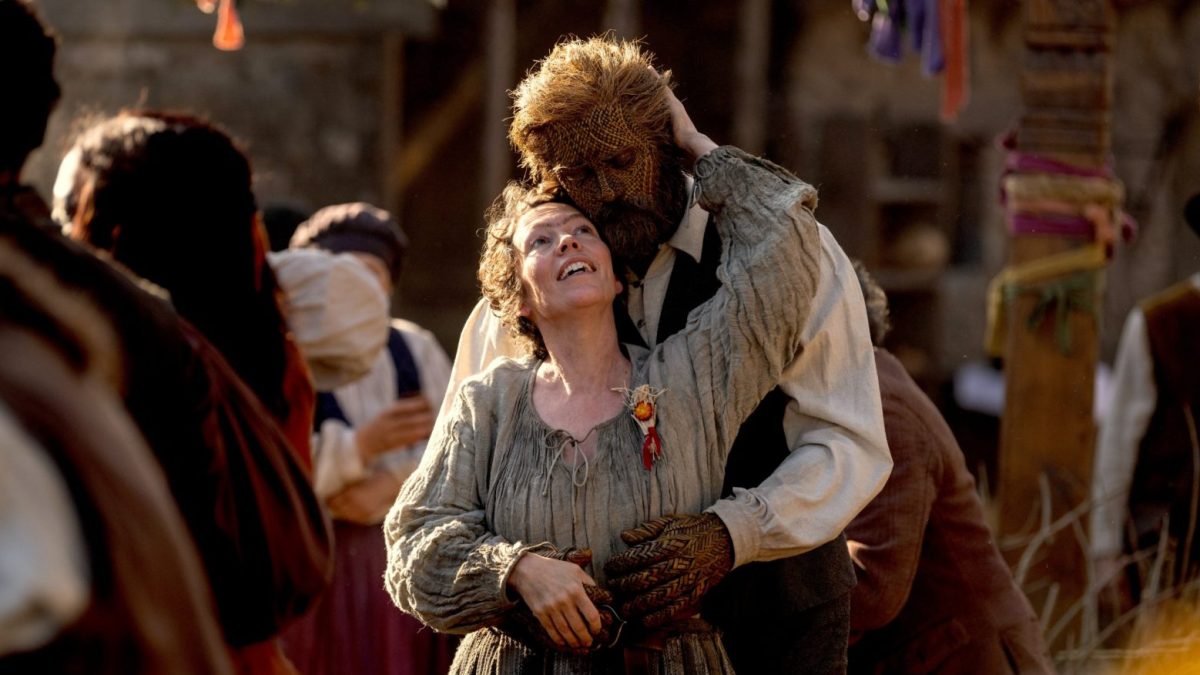
Want to take down the patriarchy? How about a Carry On meets The Canterbury Tales bonk-fest in which a medieval(ish) village is outraged by the arrival of a man made entirely out of twigs? Talk about barking mad. Wicker is a hilarious, horny – and, weirdly, profoundly sexist – allegory about a man who exists solely to please his woman (and oh boy, does he). In a Chaucer-style village where women are named after their husbands’ professions, and on their wedding day don actual neck collars as part of the ceremony, Olivia Colman’s dirty, beleaguered Fisherwoman pays the local Basketmaker (Peter Dinklage) to make her a husband out of willow. Enter Alexander Skarsgård’s racy hero, a wickerwork effigy who somehow manages to convey all of the actor’s considerable sex appeal through two blue eyes and hefty prosthetic wooden pecs (plus a very brief shot of a wicker penis), a deeply strange creation somewhere between a scarecrow and Prince Charming. Soon he’s taking his delighted new bride to bed with a comically loud creak as that willow hardens, their marital harmony so disquieting in a village of heteronormative inequity that the locals become hell-bent on either destroying it or nabbing some for themselves. “Straightened me right out,” quips Fisherwoman with a wink. But as funny as all this is (unless you’re not a fan of bawdy humour), this film, based on a 2008 short story by Ursula Wills-Jones, demonstrably doesn’t care about the Wicker Husband’s interiority or indeed his own desires at all. In fact, Wicker explicitly encourages men to prioritise their female partner’s every whim, including putting themselves in danger (“I’m highly flammable!” the husband pleads as his wife beckons him to sit by the fire) or accepting actual domestic violence if it makes their woman feel better.Peter Dinklage as Basketmaker, who makes Fisherwoman a husband out of willow (Photo: Black Bear/Panther) It’s a painfully gendered fairy tale in which a flawless manic pixie dream man fixes the roof by day and sensitively rails his wife by night. It’s unhinged and misandrist – an over-correction whose message I’d hate my son to absorb: that your partner’s happiness takes precedence over your own. And yet I adored it. Is this allowed? If the genders were reversed I definitely wouldn’t think so and neither, evidently, would Hollywood, which tends now to run stories of unquestioning devotion as horror. The ultimate case in point: Obsession, Curry Parker’s recent, brilliant budget horror film about a guy who wishes a girl would love him more than anything in the world – a deliciously dark cautionary tale about getting exactly what you wish for. But, like Companion, in which a man programmes his robot girlfriend to adore and obey him, and Ruby Sparks, in which a writer conjures his ideal woman into existence, Obsession is also interested in the sinister implications of a lover whose devotion is guaranteed. How can it be love when there’s no free will? Wicker tries to insist its beau’s lack of agency isn’t a thing with a throwaway line from the Basketmaker: “I did not build you some f**kable furniture. His life was his own.” But one can’t escape the feeling that the poor man is inescapably tethered to the person who paid for his creation. “I was made to be with you,” he even whispers into his wife’s ear like poetry. “My soft-bodied, female animal.” The film has had some criticism for not being quite as clever as it thinks it is, and to a degree that’s true (Photo: Black Bear/Panther) And yet, somehow, this all feels sort of OK. Why? Could it be because men have so long felt entitled to their spouses’ servitude, in one way or another, that an over-correction just feels like a necessary settling of the score? I think also it’s to do with how Colman’s beautifully complex Fisherwoman feels about the way the Wicker Husband loves her. She doesn’t feel entitlement to him, just overwhelming relief. Relief at a man who is kind and patient, and thinks it’s great she works, and, who when asked by the lads down the pub why he keeps fixing things, replies: “It makes her happy.” Wicker has had some criticism for not being quite as clever as it thinks it is, and to a degree that’s true (go for the laughs, not the lecture) but that criticism also misses the point. There’s a simple message here that bears repeating: women like it when men don’t expect them to be subordinate! Incel culture and the persistent inequality that feeds it is bad! Hurray! Also, lest we forget, it’s very obviously a fairy tale: a ridiculous, impossible fantasy. Elizabeth Debicki’s wonderfully sad and jealous Tailor’s Wife (a clever addition from the screenwriters – she’s just a passing line in the original story) encapsulates both this silliness and seriousness. Increasingly desperate for the kind of agency and respect she sees in this new union, in a moment where her peers’ shameless lusting over the Wicker Husband becomes intolerable, she emits a single and immediately hushed up scream of rage and frustration. Right before responding with bewilderment: “He’s… wicker?!” ‘Wicker’ is in cinemas now
Wicker is unhinged and sexist. I loved it
Full Article
Original Source
Read the full article at Inews →KhanList aggregates and links to publicly available news content. We do not host full articles from third-party sources. Always verify important information with original sources.