
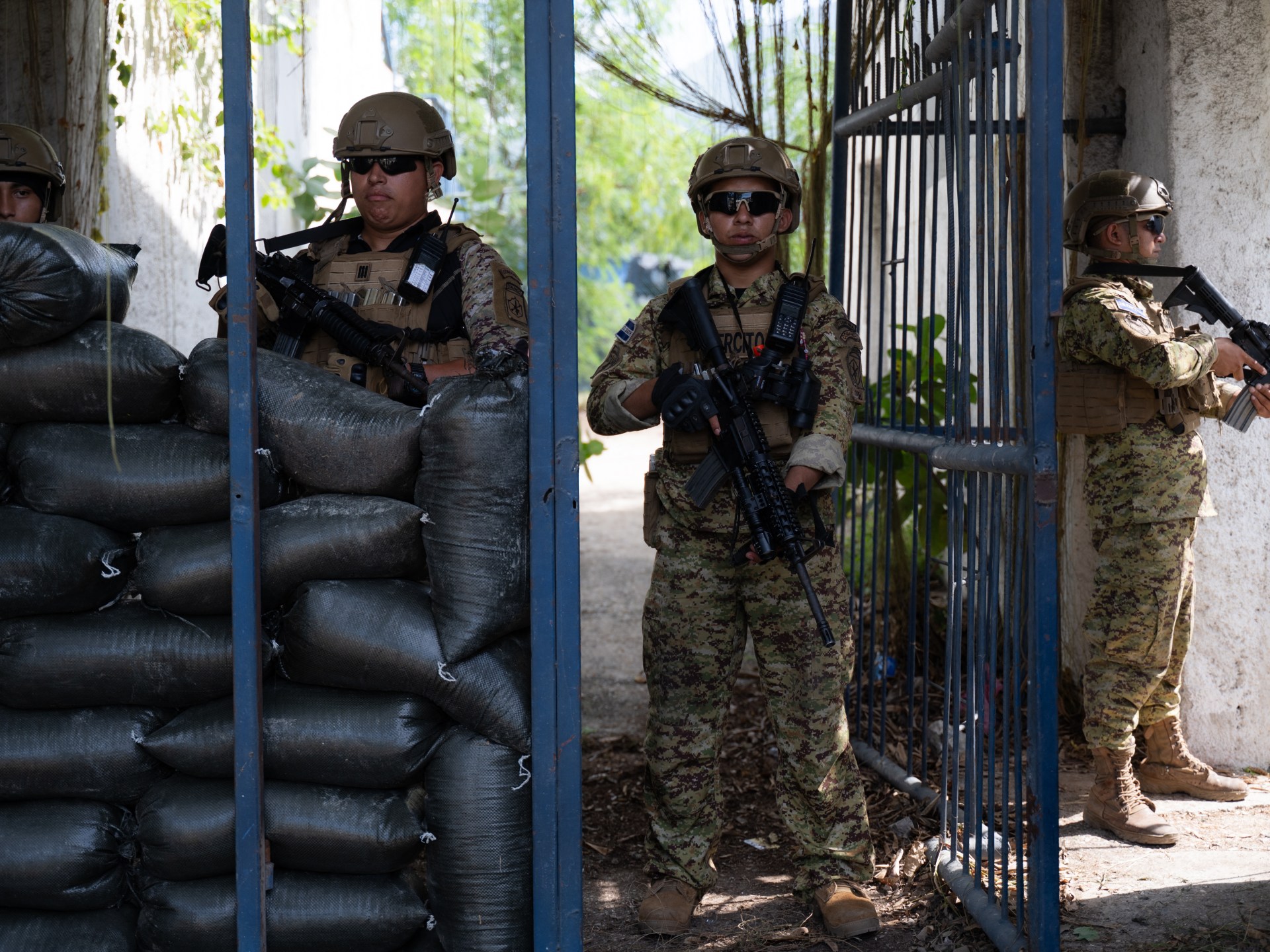
The streets of Haiti’s capital, Port-au-Prince, rang out on Tuesday and Wednesday with chants from local residents in support of a president who was not their own: El Salvador’s Nayib Bukele. In a country where the scars of foreign intervention run deep, some Haitians are placing their hopes on another foreign force, this time from El Salvador, to help take their neighbourhoods back from armed gangs.Thousands turned out to cheer on the roughly 2,500 soldiers Bukele has sent since October. What began as a narrow mission to rescue four missing Salvadoran aviation technicians has grown into a much broader military operation.Recommended Stories list of 4 itemslist 1 of 4El Salvador deploys armed robots to fight gangs in Haitilist 2 of 4Widow of Haiti’s slain leader Moise to contest presidential votelist 3 of 4Haitians protest in support of El Salvador’s anti-gang troop deploymentlist 4 of 4Photos: Thousands march in Haiti in support of Salvadoran troopsend of listFor some of those who marched, the intervention is exactly what the country needs after years of kidnappings, killings, and displacement, with little sign of relief.But even with the Haitian government’s backing and a warm reception from the public, questions are growing about what the troops are doing on the ground and what kind of mark Bukele will ultimately leave on Haiti.Why are Salvadoran troops in Haiti?The immediate trigger came on October 18, when four Salvadoran aviation technicians working with the United Nations-backed Gang Suppression Force (GSF) went missing after armed men attacked their vehicle near Port-au-Prince.The force was created to help Haitian authorities deal with a security crisis that has grown more severe since the 2021 assassination of President Jovenel Moise. According to Reuters, gangs now control more than 80 percent of the capital region, with Haitian and international forces struggling to reclaim that territory.Shortly after the technicians went missing, Bukele announced a new military operation in Haiti, sending 100 special forces soldiers to rescue them. Since then, he’s sent about 2,500 in total.Most of them are operating outside the UN-backed force and outside the UN support office’s monitoring mechanisms, according to UN spokesperson Stephane Dujarric.And the deployment itself has turned from a narrow rescue operation to a broader offensive against Haiti’s gangs, with Salvadoran soldiers joining Haitian security forces, the GSF, and private contractors, including Blackwater founder Erik Prince’s Vectus Global.Bukele, who gained international notoriety for a crackdown on gangs in El Salvador that led to a sharp decline in crime but has drawn widespread condemnation over human rights abuses, has been aggressively promoting the deployment on social media.He has posted dramatic videos of helicopter attacks on gang leaders’ properties and, more recently, footage of rallies cheering on his troops.“I never expected anything like this,” he wrote in a Tuesday post accompanying a video of a rally. “I hear you loud and clear. I love you, too.”Neither the Haitian government nor the Salvadoran government replied to Al Jazeera’s requests for comment about the troops in Haiti.People rally in support of Salvadoran Army troops in their mission to help the fight against gangs, in Port-au-Prince, Haiti, on November 18, 2026 [AFP]Why are some Haitians cheering on the Salvadoran troops?The troops have landed amid a worsening humanitarian crisis in Haiti, with nearly 1.5 million people displaced from their homes, and violence making it difficult to access food and basic services. More than 22,000 people have been killed in gang-related violence, including security operations, since 2022, according to Reuters.At rallies in Port-au-Prince and other parts of Haiti, demonstrators voiced support for the deployment. Some who spoke to The Associated Press news agency described losing loved ones to gang violence and being forced to leave their homes.“The support we see from many Haitians comes from sheer desperation after years of failure and widespread terror,” Louimann Maceus, president of the human rights organisation Ensemble des Citoyens Competents a la Recherche de l’Egalite des Droits de l’Homme en Haiti (ECCREDHH), told Al Jazeera. “People are exhausted.”“There is a genuine hope, especially among the hundreds of thousands of internally displaced people we work with who just want to return safely home,” said Maceus, who lives in Port-au-Prince.That hope, he said, follows years of frustration with UN-backed forces, which he said had done little to improve security.The Salvadoran deployment already outnumbers the GSF, according to numbers from the GSF’s special representative Jack Christofides, on October 18, when it had just surpassed 2,000 personnel.International Crisis Group analyst Diego Da Rin also links some of the enthusiasm to what he describes as a really effective communication campaign by Bukele, whose videos of strikes on gang leaders’ homes are all over Haitian social media.“These are symbolic wins that everybody was waiting for,” he said, adding that AI-generated videos were also circulating of gang leaders being arrested.But support for the deployment is not universal. Da Rin pointed to the residents of gang-controlled areas.“Many of these people, who clearly see the risks in these iron-fist operations, are extremely scared of being attacked and being collateral damage of any of these operations,” said Da Rin.A member of the Salvadoran Army stands guard during the second day of patrols in Port-au-Prince, Haiti, on October 31, 2026, when Salvadoran troops were searching for four military aviation technicians who went missing following a gang ambush on October 18 [File: Jonet St Elois/EPA]What have Salvadoran troops actually achieved?Security force clashes and drone strikes targeting gangs increased by 46 percent in the 21 days after the start of the deployment, compared to the 21 days before it, according to the conflict monitoring group the Armed Conflict Location & Event Data Project (ACLED).ACLED estimated more than 100 people were killed in the same period, including at least 26 civilians.Haiti’s Justice Minister Patrick Pelissier, however, said on Monday that the government had received no reports of civilian casualties in the latest operations, which it described as professional, according to Reuters.Bukele has used social media to highlight what he sees as the offensive’s successes.After Salvadoran troops joined Haitian police and a government task force in a November 8 attack on a house belonging to Wilson Joseph, leader of the powerful 400 Mawozo gang, Bukele posted video of helicopters repeatedly firing at the building, as people ran away from the area.Joseph reportedly was not there and survived the attack.A few days later, Haitian national police and Bukele announced that they’d retaken control of the national football stadium. Bukele shared video of robot dogs armed with rifles moving through the corridors of the stadium alongside troops, although it’s unclear how exactly they were used in the operation.Da Rin said it was worth noting that police initially credited their officers and the task force with retaking the stadium before handing control over to Salvadoran troops, who set up a base there.The stadium is a useful spot to launch operations against nearby gang strongholds, he added, but it represented a relatively small gain from positions Haitian forces had already secured.On Wednesday, Bukele posted another video showing a helicopter attack on the home of Jeff Larose, leader of the Taliban gang, which controls the area of Canaan in northern Port-au-Prince.It was not clear whether the attack had killed Larose or whether Haiti’s police or army had participated. The GSF was not involved, according to The Associated Press.For displaced people looking to return home, the gains have yet to make a tangible difference, said Da Rin.After the attack on Joseph’s house, none of the security forces set up a permanent presence in the area, he said.“Armed groups were able to return and are now intimidating residents, searching their phones, threatening people suspected of sharing information with the security forces,” Da Rin told Al Jazeera.He warned that forces appeared to be “in a race” to show results without a unified strategy to sustain them.Salvadoran officials have said they plan to leave once the missing technicians are found. Joseph, leader of the 400 Mawozo gang, told the Associated Press earlier this month that they were dead, but their fate remains officially unknown. “The priority should be to plan the most difficult part, how the forces will work together to establish lasting control,” said Da Rin.Why are some experts concerned about the deployment?The terms of the Salvadoran deployment haven’t been made public.Amnesty International has called on both governments to explain who oversees the troops, what rules govern their use of force, and how civilians can safely report abuses.On Monday, Salvadoran Vice President Felix Ulloa said the agreement would be kept under wraps until diplomatic conditions allowed its release and accused critics of having a “hidden agenda”.Sam Vigersky, a fellow with the Council on Foreign Relations who studies emergency relief in response to armed conflict, said the lack of monitoring or publicly shared rules of engagement for Salvadoran troops operating outside the GSF means “we do not know what collateral damage might come of these offensives”.For Vigersky, the lesson from past interventions, including a UN peacekeeping mission whose personnel brought cholera to Haiti and were implicated in widespread sexual abuse, is that “oversight matters”.“Absent that,” he said, “the deep scars that Haiti has already from these past UN or other operations are only likely to grow.”
Why are Bukele’s Salvadoran troops in Haiti and what have they achieved?
Full Article
Original Source
Read the full article at Aljazeera →KhanList aggregates and links to publicly available news content. We do not host full articles from third-party sources. Always verify important information with original sources.