
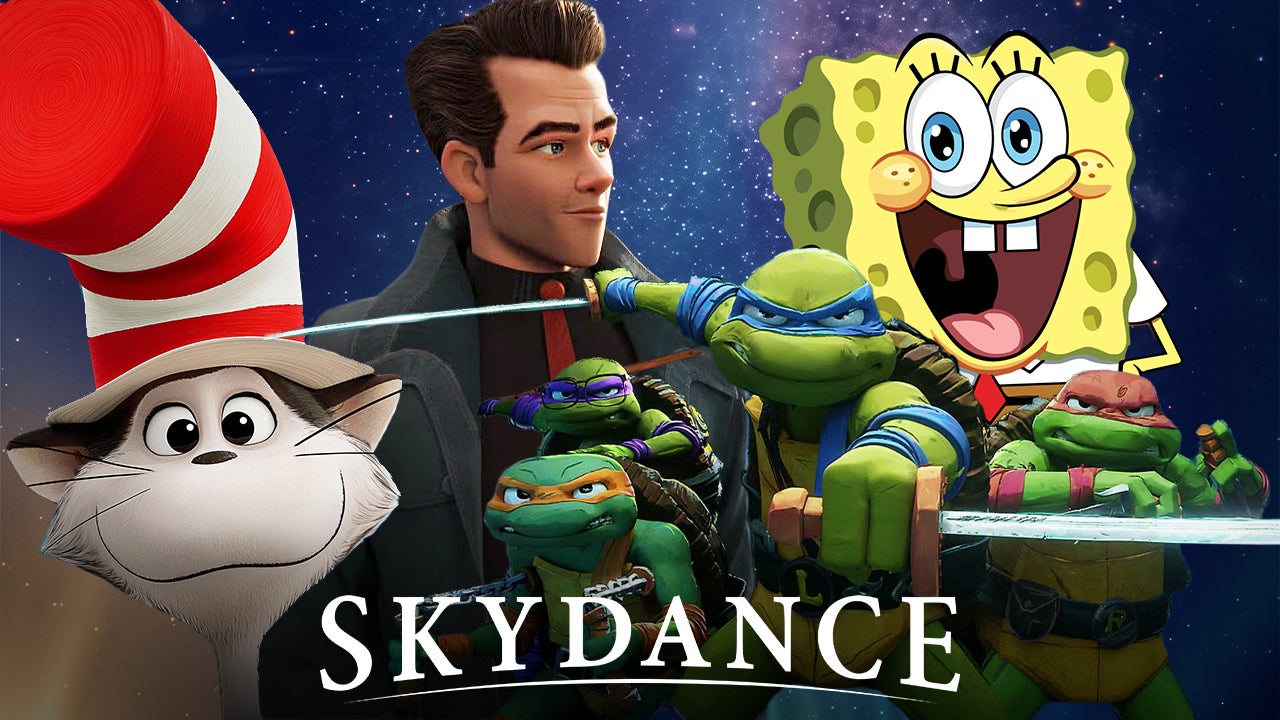
Somewhat lost in the palace intrigue of Skydance’s acquisition and integration of Paramount and Warner Bros. Discovery is the newly created constellation of three disparate animation studios now housed under a single overstuffed roof. It raises the natural question: if two’s company, is three a crowd? Following the blockbuster merger, Skydance owns Paramount Animation, home to the “Paw Patrol” and “SpongeBob SquarePants” franchises (along with “Teenage Mutant Ninja Turtles”); Skydance Animation, which has thus far only produced films in partnership with Apple TV (“Luck”) and Netflix (“Spellbound,” “Swapped” and the upcoming “Ray Gunn”) and Warner Bros. Pictures Animation, a newly formed division that is looking to mine both the company’s deep bench of characters and IP and develop promising new confections (its first film, “The Cat in the Hat,” is part of a larger arrangement with Dr. Seuss Enterprises and arrives on Friday). Skydance will tell you – as it told us – that the plan, at least for now, is to have each animation studio remain open and operate independently. Like the rest of the labyrinthian deal, Skydance is still finessing the particulars, but the hope is that each studio will serve different needs to satisfy the appetite of an ever-voracious audience for animation. Solving this piece of the Skydance puzzle is so critical because of the upside of animated films, particularly with established franchises as close to a surefire hit as you’ll get, as seen with “Toy Story 5” and “The Super Mario Galaxy Movie” both grossing more than $1 billion this year. And given Skydance’s mandate to produce a ton of films and the $80 billion of debt it’s wrestling with, it needs all the blockbusters it can get. But there’s reason to be skeptical that Skydance will be able to juggle all three studios, especially if history is any indication. When Disney acquired 21st Century Fox in 2019, the acquisition left an animation studio, Blue Sky, out in the cold, despite having a rich track record of box office hits that continue to generate millions of dollars for the company. Blue Sky Studios was, at the time, responsible for one of the biggest animated franchises of all time – “Ice Age,” which began in 2002 and by 2016, shortly before the merger process started, had grossed more than $3.2 billion, across five films. Blue Sky had also produced the similarly popular “Rio” films, along with more modest hits like “Epic” and “The Peanuts Movie.” By February 2021, Disney announced that it was shuttering Blue Sky Studios. The fact that Disney, the king of animation, felt that having two animation studios was enough makes you wonder if Skydance’s bold ambition to house three distinct animation studios, with unique corporate cultures and specialized workflows, without the studios clashing into each other, is viable. There’s also Universal, which also owns and operates a pair of animation studios – Illumination, home to the “Despicable Me” and “Sing” franchises, which still operates as an independent contractor under an “exclusive financing and distribution partnership” with Universal; and DreamWorks Animation, with its “Shrek” series and recent hits like “The Wild Robot,” which Universal acquired in 2016. (Previously, DreamWorks was an independent entity that made distribution deals with various studios, including Paramount.) Just like Disney, Universal oversees two studios, with an emphasis on maintaining what makes each studio special, including their distinct corporate cultures and production pipelines. While an unspoken rule, it seems like two feature animation units are about as much as any studio can handle. So how will Skydance make three work? To understand how this arrangement could work out (if, indeed, it will work at all), requires looking at the history of each specific animation studio, the status of their respective slates and what they potentially bring to the table. Things are about to get very animated. Paramount Animation Paramount Animation, led by Jennifer Dodge, a veteran of “Paw Patrol” parent company Spin Master, started in 2011 after the surprise success of “Rango,” the Gore Verbinski-directed, Industrial Light & Magic-animated western that would eventually win the Best Animated Feature Academy Award. Founded by Brad Grey, they were bolstered by the upcoming release of Spielberg’s “The Adventures of Tintin” and spurred by the dissolution of a distribution deal with DreamWorks Animation. There had been animated movies released by Paramount before, usually offshoots of its popular television series (like the “The SpongeBob SquarePants Movie,” “South Park: Bigger, Longer and Uncut” or “Beavis and Butt-Head Do America”) or oddities like 1992’s “Bebe’s Kids” or the bizarre animation/live-action hybrid “Cool World” (also 1992). What Grey wanted was an in-house team that regularly developed projects, both originals and projects based on assets in the Paramount library, that could compete with other top-tier animation studios. And, to be honest, the output was shaky. While splashy development deals were announced with J.J. Abrams’ Bad Robot and ambitious live-action/animation projects added to the slate (only one, 2016’s “Monster Trucks,” made it into theaters), the output was erratic. Spanish studio Ilion Animation Studios would work on a number of projects as a vendor studio but later be purchased by Skydance in 2020 to serve as the main production hub for Skydance Animation. (Do you see how tangled this web is?) The slate was seemingly snakebit – the beautiful “The Little Prince” got hung up at the last minute and was eventually released by Netflix; “Wonder Park” was one of the more doomed animated projects in recent memory, with a notoriously difficult production (the final film doesn’t even have a credited director); and a succession of executives were installed, attempted to right the ship and then dismissed. It was, for a long while, seemingly rudderless. Before the Skydance acquisition, Paramount Animation was run by Ramsey Naito, a well-liked figure in animation circles who had worked as a producer at Blue Sky and Nickelodeon Films. Her notable projects include 2023’s “Teenage Mutant Ninja Turtles: Mutant Mayhem,” which adopted a scribbly, high school notebook aesthetic; and 2024’s “Transformers One,” directed by Josh Cooley and featuring sublime animation from Industrial Light & Magic. Both offered a look at where the division could be headed, stylistically and thematically. Paramount Animation But “Transformers One” underperformed, making just $129 million worldwide on a budget reportedly in the $150 million range, a disappointing number both because of the strength of the brand and because the movie was really, really good. “Teenage Mutant Ninja Turtles” probably also should have done better, making $182 million on a budget of around $70 million. It had all the hallmarks of a sensation but wasn’t even nominated for the Best Animated Feature Oscar (ditto for “Transformers”). In the case of “Teenage Mutant Ninja Turtles,” the studio had already committed to an animated spinoff series for Paramount+, a short film that narrowly missed its own Oscar nomination and a sequel, due out next year, undoubtedly bolstered by strong consumer products numbers. While not the blockbuster Paramount hoped it would be, “Mutant Mayhem” still engendered enough goodwill to turn it into a franchise. With Dodge, who took over in January, Paramount Animation has a practical leader, one steeped in the world of consumer products and canny cross promotion. More than one person we spoke to marveled at her ability to put together an animated “Survivor” movie, with talking animals (one of four types of movies the unit is keenly interested in, along with musicals, broadly appealing comedies and spookier films), working with CBS, Castaway Productions and Survivor Productions LLC to get the deal done. One person with knowledge of the deal described the feat as “unprecedented.” And the movies that Paramount Animation has announced as being in development do offer a nice mix of tones and styles – there’s “Diya,” a Bollywood musical produced by John Francis Daley and Jonathan Goldstein; “Freddy the 13th” from “Predator: Badlands” director Dan Trachtenberg, already slated for Halloween 2028; and a fourth “Paw Patrol” movie, due in 2029. There’s also an unhinged Christmas movie from Robert Rodriguez and his Troublemaker Studios that the studio seems very excited about. But as with every new regime, a number of projects have been removed from development, including Cooley’s “I Eat Poop,” which was produced by Ryan Reynold’s Maximum Effort and based on the popular children’s book written and illustrated by Mark Pett. (Hey, a movie about a dung beetle was always going to be a tough sell.) We’re also hearing conflicting reports about the uncertain future of the “Teenage Mutant Ninja Turtles” animated saga. Should the sequel be a runaway success, there will certainly be more in that world. But the new Paramount leadership has also made a point of putting Neal Moritz, the producer behind the lucrative, live-action “Sonic the Hedgehog” franchise, in charge of a new live-action “Teenage Mutant Ninja Turtles” movie, which could edge out the animated features. The well-liked Paramount+ spinoff series was quietly canceled, also clearing the way for its potential removal from the sacred timeline. Insiders stress that there isn’t a single house style to Paramount Animation films and that the slate will continue to mix new projects with those based on preexisting IP. A new trailer for “The Angry Birds Movie 3,” which Paramount will be distributing this Christmas (Sony released the first two films), perhaps best exemplifies this approach – one of the characters (voiced by Josh Gad) is seen racing alongside Sonic the Hedgehog (voiced by, presumably, Ben Schwartz), one of Skydance’s crown jewels. Skydance Animation Skydance Animation was formed in 2017 and was initially meant to supply Paramount Pictures with animated features, extending the partnership between the two studios which had already included a number of live-action films. (Yes, it really is this tangled.) Bill Damaschke, former CCO of DreamWorks Animation, was hired to run the company, with the first two movies – “Split” (eventually known as “Spellbound”) and “Luck” set to be distributed theatrically by Paramount. In 2019, Damaschke was replaced by John Lasseter, the former Pixar and Walt Disney Animation Studios bigwig, who had been fired after a probationary period following allegations of inappropriate misconduct. (Skydance did an internal review of Lasseter’s conduct before hiring him.) And the changes kept coming. By 2020, the deal with Paramount had been replaced by an arrangement with Apple; Skydance Animation was set to deliver animated features and animated series for the company’s new streaming service. “Luck,” with Peggy Holmes replacing original director Alessandro Carloni (who just directed “The Cat in the Hat” for Warner Bros. Pictures Animation), arrived on Apple TV on 2022. The same year, an impressive Skydance Animation lineup had been revealed, with new, original projects from “The Incredibles” director Brad Bird (“Ray Gunn”), “Tangled” filmmaker Nathan Greno (“Swapped,” formerly “Split”) and Rich Moore, who had made “Wreck-It Ralph” and “Zootopia” for Disney (an untitled Jack and the Beanstalk project). A year later, Skydance Animation had exited the Apple deal and entered into a deal with Netflix, which richly rewarded Skydance. Netflix hadn’t adequately built up its animation pipeline and desperately needed content. The movies were attractive and so was Lasseter’s expertise and track record as a hitmaker. “Spellbound,” a Disney-style musical fairy tale complete with Alan Menken score, arrived on 2024 and didn’t make much noise. But “Swapped,” a fantasy starring Michael B. Jordan about two animals that switch bodies, was released earlier this and became a gigantic hit, quickly becoming one of Netflix’s most-watched original movies. Skydance Animation And “Ray Gunn,” one of the best animated films of the past decade that’s racking up positive reviews on the festival circuit, is poised to hit Netflix at Christmas, after a bumpy ride with the filmmaking team pleading for a wide theatrical release and neither Netflix or Skydance stepping up. But earlier this year, Skydance Animation and Netflix prematurely ended their deal. Netflix cited the fact that its own animation studio was finally up to speed (the first end-to-end Netflix Animation Studios feature, “Steps,” arrives later this month) and that its partnership with Sony Pictures Animation, which produced the zeitgeist-capturing “KPop Demon Hunters” and the Oscar-nominated “The Mitchells vs. the Machines” was probably enough. The last Skydance Animation feature that Netflix will release is Moore’s untitled Jack and the Beanstalk movie, coming next year. Lasseter will return to the director’s chair for “Cosmic Motors,” which everyone we spoke to has described exactly the same way: “’Cars’ in space.” It will be the first Skydance Animation movie to be released theatrically, by Paramount, next year. There are, perhaps, more questions regarding Skydance Animation and where it fits into the larger ecosystem than any other animation studio under the current corporate umbrella. For one, Lasseter’s appointment at the studio, underneath president Holly Edwards, was contingent on the Netflix deal. Now that the Netflix deal is done, he’s free to – hypothetically – run Paramount Animation or run the entire animation apparatus. He’s also free to be replaced. His appointment was part of what made the deal so attractive to Netflix. Now that deal is over. With Lasseter set to reemerge next year to promote his first directorial effort since 2011’s “Cars 2,” could he make a play for the crown at the same time? While at Disney, Lasseter, who turns 70 early next year, oversaw Pixar and Walt Disney Animation Studios and even served as Principal Creative Advisor at Walt Disney Imagineering, the unit behind the company’s theme parks and cruise ships. Skydance insiders insist that Skydance Animation (and, by extension, Lasseter) will remain siloed and that Lasseter will merely be at the top of Skydance Animation. It’s also unclear what is happening with the movies that were put into development to satisfy the Netflix quota. We were told that Greno’s next feature was quickly put into development at Skydance Animation following the success of “Swapped,” partially as a way of fulfilling the Netflix order. But now that Netflix doesn’t need those movies, what will become of that movie and a host of others that were being readied for the streaming giant? One thing we can exclusively reveal is that Don Hall, the legendary Disney filmmaker behind 2011’s “Winnie the Pooh,” 2014’s “Big Hero 6” and 2021’s “Raya and the Last Dragon” (he was also a co-director, along with frequent partner Chris Williams, on 2016’s “Moana”), has left Skydance Animation, after a splashy announcement in 2024. Hall has returned to Walt Disney Animation Studios, according to several people with knowledge of the situation, and already started work on an unannounced project for his old studio. Who says you can’t go home again? Warner Bros. Pictures Animation Warner Bros. Pictures Animation, which replaced Warner Animation Group (WAG), started in 2023. It is run by President and CCO Damaschke, a longtime veteran of DreamWorks Animation, but was birthed under the creative guidance of former film co-chiefs Pam Abdy and Michael De Luca. This studio marked a new era, one that would be based on established IP and bold original swings. An informal cocktail party held earlier this year by Warner Bros. on the WBPS campus, in an area affectionately known as Termite Terrace (named after the ratty building where the original “Looney Tunes” shorts were produced), had some of the biggest names in animation mingling with a handful of invited journalists. The mood was electric, the possibilities seemingly endless. There’s one big thing working in Warner Bros.’ favor should a “Hunger Games”-style culling come for one Skydance animation studio: It boasts a fabled history in animation, dating back to the “Looney Tunes” and “Merrie Melodies” shorts of the 1930s, and its deep roster of characters are instantly identifiable to moviegoers, including those from the DC Comics and Hanna-Barbera libraries. Many we talked to positioned Warner Bros. Pictures Animation as the crown jewel of the three Skydance-owned studios and Damaschke as a potential creative lead for all three studios. “They should just give the whole thing to Bill,” said one animation industry insider. In June, Warner Bros. Pictures Animation unveiled its upcoming slate at this year’s Annecy International Animation Film Festival in France. Warner Bros. Pictures Animation This week sees the release of “The Cat in the Hat,” an update of the Dr. Seuss classic and part of a larger collaboration between WBPA and Dr. Seuss Enterprises that also includes “Oh, The Places You’ll Go!,” due out on March 17, 2028, with animation from Industrial Light & Magic. It will mark the first time Jon M. Chu has directed animation. Abrams and Bad Robot will produce. We have been told that, should “The Cat in the Hat” be a hit, a sequel would be the third film in the pact. Next year sees a pair of originals released: Rock musical “Bad Fairies,” a co-production with British studio Locksmith, directed by “Centaurworld” creator Megan Nicole Dong and featuring punk rock fairies voiced by Cynthia Erivo, Ncuti Gatwa and Kylie Minogue (of course), arrives on May 21, 2027. Isabella Summers, Toby Marlow and Lucy Moss are writing the songs and the animation is being provided by DNEG, who also did “The Cat in the Hat.” Next November also sees the release of “Margie Claus,” directed by animation legend Kirk DeMicco and produced by recent “KPop Demon Hunters” Oscar winner Michelle Wong, with Melissa McCarthy as the title character and animation from DNEG. Beyond “Oh, the Places You’ll Go!,” 2028 will see the arrival of the recently announced “Hello Kitty” movie, directed by Dave Derrick and John Aoshima, and produced by Naito (yes, really), based on the beloved Sanrio character originally created in 1974. 2028 should also see the release of “Dynamic Duo,” a DC Studios project produced by Swaybox, a New Orleans-based studio that combines puppetry with cutting edge computer animation, which Warner Bros. partially owns. (The first time we saw footage from the movie, it evoked a similar feeling as seeing imagery from “Spider-Man: Into the Spider-Verse.”) The film, set in the Batman universe and produced by “The Batman” director Matt Reeves, is currently scheduled for Sept. 22, 2028. A little over a month later comes “The Lunar Chronicles,” based on Melissa Meyer’s bestselling book series that imagines classic fairy tale characters in a crazy sci-fi setting, which is meant to hit theaters on Nov. 2, 2028. Directed by story artist Noëlle Raffaele and featuring animation from Industrial Light & Magic, it’s meant to be the beginning of a new franchise for Warner Bros. Pictures Animation. Because every studio needs a “Frozen.” Or a “KPop Demon Hunters” for that matter. Beyond the initial slate, there are plenty of exciting projects that mine the Warner Bros. vault, including a “Tom and Jerry” feature, a new “Flintstones” project (the first in computer animation), a new “Looney Tunes” feature in the vein of “Ocean’s 11,” and a “Speedy Gonzales” movie from “Book of Life” director Jorge R. Gutiérrez. There’s also a photo-real adaptation of series “Meerkat Manor” in the works from “Jurassic World” director Colin Trevorrow called “Meerkats” that is described as an “animated family adventure for the next generation.” At Annecy, WB also teased an animated feature based on the classic Saturday morning cartoon series “Thundercats,” although nothing was revealed beyond a preliminary logo. Warner Bros. Pictures Animation Maybe the most important project to come out of Warner Bros. Pictures Animation is the short film that’s attached to “The Cat in the Hat.” “Daffy Season,” the first theatrical Looney Tunes short in over a decade, is meant to herald the arrival of a bold new animation studio, one that acknowledges its past while blazing a new path forward. It’s also meant to shake off the cobwebs of “Coyote vs. Acme,” a movie produced in partnership with WAG that former Warner Bros. Discovery chief David Zaslav tried to s–t-can, only for it to be acquired and released earlier this year, making more money at the box office than most Warner Bros. titles in 2026. In terms of achieving these lofty goals, “Daffy Season” works. The short is terrific, with animation from DNEG and some of the last Looney Tunes voice work by Eric Bauza, the talented voice actor who passed away in October at the age of 46. It’s a testament to everything that came before and a promise of what’s to come. We just hope every animation within the Skydance portfolio can play well together. We’d hate for them to fight like Daffy and Bugs, after all.
What’s Going on With Skydance’s Animation Studios? | Exclusive
Full Article
Original Source
Read the full article at Thewrap →KhanList aggregates and links to publicly available news content. We do not host full articles from third-party sources. Always verify important information with original sources.