
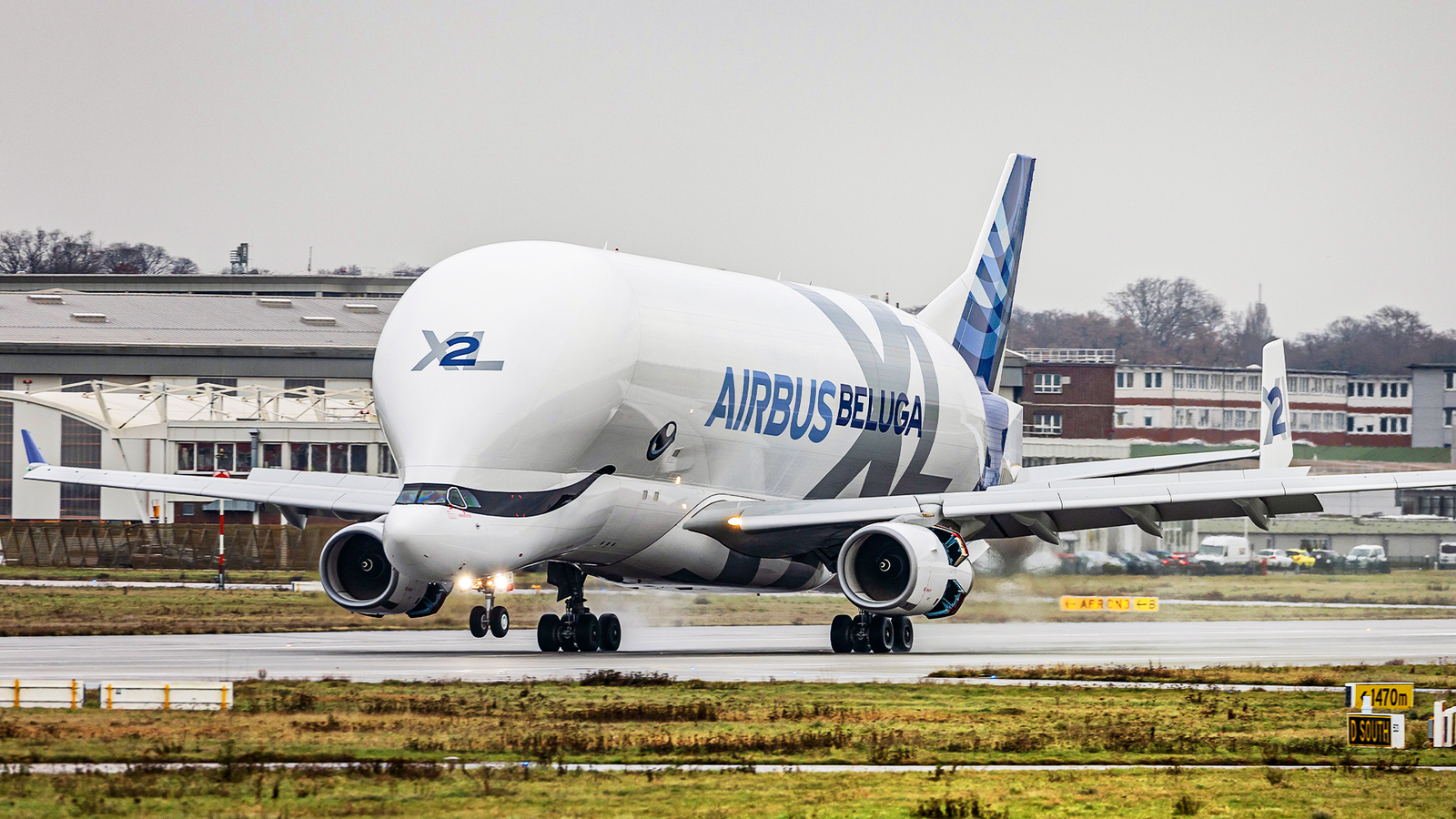
Airbus' distinctive whale-shaped Beluga XL aircraft are a familiar sight across European skies, but their unusual appearance serves a very practical purpose. Designed to transport oversized aircraft components between production facilities, these specially adapted freighters play an important role in keeping Airbus' manufacturing network connected. Their work rarely involves long-haul journeys; repeated short flights between factories form the backbone of their operations. A particularly busy week for F-GXLH, an Airbus A330-700 Beluga XL operated by Airbus Transport International, illustrates just how frequently these aircraft are needed. Using the Simple Flying Flight Tracker to examine its movements between November 11 and 17, 2026, the aircraft's schedule reveals 15 flights, more than 28 hours in the air, and 10,193 miles (16,404 kilometers) covered between airports. Its operations involved five airports in France, Germany, and the UK, with Toulouse serving as its operational center. Meet F-GXLH: The Whale-Shaped Workhorse Credit: Airbus The Airbus Beluga XL is one of the most recognizable aircraft in commercial aviation, thanks to its unusually large upper fuselage and distinctive cockpit design. Based on the Airbus A330-200, the aircraft was developed to carry exceptionally large aircraft components that conventional cargo aircraft cannot accommodate. Its enlarged cargo section gives Airbus the capacity to transport major structures between its geographically separated production facilities. Airbus operates the Beluga XL fleet through Airbus Transport International, with the aircraft supporting the manufacturer's European industrial network. Rather than operating like conventional freighters, which typically connect major cargo hubs, these aircraft perform a specialized logistical role. Their schedules are built around aircraft production requirements, moving components between facilities so different stages of manufacturing can continue without unnecessary delays. Boeing's equivalent cargo aircraft is known as the Boeing Dreamlifter. F-GXLH was particularly active during the week under review, completing 15 flights between November 11 and November 17. Its total flying time reached 28 hours and 22 minutes, while the total distance flown amounted to 10,193 miles (16,404 kilometers). These figures made it the busiest aircraft in the comparison by both flight count and time spent airborne, although another Beluga XL completed the same number of flights. The aircraft operated on six of the seven days, taking a break on Sunday, November 15. Its busiest individual days were Wednesday, November 11, Saturday, November 14, and Monday, November 16, when it completed three flights on each day. The pattern shows how the aircraft's working week revolves around repeated movements rather than a few lengthy journeys. A Busy Week Between Airbus Facilities Credit: Wikimedia Commons | Simple Flying Wednesday, November 11, provided an immediate indication of the aircraft's demanding schedule. F-GXLH began at Toulouse-Blagnac Airport (TLS), departing at 2:04 PM local time for Hawarden Airport (CEG) in Wales. The flight lasted two hours and one minute before the aircraft continued to Hamburg-Finkenwerder Airport (XFW), arriving at 6:55 PM local time. Its third movement took it back to Toulouse, completing a three-flight day. Thursday, November 12, was considerably quieter, with two flights connecting Toulouse and Hawarden. The aircraft departed Toulouse at 3:56 PM local time, arriving in Wales at 4:49 PM local time after one hour and 53 minutes. It then returned to France, leaving Hawarden at 6:55 PM local time and landing at Toulouse-Blagnac at 9:40 PM local time. Together, these movements added another three hours and 38 minutes to its weekly flying schedule. Friday, November 13, saw F-GXLH make another two-flight working day, although its destinations were different. It departed Toulouse at 9:42 AM local time for Bremen Airport (BRE), landing at 11:49 AM local time after two hours and seven minutes. The aircraft subsequently continued to Hawarden, departing Bremen at 1:08 PM local time and arriving at 2:10 PM local time. The two flights brought its accumulated weekly flying time to more than 10 hours. Saturday, November 14, was another particularly active day, with three flights involving Toulouse and Hamburg. F-GXLH first departed Toulouse at 8:40 AM local time for Hamburg-Finkenwerder, arriving at 10:53 AM local time. It subsequently flew back to Toulouse, departing Hamburg at 12:12 PM local time and landing at 12:55 PM local time. A third departure followed at 2:20 PM local time, taking the aircraft back to Hamburg, where it arrived at 5:11 PM local time. Sunday, November 15, was its only day without a recorded flight. The Final Two Days Of The Working Week Credit: Skycolors | Shutterstock After its Sunday break, F-GXLH returned to the skies on Monday, November 16, for its busiest day by flying time. The aircraft began with a departure from Toulouse at 9:00 AM local time, heading to Hamburg-Finkenwerder Airport. Taking two hours and 17 minutes, this was the longest individual flight recorded during the week. It landed at 11:17 AM local time before preparing for another journey. The second flight on Monday connected Hamburg with Saint-Nazaire Montoir Airport (SNR) in western France. Departing at 12:32 PM local time, F-GXLH arrived at 11:25 PM local time after one hour and 53 minutes. Its final movement of the day was particularly short, taking the aircraft from Saint-Nazaire back to Toulouse in just 49 minutes. This was the shortest flight recorded by the Simple Flying Flight Tracker during the period in question. Tuesday, November 17, concluded the aircraft's busy week with another pair of flights. F-GXLH departed Toulouse at 1:07 PM local time, bound for Hamburg-Finkenwerder Airport, arriving at 3:22 PM local time after two hours and five minutes. It then departed Hamburg at 4:32 PM local time, returning to Toulouse at 6:43 PM local time. The final flight lasted two hours and 10 minutes. Across the six operating days, the schedule consistently brought the aircraft back to Toulouse, underlining the importance of the French city for the European manufacturer. There were no extended stays at distant destinations, and the aircraft repeatedly moved between production-related airports. By the time Tuesday's final flight ended, F-GXLH had accumulated 15 flights and 28 hours and 22 minutes in the air. Five Airports Across The Airbus Network Credit: Torben Knauer | Shutterstock Toulouse-Blagnac Airport was the most frequently visited location during the week, recording 12 takeoffs and landings involving F-GXLH. As the location of Airbus' headquarters and major aircraft manufacturing activities, Toulouse is an important part of the manufacturer's network. Its repeated appearance in the aircraft's schedule reflects its role as a central point for the Beluga XL's movements. Hamburg-Finkenwerder Airport was the second-busiest location, recording eight movements during the period. The airport is closely associated with Airbus' aircraft production activities in Germany, making it an important destination for specialized transport flights. Toulouse and Hamburg also formed the most frequently operated airport pair, accounting for five of the aircraft's 15 flights when both directions are included. Hawarden Airport, near Airbus' Broughton manufacturing facility in Wales, recorded six movements. Broughton is particularly important to Airbus because of its involvement in wing production, making the connection with the wider European manufacturing network an important part of the manufacturer's logistics operations. The remaining movements involved Bremen Airport and Saint-Nazaire Montoir Airport, each recording two takeoffs and landings, followed by Bremen and Saint-Nazaire. Although these destinations accounted for fewer movements than Toulouse, Hamburg, and Hawarden, their inclusion illustrates the geographical reach of Airbus' specialized transport network. F-GXLH Was Not The Only Busy Beluga Credit: Airbus The wider Beluga fleet also recorded considerable activity during the same seven-day period. Another Airbus A330-700 Beluga XL, F-GXLN, completed 15 flights, matching F-GXLH's total. However, it accumulated just 21 hours in the air, substantially fewer than F-GXLH's 28.4 hours. The difference highlights how two aircraft can complete the same number of journeys while operating very different schedules. F-GXLG was another active member of the Beluga XL fleet, completing 13 flights and spending 20 hours airborne. F-GXLI recorded 11 flights and 17.6 hours, while F-GXLO completed nine flights with 16.9 hours of flying time. These figures show that Airbus had several Beluga XL aircraft undertaking regular operations during the same period, rather than relying exclusively on F-GXLH to support its production network. The older Airbus A300-600ST Beluga aircraft also appeared in the weekly comparison. F-GSTB completed six flights and recorded 12.1 hours in the air. Across the eight aircraft included in the Simple Flying Flight Tracker comparison, the combined activity amounted to 70 flights and approximately 96.5 hours in the air, illustrating the scale of the specialized operation supporting Airbus' manufacturing activities. How The Flights Were Tracked Credit: Airbus The figures for F-GXLH come from the Simple Flying Flight Tracker, which provides aircraft movement information using tracking data, including Automatic Dependent Surveillance-Broadcast (ADS-B). Its flight history makes it possible to examine individual journeys, identify the airports visited, and compare the activity of different aircraft. The tracker includes departure and arrival airports, local departure and landing times, flight durations, and airport-to-airport distances. This makes it possible to reconstruct the aircraft's schedule across the seven-day period and compare its activity with other members of the Beluga fleet. The Simple Flying Flight Tracker also allows aviation enthusiasts to follow aircraft movements and examine completed journeys rather than relying solely on scheduled services. Credit: Simple Flying Flight Tracker The tracking information provides a useful snapshot of how Airbus' unusual transport aircraft are deployed during a working week. F-GXLH did not need to travel across continents or spend extended periods operating long-distance cargo services to accumulate substantial activity. Instead, its schedule was built around repeated connections between five airports, with Toulouse appearing particularly frequently. For the Beluga XL, this is the nature of the job: keeping Airbus' geographically separated manufacturing facilities connected through a steady stream of specialized cargo flights.
We Tracked An Airbus Beluga XL For A Week: 15 Flights Moving Airbus Parts Around Europe
Full Article
Original Source
Read the full article at Simpleflying →KhanList aggregates and links to publicly available news content. We do not host full articles from third-party sources. Always verify important information with original sources.