
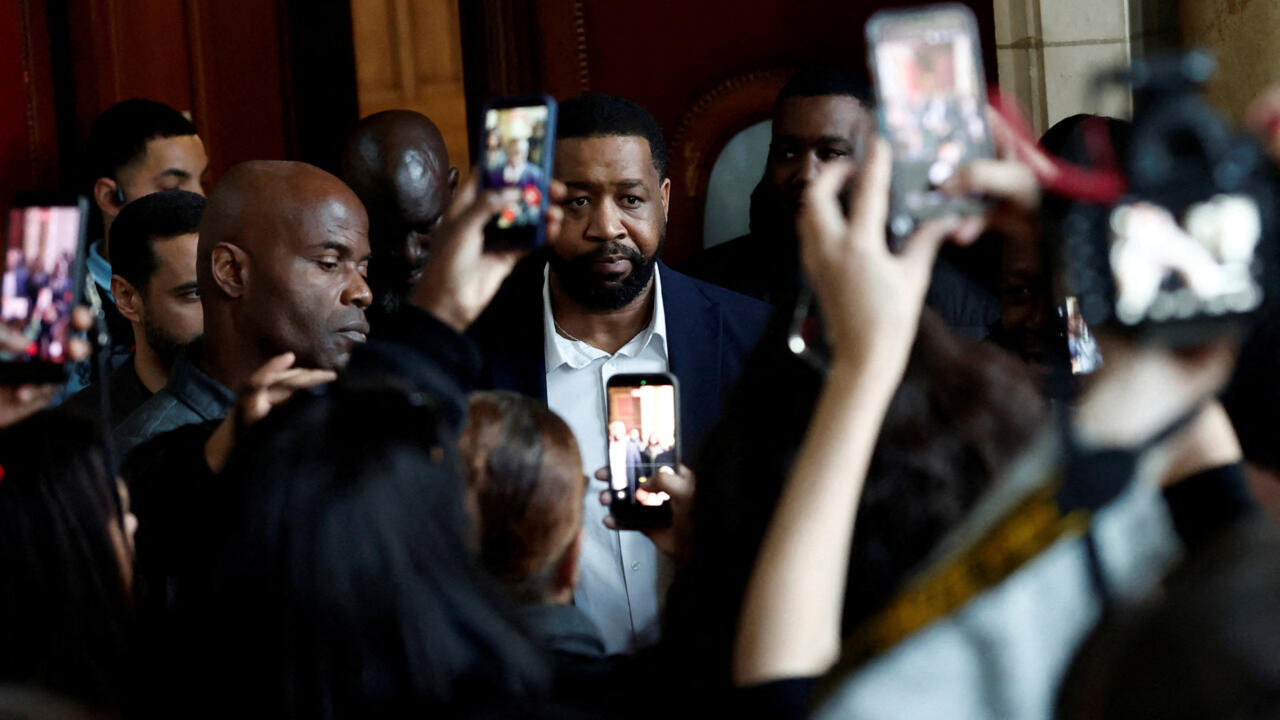
A French court has handed down prison sentences to three police officers for the violent assault of black music producer Michel Zecler in Paris in 2020, ruling that racism was an aggravating factor in a case that sparked nationwide outrage over police brutality and racial discrimination. Issued on: 21/11/2026 - 16:41 3 min Reading time The three officers were convicted on Friday over the beating of Zecler, now 47, who was attacked at the entrance to his Paris recording studio during France's Covid-19 lockdown in November 2020. The assault, captured on security cameras, sparked widespread condemnation after footage emerged showing officers repeatedly punching and kicking him. The court sentenced Aurélien Lapersonne, 29, to five years in prison, including three years suspended, while Philippe Tondeux, 50, received five years, with three-and-a-half years suspended. A third officer, Pierre Plantier, 37, received five years, including four suspended. He will serve the remaining year under electronic surveillance rather than in prison. Lapersonne and Tondeux will begin serving their custodial sentences at a later date. Supporters applauded as Zecler emerged from the courtroom. "Justice has been done. It has restored a man's dignity and allowed him to begin rebuilding himself," his lawyer, Serge Money, said. All three officers had apologised earlier in the day, with Plantier breaking down in tears. Tondeux expressed regret over the damage caused to the police force's reputation. 'I still have nightmares': victim of police violence seeks justice six years on Security footage challenges police account The incident took place on 21 November 2020, when officers stopped Zecler outside his studio for allegedly failing to wear a mandatory face mask. Investigators established that they pushed him into the entrance before assaulting him, leaving him with head trauma, injuries to his lip and scalp, and a ruptured biceps tendon. The officers initially claimed Zecler had attacked them and attempted to seize a firearm, but security footage contradicted their account. They were subsequently prosecuted for assault and falsifying their police report. Zecler also maintained that the officers repeatedly directed racist insults at him – an allegation central to the court's ruling. Although prosecutors had sought prison sentences of four to six years, the judges imposed lighter penalties while recognising racism as an aggravating circumstance, contrary to the investigators' assessment. They cited the consistency of Zecler's testimony, noting that he had reported racist insults immediately after the beating, at the police station, during his transfer to hospital and to relatives. The court also found that the officers' falsified report undermined the credibility of their denials. Rights groups complain to UN over French police racial profiling Wider debate over racial profiling The verdict comes amid continuing debate over police violence and racial profiling in France, where convictions in high-profile brutality cases remain relatively rare. Campaigners and researchers argue that excessive force and discriminatory policing reflect systemic problems, while authorities and police unions generally maintain that misconduct involves a minority of officers. The Zecler case became a focal point of that debate after the footage circulated widely in 2020, prompting demonstrations and renewed demands for police accountability. In another closely watched case, three officers received suspended prison sentences in 2024 over the violent arrest of Théo Luhaka, a young black man who suffered irreversible rectal injuries during a stop-and-search operation near Paris in 2017. Research by France's independent human rights watchdog, the Défenseur des droits, has also highlighted persistent racial disparities in policing. A 2025 report, based on a survey of more than 5,000 people, found that young men perceived as Arab, black or North African were four times more likely to be stopped by police than the rest of the population. They were also 12 times more likely to face more intrusive measures, including being frisked. Friday's ruling marks a significant development in Zecler's six-year legal battle, particularly through the court's recognition of racism as an aggravating factor in the assault. (with newswires)
French court finds racism played role in police beating of black music producer
Full Article
Original Source
Read the full article at Rfi →KhanList aggregates and links to publicly available news content. We do not host full articles from third-party sources. Always verify important information with original sources.