
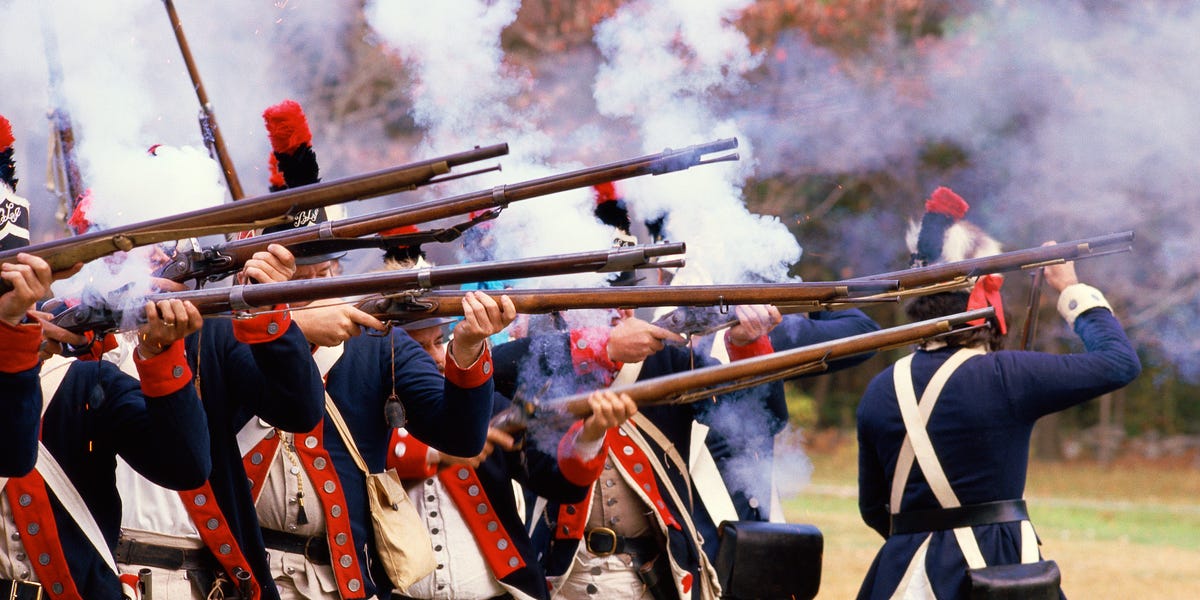
4 min readHere’s what you’ll learn when you read this story:Volunteers for an archaeological project at Red Bank Battlefield Park discovered a mass grave from 1777. The Battle of Red Bank was a key event during the Revolutionary War’s Philadelphia Campaign. The researchers noted that they had anticipated dozens of artifacts from the public project, but never human remains—and certainly not a mass burial.The banks of the Delaware River have long held significant amounts of Revolutionary War history, representing both the triumphs and costs of the battles that occurred in the area. An archaeological excavation at Red Bank Battlefield Park in Gloucester County, New Jersey, may be the perfect example, as volunteers uncovered both artifacts from the fighting and a mass grave.“We knew this public project would likely reveal dozens of artifacts, but we never anticipated finding human remains,” wrote Jennifer Janofsky and Wade Catts, history professors at Rowan University, in a piece for The Conversation. “And we certainly did not expect to find a mass burial—one of just a handful of Revolutionary War mass burials that have been discovered.”During the Philadelphia Campaign, which lasted from July 1777 to July 1778‚ British General William Howe moved an army by sea to Chesapeake Bay and then marched north toward Philadelphia to take on General George Washington and his troops. The first clash occurred on Sept. 11, 1777, at the Battle of Brandywine, which resulted in a decisive British victory. This allowed Howe to continue advancing until his forces reached Philadelphia on September 26. After being pushed out of the city, Washington’s army continued to fight. In October, the Delaware River and its supply lines became a key point of conflict. The continued American occupation of Fort Mifflin and Fort Mercer created a stalemate of sorts by preventing British forces from advancing northward along the Delaware River.British efforts to capture Fort Mercer led to the Battle of Red Bank in October 1777 and resulted in a small victory for the patriots. Two Rhode Island regiments defended the fort as the British Army sent a hired German Hessian brigade on the attack. The patriots withstood the assault, and 111 Hessian soldiers died, according to German historical documents. Fourteen Americans were lost.The day after the battle, Colonel Christopher Greene ordered his Rhode Island regiment to bury the dead. “The remains of the Hessian soldiers were unceremoniously dumped in a ditch,” Janofsky and Catts wrote. They added that documentation at the time noted the burial of 75 Hessians in one grave and another 10 soldiers closer to the river.Experts initially believed the soldiers were buried near the historic home of James and Ann Whitall, whose property was seized to make way for the fort and which now sits across the river from Philadelphia International Airport. However, the Rowan University-led dig took place nowhere near the Whitall house. Instead, the excavation site lies adjacent to the northern boundary of Red Bank Battlefield Park and includes a previously undisturbed trench that was once part of Fort Mercer’s fortifications.“We had begun to archaeologically survey the site, never expecting that this unassuming parcel would become among the most significant spots in the park,” Janofsky and Catts wrote.A volunteer first discovered a human bone, and then the team recovered the remains of 15 individuals, all believed to be Hessian soldiers. “The work of removing the human remains was delicate,” the team wrote. “The bones were not in good condition.” The bones were recovered in pieces—no full skeletons were present—but buckles, buttons, and musket balls helped the experts to identify the remains as Hessian.The remains of individual No. 7, found face down at the base of the fort wall, showed a lead musket ball in his right hip, a lead canister shot in the center of his back, and iron grapeshot (like a mini cannonball the size of a golf ball) in his left arm.“Other injuries revealed more grim realities of a Revolutionary War battlefield, such as the Pennsylvania Navy’s use of bar and chain shot as ammunition,” the team wrote. “Bar shot looks like a heavily weighted dumbbell. Chain shot is two cannonballs linked by a chain. Once fired from a cannon, both spin as they sweep through the air toward the target.” These weapons were originally designed to destroy a ship’s rigging and masts.With the remains gathered up, the researchers turned to analytics. The team studied the teeth of the soldiers and found that the men all spent their childhoods within a 30-mile radius of one another in northwestern Europe. The experts are continuing to extract data from the discovery with the goal of identifying at least one of the men from the mass grave by name. Nearly 250 years after they were hastily buried far from home, these soldiers may finally be remembered for who they were.Tim Newcomb is a journalist based in the Pacific Northwest. He covers stadiums, sneakers, gear, infrastructure, and more for a variety of publications, including Popular Mechanics. His favorite interviews have included sit-downs with Roger Federer in Switzerland, Kobe Bryant in Los Angeles, and Tinker Hatfield in Portland.
Volunteers Were Hunting for Revolutionary War Artifacts—and Stumbled Upon a Mass Grave of Soldiers
Full Article
Original Source
Read the full article at Popularmechanics →KhanList aggregates and links to publicly available news content. We do not host full articles from third-party sources. Always verify important information with original sources.