
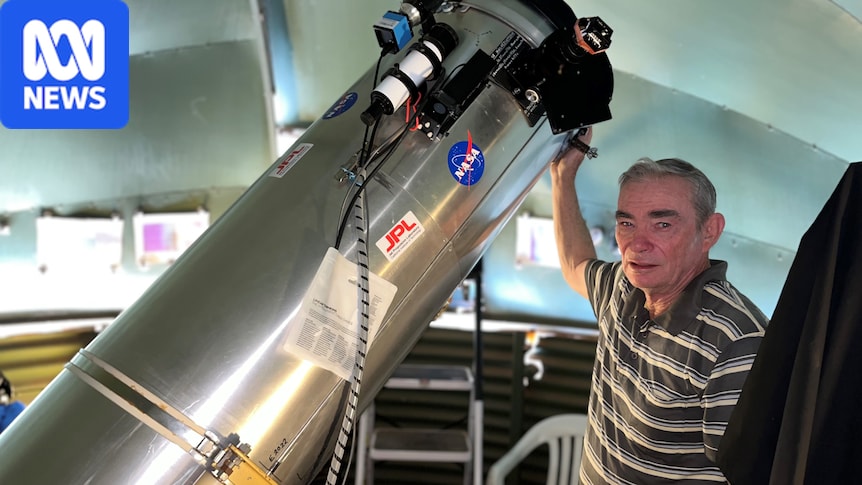
From a backyard in outback NSW in 2024, a former mine worker spotted something mysterious in the sky on his favourite planet, Saturn.Two years later, Trevor Barry is among the co-authors of a peer-reviewed paper published in the Science Advances journal about a world-first discovery of a decagon wave around Saturn's south pole.Polar projection of the decagon wave on Saturn's south pole made by Trevor Barry in July 2024. (Supplied: Trevor Barry)In his homemade observatory in Broken Hill, "Terrestrial Trevor", as he is affectionately known, has been capturing data since the early 2000s."From 2024, mid 2024, I started to capture what I described to my professor as a ripple impinging down, bright spots forming a ripple that impinged down into the south polar collar of Saturn," Mr Barry said.He sent what he had captured to professor Agustín Sánchez-Lavega in Spain, whom he has been working with since 2008."Agustín got back to me, and he said, 'Well, Trev, never mind ripple, think wave and don't circulate it,' because Amy Simon – who we also work with at NASA Goddard [Space Flight Center] — in her 2023 data, like Hubble [telescope] images, she was seeing the beginning of a formation of a structure."Trevor Barry is proud Broken Hill is listed alongside NASA and major universities. (ABC Broken Hill: Soofia Tariq)The discovery of the 10-sided atmospheric wave is the first time a large jet pattern has been observed in Saturn's southern hemisphere.It is similar to the hexagonal wave that spins like a hurricane on Saturn's North Pole, which was discovered in 1980 and 1981 by NASA's Voyager flybys."[Saturn] has a very unique feature at the north pole, a hexagon; there is no structure like that ever seen anywhere else in the solar system," Mr Barry said."The fact that now a decagon has formed at the south pole, this is a world-first discovery of a feature never before seen on a planet in our solar system."Trevor Barry built his observatory in the backyard of his Broken Hill home. (Supplied: Trevor Barry)He said once he knew of the importance of the feature, he started making polar projections from the data he collected from the perspective of looking straight down at the south pole."It has to be very good data. I capture a lot of data, but I had to have very stable air to actually reveal this," Mr Barry said."It's great to be a part of this and to be able to produce data of high enough resolution and value to be included in a new discovery, a whole new discovery."'One of NASA's premier Saturn observers'Amy Simon, planetary scientist at the NASA Goddard Space Flight Center, is also a co-author on the paper and has worked with Mr Barry for several years, using his data and measurements for many of their papers.Amy Simon described Trevor Barry as one of NASA's "premier Saturn observers". (Supplied: Dr Amy Simon)"He is one of our premier Saturn observers. He gives us very, very meticulous reports, his images are really great and he really tracks this stuff over time," Dr Simon said.She says amateur astronomers were the first to notice the formation as Saturn's southern hemisphere became more visible.This is because Saturn sits on a tilted axis, similar to the Earth, and as the planets orbit around the Sun, we see less of one hemisphere than the other.Dr Simon said that data from people like Mr Barry was crucial to fill in gaps as the Hubble Telescope can not be used all the time."Having an observatory that gives very consistent results, high quality images, really does help us understand when something forms or whether it was just one bad observation."She added that what makes Mr Barry special was his detail."Terrestrial Trevor" with his backyard observatory. (ABC Broken Hill: Bill Ormonde)"Trevor is very meticulous. So when he spots something he records where it was, what time he saw it [and] what he saw," she said."He'll track it over time, and that really makes it a lot easier for us to say 'yes, that is real'."Broken Hill gets a mentionMr Barry, who left high school in Year 10 and is now in his 70s, is no stranger to acclaim, having won national and international awards for his work.But for him, seeing his hometown of Broken Hill and his homemade observatory listed alongside NASA's Goddard Space Flight Center and the University of California is what makes him most proud."I love that Broken Hill gets a mention in this [research paper]," he said."All the other authors are professors or PhDs but there's Trevor the mine worker from Broken Hill," Mr Barry said."In their list of affiliations again, the creme de la creme of institutions on planet Earth, but in amongst them is [my] Broken Hill observatory."Two views of Saturn from NASA’s Hubble Space Telescope reveal a giant, evolving 10-sided atmospheric wave encircling the planet’s south pole. (Credit: NASA, ESA, STScI, Agustin Sánchez-Lavega (UPV), Amy Simon (NASA-GSFC), Michael Wong (UC Berkeley); Image Processing: Alyssa Pagan)The Broken Hill Library, which also features his book, Outback Astronomer, has printed and displayed copies of the research paper for locals to read.Much is still not known about the decagon, such as how exactly it formed or if it is permanent, so the work continues."We don't know if this is also going to become a very stable feature. It's just one of those things that keeps my appetite for what I do going," Mr Barry said."Who knows what else might happen, but trust me, there'll be eyes from Broken Hill."
Backyard astronomer contributes to world-first Saturn discovery
Full Article
Original Source
Read the full article at Abc →KhanList aggregates and links to publicly available news content. We do not host full articles from third-party sources. Always verify important information with original sources.