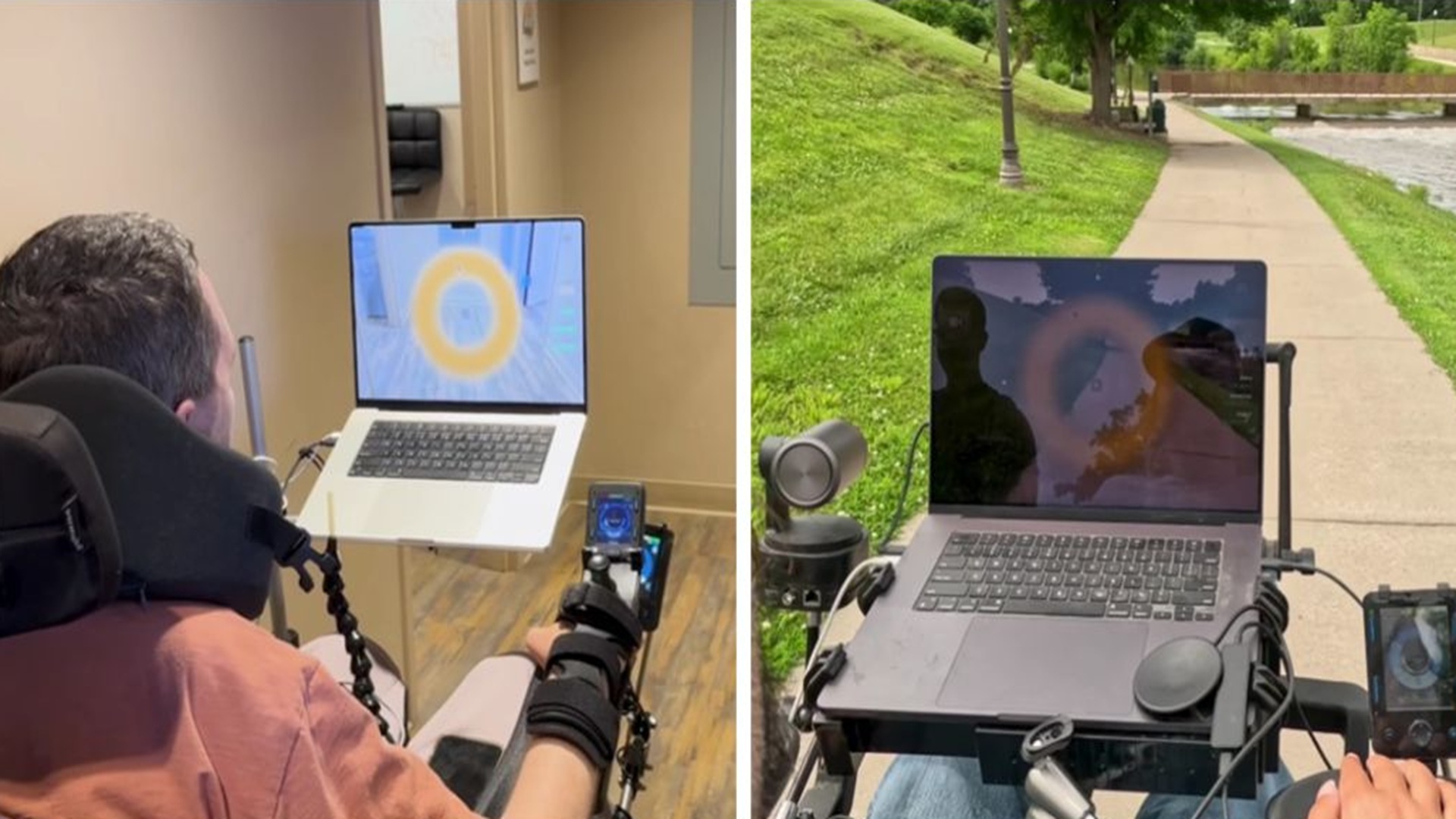
U.S. neurotechnology company has unveiled a brain implant that allows people with paralysis to steer, reverse, and adjust their wheelchairs using nothing but their thoughts. California-based Neuralink Corp., founded by Elon Musk in 2016, provided a new update on its ongoing PRIME clinical trial on July 24. In a clip shared on YouTube, the company showed participants with paralysis controlling powered wheelchairs using neural activity alone. Driven by the company’s N1 implant, which is placed inside the motor cortex (the region responsible for planning voluntary movement), the system allows users to reverse, steer, and adjust the chair’s seat and backrest. The implant itself measures about 23 millimeters in diameter, roughly the size of a U.S. quarter. The trial marked a huge step in applying the company’s brain-computer interface to everyday mobility. “We’ve been exploring how clinical trial participants can control a powered wheelchair, with their minds,” Neuralink pointed out. Telepathic wheelchair control According to Neuralink, the N1 implant contains a total of 1,024 electrodes. These are distributed across more than 100 ultra-thin threads. Current devices use up to 128 threads, each thinner than a human hair. A specialized surgical robot inserts the electrodes with high precision while minimizing damage to surrounding brain tissue. Even when someone with paralysis cannot physically move, neurons involved in movement still generate electrical activity. The implant records those signals in real time before a machine learning model decodes them into digital commands. The decoded signals control a virtual cursor that moves across a computer screen, which is then translated into wheelchair commands and recognized by the chair’s control system. This enables users to move forward, reverse, turn left or right, and even reposition the seat. The participants navigated indoor hallways and outdoor paths using a live video feed from a camera mounted on the wheelchair. “The Neuralink implant decodes movement intentions in real time to move an on-screen cursor,” the company said. “That cursor controls a custom app that shows a live camera feed of what’s in front of the participant.” Built-in safety features Rather than continuing indefinitely after a command is issued, the virtual cursor automatically returns to its center position when the user relaxes their focus. As a result, the wheelchair gradually slows before stopping. This also reduces the risk of unintended movement if concentration is lost. “Move the cursor up and the wheelchair goes forward; down, backward; left and right to steer,” Neuralink underscored. “The farther they push the cursor in any direction, the faster the chair moves.” The company emphasized that the current demonstration represents research rather than a commercial product and that further testing remains necessary before broader deployment. The demonstration builds on Neuralink’s PRIME study, which began in January 2024. Noland Arbaugh became the first human recipient of the firm’s Telepathy brain implant. According to the company’s latest updates, 26 people worldwide had received the N1 implant as of June 22. Earlier this year, Neuralink reported 21 implanted participants across four countries, while its separate GB PRIME study in the UK had enrolled seven patients by May 2026. However, despite the progress, Neuralink stressed that the technology remains investigational. The N1 implant has not been approved by the US Food and Drug Administration (FDA) yet. Recommended ArticlesGet the latest in engineering, tech, space & science - delivered daily to your inbox.Based in Skopje, North Macedonia. Her work has appeared in Daily Mail, Mirror, Daily Star, Yahoo, NationalWorld, Newsweek, Press Gazette and others. She covers stories on batteries, wind energy, sustainable shipping and new discoveries. When she's not chasing the next big science story, she's traveling, exploring new cultures, or enjoying good food with even better wine.
Video: Neuralink lets people with paralysis drive wheelchairs using only their thoughts
Full Article
Original Source
Read the full article at Interestingengineering →KhanList aggregates and links to publicly available news content. We do not host full articles from third-party sources. Always verify important information with original sources.