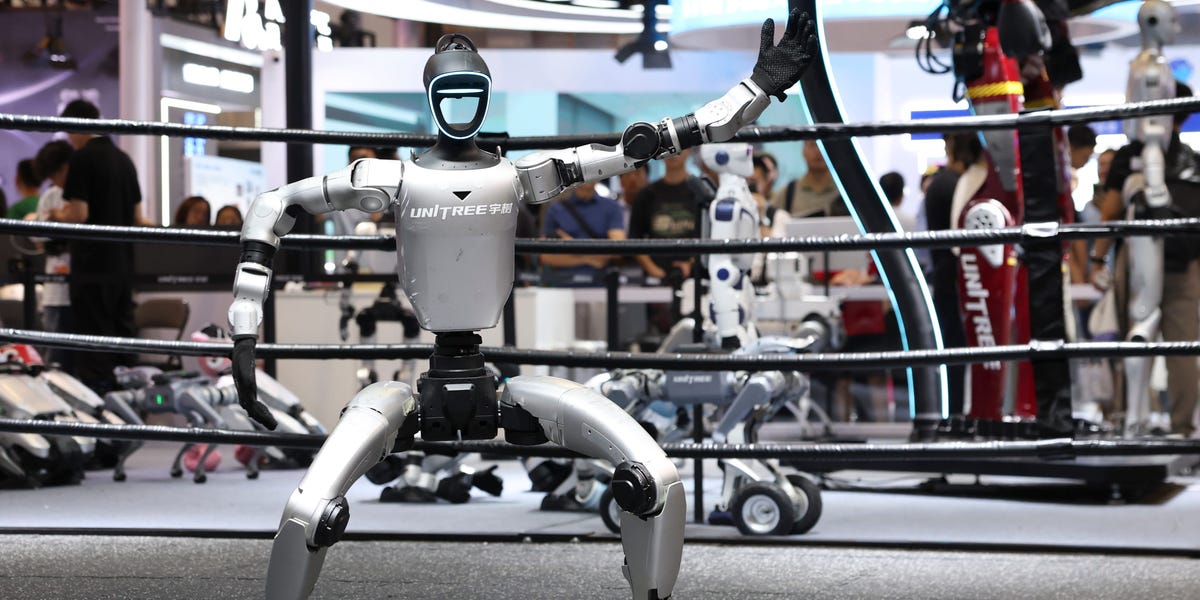
Trump's robot ban aims to counter China. US startups fear it could leave them behind. A Unitree humanoid. Yin Liqin/China News Service/VCG via Getty Images The Trump administration has opened a new front in its tech crackdown on China: robots.The Federal Communications Commission on Tuesday effectively shut the door on new foreign-made "advanced robotic devices," citing "unacceptable risks" to national security. The category includes humanoids, quadrupeds, and even some robot vacuums.Even though previously authorized models are unaffected, and manufacturers can apply for conditional approval, the move will largely impact Chinese manufacturers like Unitree, which builds relatively inexpensive machines that American startups and university researchers widely use.The FCC's restrictions have split the US robotics industry. In interviews with Business Insider, American manufacturers welcomed protection from subsidized Chinese rivals, while startups and researchers warned that losing access to affordable hardware could leave the US further behind in a humanoid market China already dominates.Chinese companies accounted for roughly 90% of global humanoid shipments last year, according to Omdia.AJ Meyer, CEO of Pickle Robot, which builds robots that unload boxes from trucks and shipping containers, said Chinese hardware is useful but carries real security risks. Still, he said the measure only benefits a small group of domestic manufacturers."I would never put a Unitree robot into a customer site and hook it up to the internet as it comes out of the box," Meyer said. He said he would first modify its software and connectivity systems. Product labeling, security certification, and liability rules would address the risks better than a broad import ban, he argued.Chinese humanoids and quadrupeds are among the few platforms that smaller teams can afford. Quadrupeds retail for as little as $3,000, while entry-level humanoids start at around $6,000 before import fees and tariffs. Most American humanoids are still in development and not available off the shelf. A Unitree humanoid. credit should read CFOTO/Future Publishing via Getty Images What American-built humanoids will eventually sell for remains unclear. Elon Musk has estimated that it could eventually cost Tesla between $20,000 and $25,000 to manufacture Optimus, the company's humanoid robot, once production scales. It's not clear how much Optimus will sell for.Vedant Nair, cofounder of Y Combinator-backed robotics software startup Miru, told Business Insider that the ban will hurt small startups and university researchers."This will severely hamper their ability to build useful products," Nair said. "Their development will be stymied by their inability to even access hardware."Chinese companies will continue selling robots elsewhere, Nair added, generating revenue and real-world data that could widen their hardware advantage.Bilal Zuberi, founder of the physical AI investing firm Red Glass Ventures, characterized the decision as shortsighted and protectionist."We should be incentivizing learning en masse from China about where the future of robotics and hardware is headed," Zuberi said.US robot makers welcome the protectionEvan Beard, CEO of New York-based robotic-arm maker Standard Bots, valued at $1 billion, has long pushed Washington to restrict Chinese robots. In congressional testimony last year, he called for an import ban or tariffs to counter Chinese government subsidies. Last month, he met with Commerce Secretary Howard Lutnick to discuss competition from China."This is one of the largest and most important US trade actions in history," Beard told Business Insider. "It's a message that the US needs to be a leader and an owner of these core foundational technologies. It's too important to outsource." Agility Robotics' Digit humanoid LLUIS GENE/AFP via Getty Images Agility Robotics CEO Peggy Johnson has also backed restrictions. The startup, which plans to go public at a $2.5 billion valuation, assembles humanoids in Oregon to perform repetitive tasks such as moving heavy boxes and loading conveyor belts.In a statement, Agility said the ban is an important step toward addressing national and economic security risks posed by foreign-made robots "before they become deeply embedded across an entire industry, much like what happened in the drone market." Chinese manufacturers came to dominate the US commercial drone market before Washington restricted new foreign-made models over national security concerns last year."This decision rewards companies that have invested in building trusted domestic supply chains from the ground up," the company said.Last year, researchers found an undocumented backdoor in Unitree's Go1 robot dog that could let outsiders control it and access its camera. Another analysis found that Unitree robots used at MIT, Princeton, and Carnegie Mellon may have been exposed to the same flaw. The FCC cited similar risks in its national security determination."Advanced robotic devices collect data that could be leveraged by malign actors to surveil Americans, enhance the capabilities of foreign intelligence services, or to remotely commandeer the robots," officials wrote."We are now living in a world where frontier AI capabilities are being seen as national assets," Omdia analyst Lian Jye Su told Business Insider. The broader goal, he said, is "robotic sovereignty" — ensuring countries control the robots they depend on rather than relying on a geopolitical rival. Read next Rya is a senior reporter at Business Insider covering physical AI and robotics. She writes about factory automation, humanoid robots, and the race to collect the real-world data needed to bring AI into the physical world. She previously worked at The San Francisco Standard, where she reported on tech culture and autonomous vehicles. She has a bachelor’s degree in history and politics from Pomona College and a master’s in history from the University of Cambridge. Rya lives in San Francisco. Contact her at rjetha@businessinsider.com or on Signal at rjetha.07. Use a personal email address, a nonwork WiFi network, and a nonwork device. Here's our guide to sharing information securely. Robotics China Elon Musk More Tesla Trump
Trump's robot ban aims to counter China. US startups fear it could leave them behind.
Full Article
Original Source
Read the full article at Businessinsider →KhanList aggregates and links to publicly available news content. We do not host full articles from third-party sources. Always verify important information with original sources.