
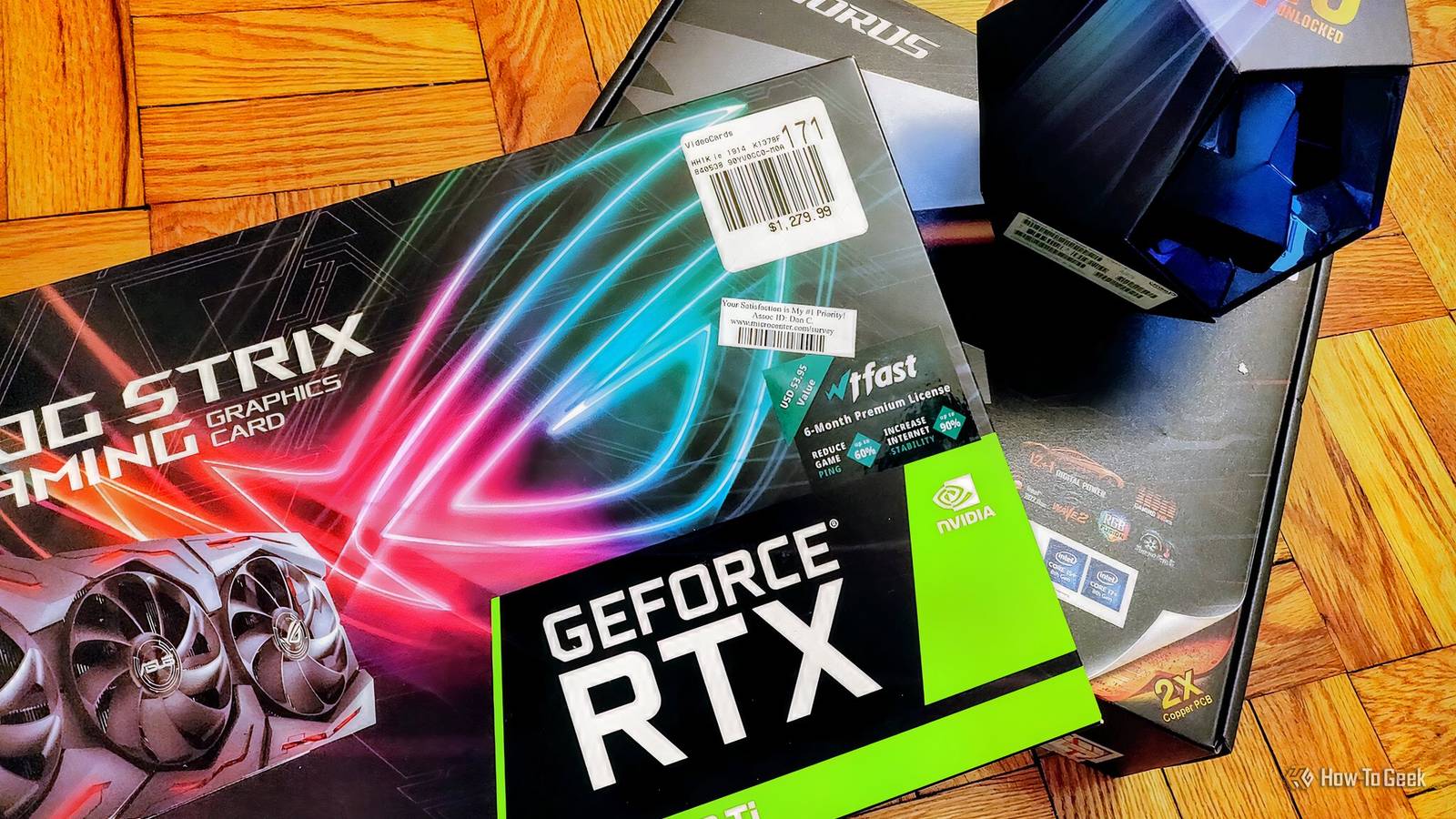
Published Nov 12, 2026, 2:30 PM EST Monica J. White is a journalist with over a decade of experience in covering technology. She built her first PC nearly 20 years ago, and she has since built and tested dozens of PCs. PC hardware is her main beat, and graphics cards and the GPU market at large are her main area of interest, but she has written thousands of articles covering everything related to PCs, laptops, handhelds, and peripherals. From GPUs and CPUs to headsets and software, Monica's always willing to geek out over all things related to computing. Outside of her work with How-To Geek, Monica contributes to TechRadar, PC Gamer, Tom's Guide, Laptop Mag, SlashGear, Whop, and Digital Trends, among others. Her ultimate goal is to make PC gaming and computing approachable and fun to any audience. Monica spends a lot of time elbow-deep in her PC case, as she's always making upgrades, testing something, or plotting out her next build. She's the go-to tech support person in her immediate circle, so she's never out of things to do. Whenever she has spare time, you'll find her gaming until the early hours and hanging out with her dog. GPU prices are a bit of a sad joke right now, so much so that many people turn to handhelds. And even before things got this bad in the PC hardware market, the Steam Deck was a popular alternative for people who wanted versatile gaming in a small footprint. The thing is, though, that you can get yourself a much better PC, with more firepower to run the latest games, if you avoid the Steam Deck and get a used GPU. The Steam Deck has gotten more expensive without getting faster It's a lot to ask for that level of performance At launch, the Steam Deck was widely considered to be pretty good value. The original LCD model launched at just $399, and even the OLED version was fairly reasonably priced when it first came out. Unfortunately, much like many graphics cards now cost an obscene amount of money, the Steam Deck saw some price increases, too. Valve raised the prices of the Steam Deck OLED, bringing the 1TB version up to $949. Before the RAM-pocalypse, you could almost build yourself a semi-decent desktop PC for that much. These days, it's less likely, but the money spent on hardware still goes a long way when you use a desktop PC vs. a gaming handheld. The benefits are in the portable form factor, of course. The worst part is that you're paying considerably more for the exact same hardware. Don't get me wrong, Steam Deck is still fantastic, but its aging AMD APU isn't getting any faster, and modern AAA games are only becoming more demanding. Sure, the Steam Deck is an entire mini computer, so it does have that edge over a plain desktop. But that plain desktop will beat it performance-wise almost every time, provided it's not a decade old. Even if it is, 1440p gaming is achievable with a cheap upgrade. In this case, when we pit the Steam Deck against an old Nvidia GPU, it's easy to see which is the better buy. The RTX 2080 still has a decent amount of gaming muscle Seven years old doesn't mean it's time for it to retire The old Nvidia GPU I'm talking about is the RTX 2080 and its slightly younger sibling, the RTX 2080 Super. The former launched in September 2018, while the Super followed in July 2019. Both were high-end GPUs in their heyday, and both still have a decent amount of performance to offer, especially when placed in a semi-decent rig. Both are also considerably cheaper than a Steam Deck when bought used, which is fair enough—buying a new GPU that's this old is no easy feat. But you don't need a new GPU for 1080p gaming. The RTX 2080 and the Super variant pack similar performance. Both have 8GB GDDR6 VRAM and a 256-bit memory bus, although the Super has marginally more CUDA cores. More importantly, both cards are better than Steam Deck's modest 8-CU RDNA 2 GPU. The Steam Deck targets 800p gaming with a tiny power budget. Meanwhile, these former Nvidia flagships used to target everything that game devs would throw their way back in the day. Even today, they handle 1080p gaming with ease in many titles. The main limitation is their VRAM. Tell XDB what you want the PC to do and how much you want to spend. We'll find parts that fit, with current prices. What will you use it for? Pick any Games or apps Optional Budget Plan my build Opens XDB, XDA's free PC builder, in a new tab. It still gets some of Nvidia's best software features DLSS is giving this old flagship a second life The RTX 2080 and the RTX 2080 Super might be getting on in years, but Nvidia hasn't completely forgotten about them. Both GPUs support DLSS Super Resolution, including the newer DLSS 4.5 models, which can help squeeze some extra performance out of these aging cards. Granted, the latest models can be more demanding on older hardware, so you might be better off sticking with an earlier version. You also get hardware-accelerated ray tracing, although I wouldn't recommend going wild with those settings on first-gen RT cores. The big thing you're missing is DLSS frame generation and multi-frame generation, which isn't surprising, given how old these cards are. One way or another, they offer a lot more firepower than a plain Steam Deck, that's for sure. A desktop with this GPU gives you more freedom to play what you want And obviously, a lot more room to grow So, let's say you want to buy a used RTX 2080/Super. They can be found on eBay, and prices vary, but I found some selling for as little as $200, while some are sold for over $400. At this price range, you can probably also find a newer Nvidia card to do the same thing but better, but remember that being flagships, the RTX 2080s can handle more than newer cards that were lower down the stack. If you choose to equip your existing PC with one of these GPUs, you'll get a lot more freedom. Freedom to play what you want on a big screen without worrying about power limits, for instance. And freedom to grow. The RTX 2080 isn't perfect, but it gives you room to upgrade It's late 2026, and the RTX 2080 is no longer anybody's dream GPU. It no longer falls under "monster PC material." But at $250, it's a solid buy that's way cheaper than the Steam Deck and gives you room to grow. You can always replace the card, as well as most things in a traditional desktop, and evolve your performance with each upgrade. Meanwhile, your Steam Deck will stay the same no matter what you do with it.
This seven-year-old $250 GPU is still a better buy than a $949 Steam Deck
Full Article
Original Source
Read the full article at Howtogeek →KhanList aggregates and links to publicly available news content. We do not host full articles from third-party sources. Always verify important information with original sources.