
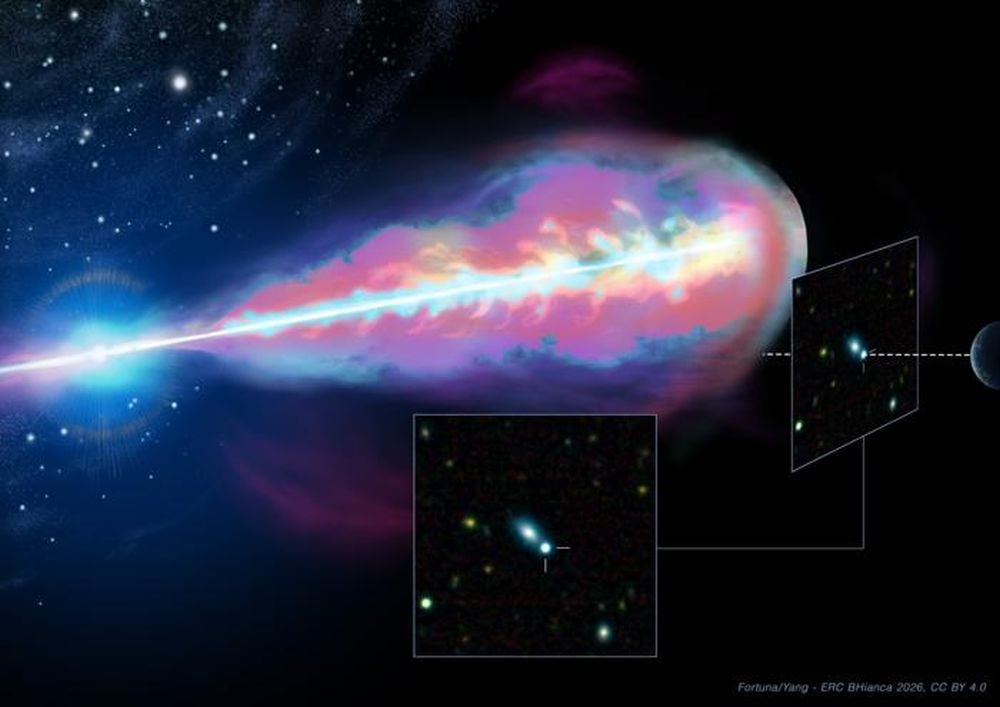
Every photon that reaches us tells us something about the Universe. Most of them come from the Sun and are well-understood. But others aren't so easily understood. The highest energy photons are gamma photons, and they reach us in gamma-ray bursts (GRBs). They were first detected by accident in the 1960s by a satellite watching for covert nuclear weapons tests, an unnatural, Earthly source of gamma radiation. Now we've detected large numbers of GRBs with satellites dedicated to sensing them. GRBs are extremely energetic events in the Universe, second only to the Big Bang. In only a few seconds, they can release as much energy as our Sun will across its nearly 10 billion years of fusion. They're the calling cards of supernovae, when the core of a massive star collapses in on itself at the end of its life, leaving behind a neutron star or a black hole. GRBs are rare, but they're not difficult to detect, due to their extreme bursts of energy. So despite being rare, they're regularly detected in distant galaxies. A typical GRB from a supernova lasts about 20 or 30 seconds, followed by an afterglow with stages of declining energy. A GRB's energy is in its jets, which are ultrarelativistic beams of plasma and radiation that approach the speed of light. This artist's illustration shows two jets from a GRB emitted in opposite directions. The jets lose energy and fade into longer wavelengths as they travel through the surrounding medium. Image Credit: By NASA/Swift/Mary Pat Hrybyk-Keith and John Jones - http://imagine.gsfc.nasa.gov/docs/features/news/10sep08.html [1]Transferred from en.wikipedia to Commons by TheDJ using CommonsHelper., Public Domain, https://commons.wikimedia.org/w/index.php?curid=8807284 The GRB is followed by an x-ray phase, then an optical phase, then a radio phase, as the jet decelerates into the surrounding medium, losing energy in stages. (Another class of GRBs, short GRBs, are separate and have a different source.) On March 10, 2026, NASA’s Fermi Gamma-ray Space Telescope detected a GRB with an unusual light signature. This one, named GRB 260310A, had an initial flash of gamma-rays that lasted almost one minute, releasing a relatively small amount of energy. Then, in another twist, its visible light afterglow gradually brightened over the course of a few hours. The optical light was brighter than the supernova's host galaxy. If that wasn't unusual enough, after its initial x-ray flash, the x-ray afterglow also brightened again, and remained visible for months. In astronomy and astrophysics, outliers always attract attention because they have something new to tell us. GRB 260310A was no different. An international group of researchers studied the burst to try and understand its unusual signature. Their results are in research titled "An Extremely Bright Slow-rising Afterglow from an Off-axis Jet in GRB 260310A," published in The Astrophysical Journal Letters. The lead author is Yu-Han Yang, a postdoctoral scholar in the Department of Physics at the University of Rome Tor Vergata. As the title says, the GRB strange signal is related to our viewing angle. “We see hundreds of GRBs every year, but the oddballs are the most informative ones,” said co-author Roberto Ricci, who led the radio observations. “We could explain individual features of this burst, but fitting them all into the same picture proved much harder.” To understand them, GRBs have to be observed across multiple wavelengths. Once the Fermi Gamma-Ray Telescope detected GRB 260310A, it sent out alerts for quick follow-up observations. NASA’s Chandra X-ray Observatory, ESA’s XMM-Newton, the China/ESA Einstein Probe mission, the Large Binocular Telescope, and the Karl G. Jansky Very Large Array all contributed. The Calar Alto Observatory in Spain also contributed observations confirming that a supernova was behind the GRB. "We present a multiwavelength study of GRB 260310A, a nearby long-duration gamma-ray burst (GRB) at z ≃ 0.153 associated with a broad-lined Type Ic supernova," the authors write. "Despite its modest prompt gamma-ray output, GRB 260310A exhibits one of the brightest afterglows ever observed in the X-ray, optical, and radio bands." This figure compares GRB 260310A with a broader population of GRB afterglows. From top to bottom, the rows of panels compare x-ray flux and luminosity, then optical apparent magnitude and absolute magnitude, then radio flux density and radio luminosity. All panels show how GRB 260310A is different than the broader population and how it peaked later than others. Image Credit: Yu-Han Yang et al 2026 ApJL 1011 L22 Most GRBs are detected when one of its jets is pointed right at us. “Much like a flashlight, the jet appears brightest when seen head-on," said lead author Yu-Han Yang. "Most of our models are calibrated using events seen from that same perspective. This burst gave us a chance to look beyond that glare." GRB 260310A wasn't pointed at us, and that explains some of its unusual light pattern, especially its weaker initial gamma flash. But its later stages were among the brightest. Both its x-ray and optical afterglows ranked among the top 1% in brightness, and its radio brightness was among the top 5% of GRBs. “We looked at it from a side angle," Yang said. "As the jet slowed down, its light became visible over a wider range of angles, allowing us to probe the jet’s shape, from its outer edges toward its inner core.” Strangely, after about three weeks, the x-rays brightened again and stayed bright for about one week. Then, it gradually faded away. “That was unexpected. At first, I thought another X-ray source was contaminating our observations. But the brightening really came from the afterglow,” said Yang, who coordinated the X-ray monitoring. “This prompted us to explore a more complex jet’s shape.” Only NASA's Chandra X-ray Observatory has the angular resolution required to detect a contaminating source, and the researchers used some of its Director's Discretionary Time to examine GRB 260310A. Those observations ruled out a contaminating x-ray source. This figure shows the Large Binocular Telescope's optical image of GRB 260310A's field in the left panel. The right panel shows the Chandra X-ray Observatory's image of the GRB. The cyan circle is the NuSTAR's Fast X-ray Transients observation, which helps show how Chandra has the power to see the source more clearly compared to other x-ray observatories. Its observations ruled out a contaminating x-ray source. Image Credit: Yu-Han Yang et al 2026 ApJL 1011 L22 So what's the overall explanation for GRB 260310A? "We argue that the combination of weak prompt emission, hard peak energy, and late afterglow onset is naturally explained by a GRB jet viewed off-axis," the authors write in their research. The critical part is that it had two separate shocks. "Our analysis of the broadband spectrum favors the presence of two emission components: a bright RS (reverse shock) dominating the radio and extending to the optical band, and an FS (forward shock) contributing to the optical and dominating in the X-rays," the researchers explain. There are existing models of GRBs with two shock components, but they didn't match GRB 260310A. "However, as often occurs for bright GRB afterglows, none of our standard RS plus FS models..." could explain the GRB. A different explanation matches the light from this GRB. "Our long-term X-ray monitoring of the X-ray afterglow identifies a peculiar late-time rebrightening at ∼20–30 days, after a phase of rapid decay," the authors write. "This behavior is difficult to accommodate within a single FS model and may instead indicate a late episode of energy injection that refreshes the shock or additional structure in the outflow, such as a two-component jet." While GRBs were initially seen as single-angle cones emanating outward from supernovae, that explanation hasn't held up. Two component jets with forward and reverse shocks more accurately explain complex light from some GRBs. In this model, the jet features a bright, inner core, and a dimmer outlying sheath. This schematic shows a two-component jet model. It shows a central, compact jet surrounded by a wider, sheath-like jet. It also shows the Reverse Shock and Forward Shock. Image Credit: J.D. Myers (NASA). A jet seen head-on like other GRBs is also ruled out, whereas a jet seen from the side, and having two components, can explain the observations. "A low-velocity jet seen (approximately) on-axis would not be able to combine the early peak and late rebrightening in a single jet model, whereas an off-axis two-component jet can accommodate both these peaks," the researchers explain. The GRB's relative dimness compared to others is not because it's intrinsically less bright. It's because of our viewing angle. "We showed that viewing effects solve the apparent tension in the burst’s properties. The slow rise and delayed onset of its optical afterglow support the scenario of a jet seen off-axis," the authors write. Understanding the viewing angle only explains some of this oddball GRB. It's unusual late re-brightening phase is also odd, even for a two-component jet. "This late-time rebrightening represents a critical test for the two-component jet model," the researchers explain. "If interpreted as the emergence of a narrow jet core viewed further off-axis, it would imply extreme luminosities and energetics for an on-axis observer." So what seemed like an unusually dim GRB, followed by an unexpected re-brightening, stems from our viewing angle. “What appeared to us as an unremarkable GRB might have looked like a monster explosion to an observer looking straight down the jet's core,” notes Yang. “Our models suggest that the explosion packed roughly a billion years of the Sun’s energy output into a pencil-thin beam.”
This Gamma-Ray Burst Wasn't Dim, It Was Just Misunderstood
Full Article
Original Source
Read the full article at Universetoday →KhanList aggregates and links to publicly available news content. We do not host full articles from third-party sources. Always verify important information with original sources.