
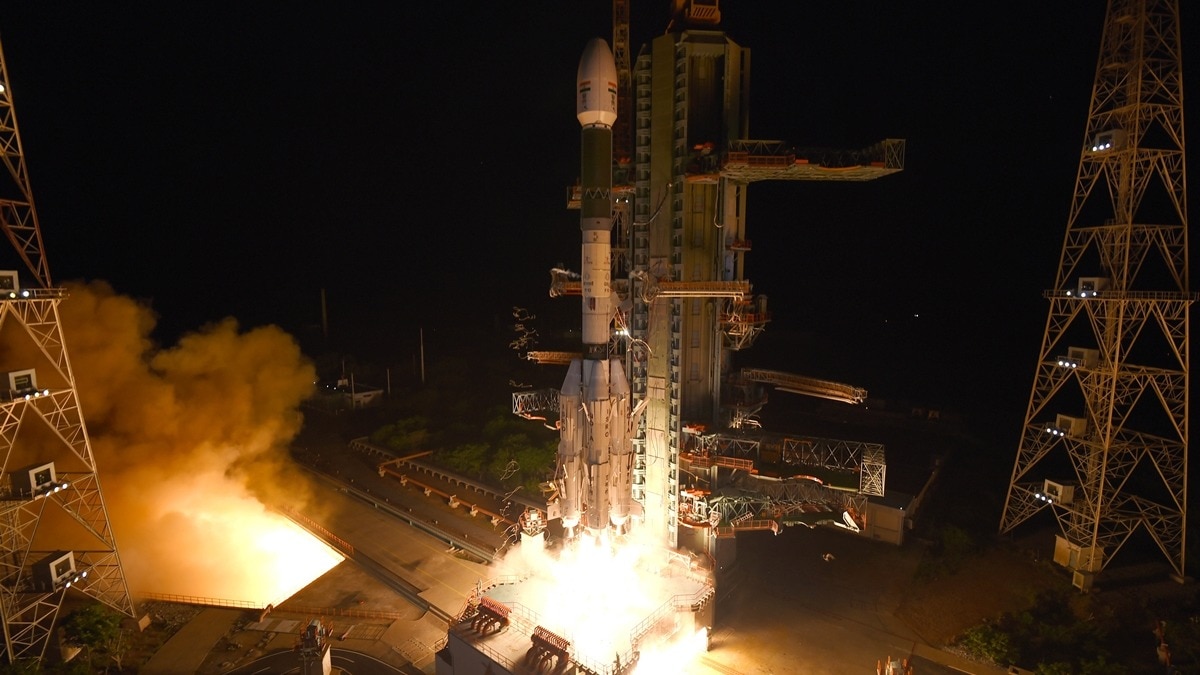
India launches NVS-03 satellite aboard GSLV to boost navigation, security, preparednessIsro GSLV launches with the powerful NVS-03 satellite. (Photo: Isro)New Delhi,Oct 31, 2026 00:17 ISTThe Indian Space Research Organisation (Isro) has successfully launched its next-generation navigation satellite NVS-03 aboard the GSLV-F18 rocket, marking a significant step towards strengthening India's independent satellite navigation system, NavIC.The launch took place at 11:51 pm on Friday from the Second Launch Pad at the Satish Dhawan Space Centre in Sriharikota, Andhra Pradesh.Over 20 minutes after the launch, the GSLV successfully deployed NVS-03 in its intended orbit. An elated Isro chief, Dr V Narayanan, monitoring the launch, announced the completion of the mission, congratulating the industry and the engineers behind the satellite.The mission marked the 20th flight of India's Geosynchronous Satellite Launch Vehicle (GSLV), which injected the 2,250-kg satellite into a Geosynchronous Transfer Orbit (GTO). NVS-03 is the third satellite in Isro's second-generation navigation satellite series, designed to ensure continuity and improve the availability of navigation services under the Navigation with Indian Constellation (NavIC).The mission is particularly important for India as the country looks to strengthen its independent positioning, navigation and timing capabilities at a time when satellite-based navigation has become critical for civilian, commercial and strategic applications.WHY NVS-03 IS CRITICAL FOR INDIA NavIC is India's home-grown alternative to navigation systems such as the American GPS. It is designed to provide positioning and timing services across the Indian mainland and a region extending approximately 1,500 km beyond the country's geopolitical boundaries. NVS-03 going through vibration test at Isro ahead of launch. (Photo: Isro) The system has applications ranging from road and maritime navigation to disaster management, precision agriculture and strategic operations by the armed forces.NVS-03 carries an indigenous atomic clock alongside procured atomic clocks, an important development for India's efforts to build self-reliance in critical navigation technology.It will also introduce the L1 frequency signal alongside the existing L5 and S-band signals. The addition of L1 is expected to improve compatibility with navigation receivers and consumer devices, potentially expanding NavIC's usability.A CRUCIAL MISSION AFTER NVS-02 SETBACKThe launch also comes after a major setback in January 2025, when the NVS-02 satellite was successfully placed into GTO aboard GSLV-F15 but failed to reach its designated operational orbit.A problem involving the electrical activation of a pyrotechnic valve prevented the satellite's Liquid Apogee Motor from receiving the required oxidiser flow, leaving it stranded in its transfer orbit. For NVS-03, Isro incorporated corrective measures to prevent a recurrence of the problem. (Photo: Isro) For NVS-03, Isro incorporated corrective measures to prevent a recurrence of the problem.However, the satellite's journey does not end with its successful launch. Its onboard propulsion system must execute orbit-raising manoeuvres to reach its designated geosynchronous operational orbit.With NVS-03, Isro is taking another important step towards strengthening India's navigation infrastructure and reducing dependence on foreign satellite navigation systems. The mission also lays the groundwork for the remaining NVS-04 and NVS-05 satellites in the second-generation constellation.- Ends
India's desi GPS boost: Isro launches NVS-03 to strengthen homegrown navigation
Full Article
Original Source
Read the full article at Indiatoday →KhanList aggregates and links to publicly available news content. We do not host full articles from third-party sources. Always verify important information with original sources.