
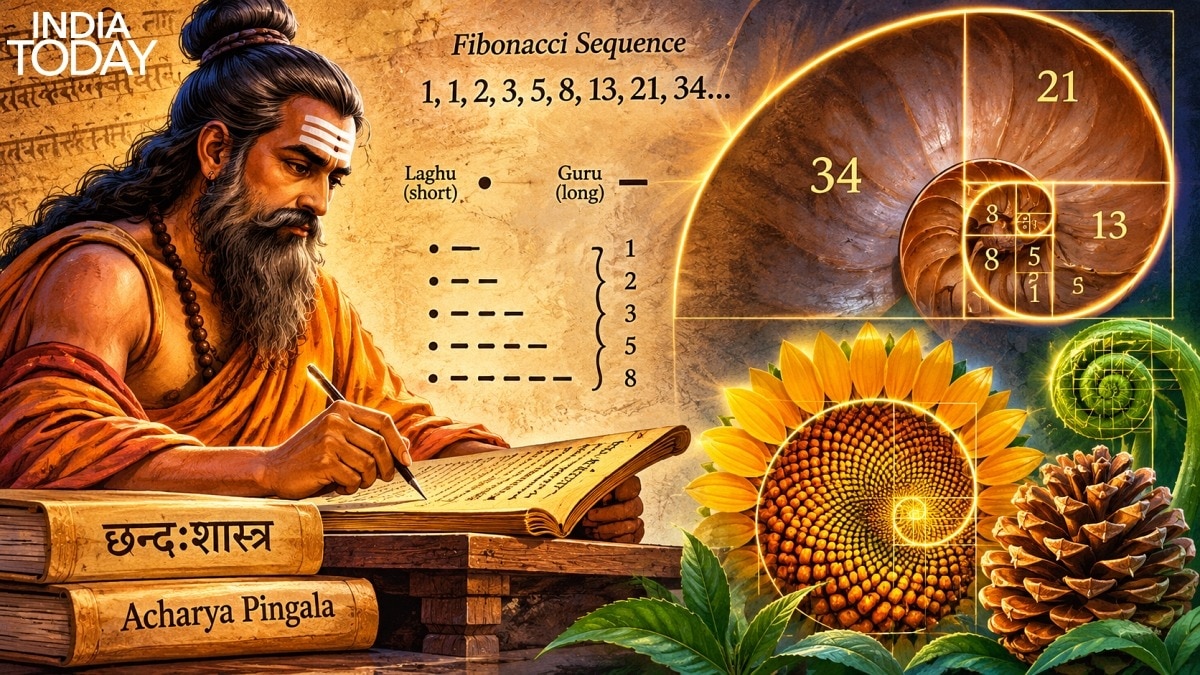
Fibonacci Day on November 23 revisits the sequence's roots in ancient Indian prosody. Sanskrit scholars described its pattern before Fibonacci popularised it in Europe.The Fibonacci sequence appears in nature, mathematics, computing, design and finance. (Photo: Generative AI by India Today)New Delhi,Nov 23, 2026 13:40 ISTNovember 23 is celebrated as Fibonacci Day.The famous mathematical sequence, taught in classrooms across the world, has a fascinating connection to ancient India.Centuries before Italian mathematician Leonardo Fibonacci popularised the numerical pattern in Europe, Indian scholars had already described the same mathematical sequence while studying Sanskrit poetry.The sequence, which begins with 1, 1, 2, 3, 5, 8, 13, 21 and continues infinitely, follows a simple rule: every number is the sum of the two preceding numbers. However, its mathematical roots can be traced to India's ancient traditions of poetry, rhythm and combinatorics. The Fibonacci sequence appears in nature, mathematics, computing, design and finance. In nature, sunflower seeds, pine cones and pineapples often display spiral patterns linked to Fibonacci numbers. Architects and designers sometimes use the sequence’s connection to the golden ratio to create visually balanced compositions.HOW INDIA KNEW IT THREE CENTURIES BEFORE EUROPEOne of the earliest foundations came from Acharya Pingala, an ancient Indian scholar who studied Sanskrit poetic metres. In his work, Chandahshastra, Pingala explored ways of arranging short and long syllables to create different poetic rhythms. Sanskrit poetry uses two basic syllable patterns: Laghu, representing a short syllable, and Guru, representing a long syllable. Mathematicians and scholars began examining how many different combinations of these syllables could fit into a fixed rhythmic duration.The connection became more explicit in the work of Virahanka, an Indian mathematician and prosodist who lived several centuries later. He described a rule for counting combinations of short and long syllables that produces the same numerical pattern now called the Fibonacci sequence.Other Indian scholars, including Gopala and Acharya Hemachandra, further developed this mathematical understanding. Hemachandra, who lived between 1089 and 1172, described the sequence around the middle of the 12th century, several decades before Fibonacci's famous mathematical work.HOW FIBONACCI BECAME FAMOUSLeonardo Fibonacci, an Italian mathematician, introduced the sequence to European mathematical literature through his 1202 book Liber Abaci.He illustrated the numerical pattern through a theoretical problem involving the reproduction of rabbits. By calculating how rabbit pairs would multiply under certain conditions, he arrived at the familiar sequence.His work helped popularise the sequence in Europe, eventually attaching his name to it.However, historical research, including a 1985 paper by mathematician Parmanand Singh published in Historia Mathematica, documented the earlier Indian contributions.While there is no conclusive evidence that Fibonacci directly borrowed the sequence from Indian scholars, the mathematical pattern was clearly described in Indian scholarship before his work.The story highlights how mathematics developed across different civilisations, sometimes through entirely unexpected routes.What is now called the Fibonacci sequence was not just a mathematical curiosity. Its history also reveals how ancient Indian scholars found sophisticated mathematical patterns hidden within the rhythms of poetry.- Ends
This ancient Indian discovered Fibonacci number pattern 300 years before Europe
Full Article
Original Source
Read the full article at Indiatoday →KhanList aggregates and links to publicly available news content. We do not host full articles from third-party sources. Always verify important information with original sources.