
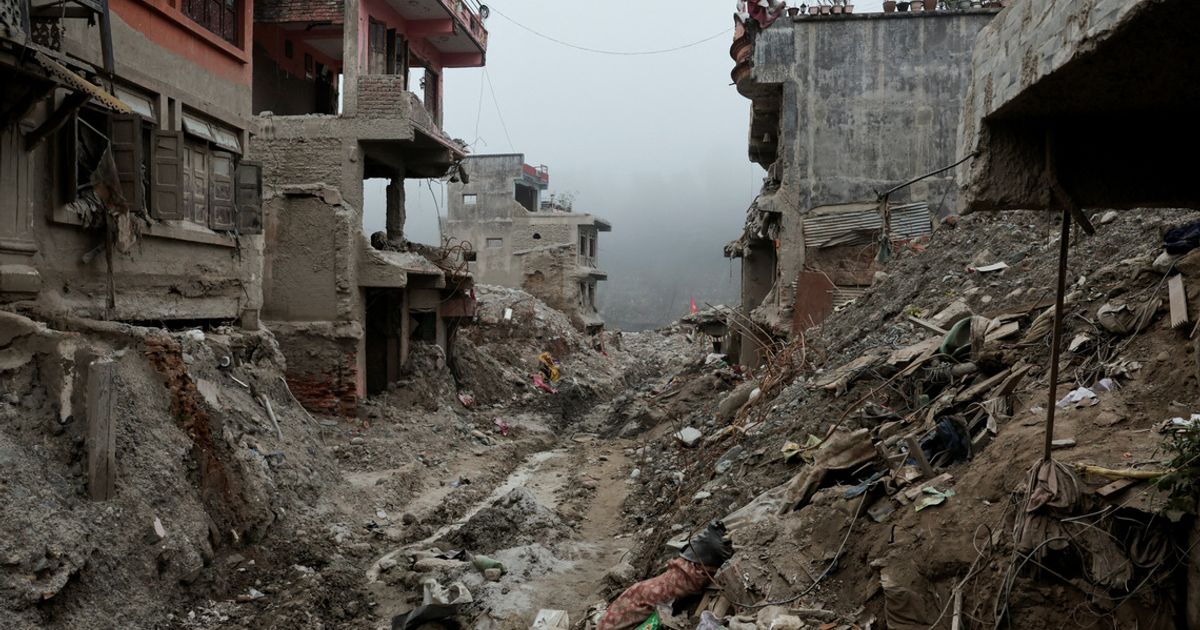
KATHMANDU – Subba Tamang, a resident of Raniswara in Bidur Municipality, Nuwakot, was staying at his elder sister’s home in Bijura, Machchhapokhari, near Trishuli Bazar, when the Aug 26 flash flood tore through the riverside settlement.The swollen Trishuli swept away not only Tamang’s elder sister’s home near Trishuli Bazar and land but also swept away his brother-in-law. The loss of a close relative has left the 40-year-old in deep trauma.“The sight of our brother-in-law swept away by the raging river troubled him deeply,” said Nanu Maiya, Tamang’s other sister, who accompanied him to the hospital.“As his condition worsened, we took him to the hospital’s emergency room.”This was a common refrain among dozens of patients who had reached Trishuli Hospital every day seeking treatment for mental health issues. Hospital officials say the number of people seeking care for anxiety, depression and other mental health conditions has risen sharply in recent months.What particularly concerns doctors is that many of the new patients are survivors of the Aug 26 mud and debris flow caused by glacial collapse in the Langtang Lirung mountain. They continue to grapple with the psychological trauma of losing family members, homes and livelihoods.Compounding their plight, the government’s continued failure to decide on their resettlement has deepened the displaced families’ uncertainty and desperation, according to experts.“Cases of anxiety, depression and other serious mental health conditions have increased at our hospital in recent months,” said Rajendra Lama, the hospital director.“Normally, around 20 to 25 patients with mental health problems seek treatment at our hospital each day. But the number has risen to 35 to 40 these days.”Engaged in masonry, Tamang was the sole breadwinner for his family of six.“He began screaming in panic in the middle of the night, calling others to go and block the river,” said Rajkumar, Tamang’s uncle.“He also started snatching people’s belongings, claiming they belonged to his sister. We took him to the hospital after his behaviour became increasingly disturbing.”Tamang was doing well before the flood and earned enough to provide for his four children and their studies.A 65-year-old woman from Suryagadhi Rural Municipality in Nuwakot was also taken to the hospital after her mental health condition deteriorated.“My mother had a sleep disorder even before the Bhotekoshi flood. Her condition worsened after the disaster,” said Susmita Tamang, her daughter.“Her problems became more severe after our uncle and aunt were swept away by the flood. Hearing the news and witnessing the devastation further aggravated her condition.”Many flood survivors and displaced people interviewed by the Post said they continued to be haunted by the trauma of Aug 26, reliving the horror of the disaster through recurring nightmares and distressing flashbacks even in their sleep.They complained that the federal government’s indecision on the resettlement of displaced people had left the victims frustrated.The government has not even declared missing people dead even after nearly three months of the disaster, which has deprived the victims’ families of getting compensation to perform last rites. Even the state has not yet handed over recovered dead bodies to victims’ families and their DNA reports.A drone view showing houses covered in mud after the flash floods and mudslide at Devighat, Nuwakot district, Nepal, on Aug 29. PHOTO: REUTERSMany victims complained that the government does not even feel the urgency to provide the rental relief the federal government has promised.Frustrated by the federal government’s delay in resettling displaced people, flood victims from Trishuli on Nov 17 occupied Nepal Electricity Authority land in Kolanmi and erected tents there.They said they had been forced to occupy the land as the government had failed to make adequate progress on their rehabilitation, provide financial assistance for funeral expenses of deceased family members, or release the promised rental assistance, even months after the disaster.Many survivors had not sought medical care as others in their families and neighbourhoods reported similar experiences.Ananta Adhikari, a consultant psychiatrist and former director of the Nepal Mental Hospital, recently attended to patients with mental health problems at Trishuli Hospital, two health facilities in Tarakeshwor Municipality, also a flood-affected area in Nuwakot, and Dhunche Hospital, in Rasuwa, where he found symptoms of post-traumatic stress among flood survivors.Post-traumatic stress disorder (PTSD) is a mental health condition that can develop after a person experiences or witnesses a terrifying, shocking or life-threatening event.Doctors say symptoms usually emerge within three months of the traumatic event, although they can sometimes appear years later.People with PTSD may experience flashbacks, reliving the traumatic event as if it were happening again, vivid nightmares and distressing memories of the incident, according to mental health experts.They may also suffer persistent feelings of fear, horror, anger or guilt, become emotionally detached from family and friends, or struggle to experience positive emotions.During the visit to the disaster-hit areas, Adhikari found that some patients had been unable to reach health facilities, while many had gone without medication for extended periods after floods swept away their medicines and doctors’ prescriptions. Several areas also lacked mental health services.Even those living in temporary shelters are growing increasingly frustrated as months have passed without any clear decision on their resettlement. Some victims have already returned to the damaged houses despite knowing that the houses and settlements are not safe to reside in.“The floods have torn families apart, with some losing parents, children, husbands or wives, while others are still searching for missing children. Their homes, ancestral property and lifetime savings have been swept away, leaving them with no certainty about where they will live or how they will earn a living,” said Adhikari.“Many are increasingly anxious about where their next meal will come from and how they will rebuild their lives.”People who once owned property worth millions of Nepalese rupees are now out on the streets, with their futures uncertain. They have lost their livelihoods and income sources, and have no family members left to turn to for support.During his visit to the disaster-hit areas, Adhikari met a woman whose husband, a truck driver, went missing in the floods. She said recurring dreams of her missing husband often kept her awake through the night.“The scale of these losses and the uncertainty surrounding their future have taken a heavy toll on survivors’ mental well-being,” said Adhikari.“It is extremely difficult. Who could remain mentally unaffected in such circumstances?”On Nov 17, 33 patients having mental health issues sought treatment at the hospital’s outpatient care. Among the patients, some have been suffering from post-traumatic stress problems.Doctors at the hospital said that many people with mental health issues are reluctant to seek treatment due to entrenched social stigma.“Patients seek treatment only when their problems become severe,” said Sandesh Upadhyaya, a psychiatric consultant at Trishuli Hospital.“Some patients say they relive the horror of the floods even when they turn on a tap, take a bath or hear the sound of running water.”A drone view of mud-covered properties following a flash flood at Trishuli in Nuwakot district, Nepal, on Aug 26. PHOTO: REUTERSChandra Kumari Khatri, 65, from Bidur Municipality, was admitted to the emergency ward at Trishuli Hospital after developing a fever for a few days. She said she had also been struggling to sleep at night. Her family of eight is currently renting a room in a nearby Angutar.The floods swept away their home, farmland and all their property. Her husband was also diagnosed with fourth-stage lung cancer and is receiving chemotherapy in Kathmandu. Each session costs around 100,000 Nepalese rupees (S$873). He has already had 21 sessions.“It is time to harvest the paddy, but we no longer have any farmland. My eldest son used to support the family by working on farms in the village, but he too has been left unemployed after the floods destroyed everything,” she complained.“Our lives have become extremely difficult. I never imagined that I would have to witness and endure such hardships at this stage of my life.”Many survivors did not celebrate festivals in 2026.Experts say mental health requires a holistic approach. Delays in resettling displaced people can lead to frustration and despair, even among those who initially appear to be coping well.“The disaster was so massive that hardly anyone in the affected areas remained untouched. People come to terms with their losses at different paces. Some accept them relatively quickly, while others take longer, and some find it extremely difficult to accept,” said senior psychiatrist Kapil Upadhyaya.“The longer the state delays providing assistance and carrying out rehabilitation, the more the problem will worsen.”Experts say resettlement efforts must be expedited. Children who have dropped out of school should be helped to return; those who have lost their homes should be provided land; families should receive support to rebuild their houses; people who have lost their businesses should be helped to restart them, and employment opportunities should be created.“Flood victims have become increasingly frustrated. In extreme cases, this frustration could even lead to suicide,” he said.“The government must pay attention to this issue in a timely manner. Flood victims must be rehabilitated at the earliest.” THE KATHMANDU POST/ASIA NEWS NETWORK
Months after flood devastated families in Nepal, survivors live in trauma
Full Article
Original Source
Read the full article at Straitstimes →KhanList aggregates and links to publicly available news content. We do not host full articles from third-party sources. Always verify important information with original sources.