
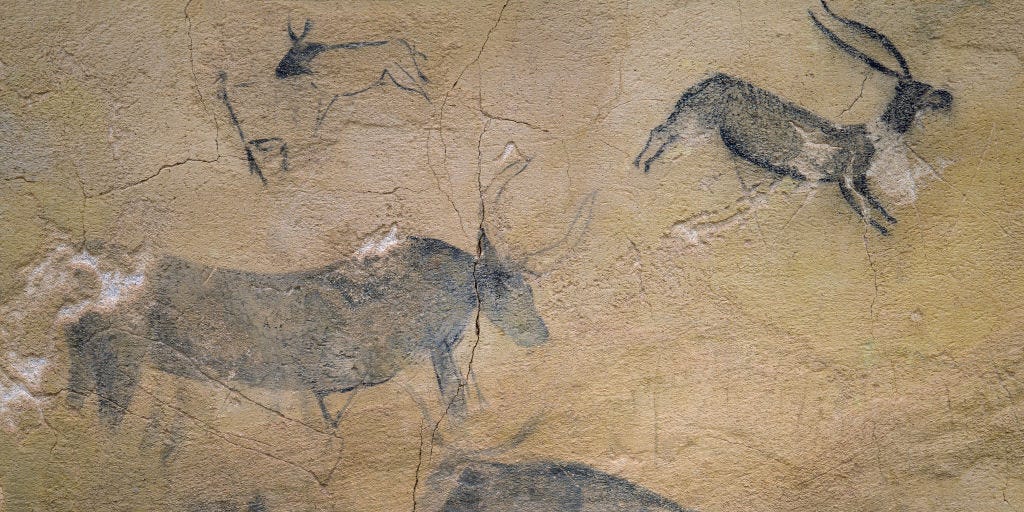
3 min readKnown for its ancient artifacts, the Catalonian village of Espluga de Francolí has been one of the most recognized troves of Paleolithic cave finds in Spain. Even the “Espluga” in its name translates to “cave.” The village is surrounded by mountains with limestone caves or covas whose human history reaches back thousands of years, and while Cova de la Font Major has been a tourist attraction since 1957, something that almost should have been obvious went unseen.Cova de la Font Major had already been investigated by archaeologists by the time it was converted into a museum in 1993. By then, it was thought that the cave had been thoroughly scoured for artifacts and other evidence that it was inhabited, and that its irregular walls had been unsuitable for cave art because of their uneven coloration and texture. Part of what became known as its Adventure Route is the Gatoneres de cal Palletes, a series of smaller galleries branching off from the main gallery. Visitors filed past for decades, never noticing the engravings concealed in the dark. Cut into the pale limestone were animals and abstract symbols, each one made by human hands.Part of the reason that these drawings had never been observed is that they have to be illuminated from certain angles in order to be visible. An archaeological team led by Josep Maria Vergès and Míriam Salas-Altès of the Catalan Institute of Human Paleocecology and Evolution (IPHES-CERCA) identified 280 motifs scratched into the soft rock, which now make up the highest known concentration of Paleolithic figures found on a cave wall in Catalonia. It’s also the third largest cave art assemblage on the eastern Iberian Peninsula. It was unexpectedly discovered during a 2019 excavation campaign, although it was obscured by modern graffiti left behind by tourists and others who’ve visited the site since explorers first crept in through the well of a townhouse courtyard in 1853. It also seems that the art incorporated stone variations.“While the intentional integration of these natural features remains interpretative and cannot be definitively demonstrated, their proposed use is supported by precise anatomical alignment with some features and the recurrent use of similar elements across the corpus,” Vergès and Salas-Altès said in a study recently published in Antiquity. Some of the animal figures, including horses, deer, goats, and aurochs, appear to trot along the seams between different types of rock. They share the walls with abstract motifs, which make up most of the cave art. Researchers also documented parallel lines, some of them cut across the animals, as well as convergent lines and tangles of loops. The meanings of these symbols can only be guessed at, and so can their age. Direct dating of material from Cova de la Font Major is difficult, though the team thinks uranium dating may work on calcite deposits that formed over at least one figure. Even then, a date for one drawing won’t necessarily reveal the age of the others. For now, the closest anchor comes from radiocarbon dating, which places the cave’s earliest Neolithic occupations between 7,050 and 7,400 years ago.The cave was also used for late Neolithic burials on the cusp of the Bronze Age. Right before it was opened to the public in 1957, archaeologists unearthed a human femur that was radiocarbon dated to 5,600–5,700 years old. Also found near the entrance was a hoard of later Bronze Age artifacts that included pins decorated with sun imagery, an axe, a dagger, and fragments of a blade that could have been a dagger or sword. Deeper in the cave, charcoal dated to 26,000 years ago may be the oldest sign of human presence, aided by similar charcoal discovered near the prehistoric shrine known as Sala del Llac and in other spots inside the cave. Much later, in the Iron Age, people used another part of the cave for rituals. They left behind ceramic vessels that may have been offerings to deities, along with metal artifacts and food remnants.“[This discovery is] a substantial advance in the understanding of Paleolithic rock art in the eastern Iberian Peninsula,” the researchers said. “Gaps in the Paleolithic record may reflect limitations in research strategies, visibility conditions or preservation factors, rather than the actual absence of rock art practices.”Elizabeth Rayne is a creature who writes. Her work has appeared in Popular Mechanics, Ars Technica, SYFY WIRE, Space.com, Live Science, Den of Geek, Forbidden Futures and Collective Tales. She lurks right outside New York City with her parrot, Lestat. When not writing, she can be found drawing, playing the piano or shapeshifting.
These 7,400-Year-Old Cave Drawings Were Hiding in Plain Sight for Decades. They’re Finally Getting Their Due.
Full Article
Original Source
Read the full article at Popularmechanics →KhanList aggregates and links to publicly available news content. We do not host full articles from third-party sources. Always verify important information with original sources.