
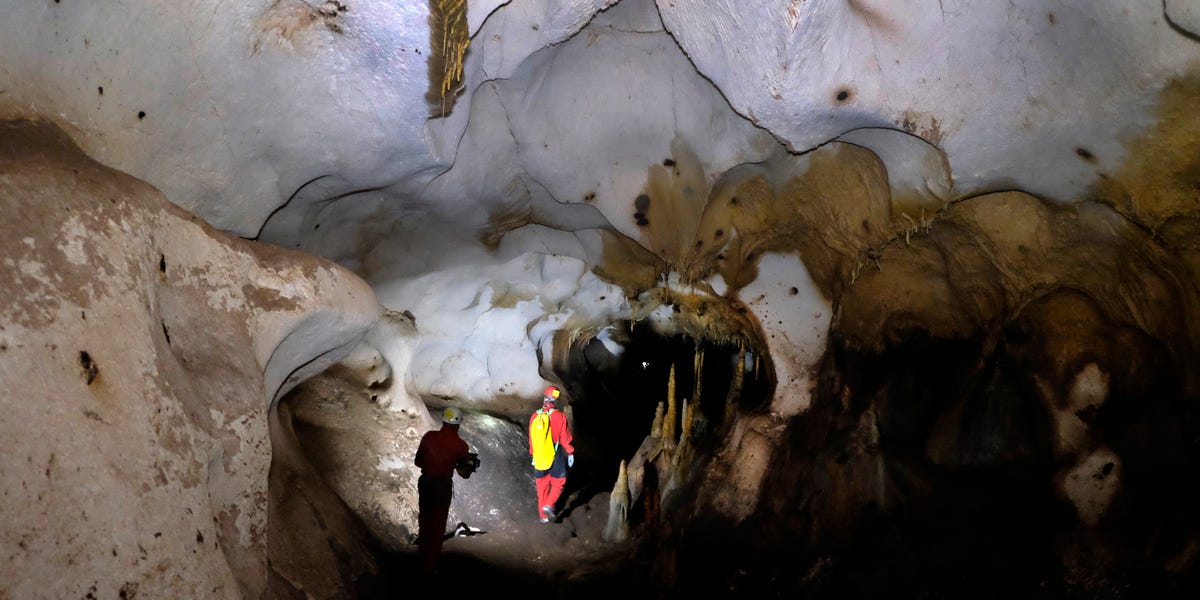
Southern Italy’s Apulia region gained a measure of fame in 1966, when archaeologists discovered bone figurines dating to at least 18,000 years ago tucked inside the Cave of Venuses. Now, experts believe the cave may hold new archaeological surprises after detecting what could be additional cavities, spaces that have gone unexplored and unknown for untold millennia.According to a study published in the journal Digital Applications in Archaeology and Cultural Heritage, researchers conducted a geophysical survey at the site in Parabita, in the heel of Italy’s boot. Using ground-penetrating radar and electrical resistivity tomography, they identified a series of anomalies that they interpreted as cavities.“The results are surprising and show different areas with the presence of cavities in the vicinity of the same cave,” the authors wrote. “Results show a probable unexplored zone of the cave.”The cave first burst onto the archaeological scene in 1966, when experts announced the discovery of two figurines inside it. The figurines measure 3.5 inches and 2.3 inches long and were carved from either cow or horse bone. Both are classified as Venus figurines, which depict a female figure and likely celebrate pregnancy. They resemble others found throughout Europe, including the famed Venus of Willendorf in Austria. Their age of at least 18,000 years places the Italian find well within a glacial period of the Upper Paleolithic.That discovery confirmed the presence of Paleolithic humans at the site and led to further excavations in 1968, which revealed stone tools, decorated bones, and remains from the Neolithic and the Metal Ages. Together with a burial of a man and a woman dated to around 28,000 years ago, these finds showed that people used the cave over a very long period.Ironically, the fame of the ’66 finds indirectly led to the latest discovery. Teams from the University of Malta and the Institute of Heritage Science of Italy’s National Research Council conducted the surveys ahead of a project to turn the site into a tourist attraction. Before that project could move forward, contractors needed to know how strong the limestone was throughout the area.To find out, the researchers used two complementary techniques. Ground-penetrating radar, which works somewhat like sonar, sends pulses of radio waves into the ground. Depending on the material the waves hit, such as solid rock or empty space, different patterns reflect back to the instrument. Electrical resistivity tomography serves a similar purpose: it sends an electrical current through the ground and measures how easily the current travels. Using the two technologies together helps researchers cross-check results and reduce false readings.“The geophysical data confirm that there are actually a series of cavities—not known until now—that could be connected to the main cave,” the authors wrote. “The resulting model provides the necessary parameters—depth and volumes—for the design of a series of direct investigations by archaeologists.”So far, archaeologists haven’t dug into the ground to inspect the anomalies directly, but the voids in separate areas around the known cave could be additional cave passages. However, the data could also reflect heavily fractured rock, which would be a weak point in the cave rather than a new cavity. Even that would be valuable information for crews planning the tourist attraction.Next, experts hope to excavate and explore the previously undocumented cavities. These could connect the Cave of Venuses to additional chambers and possibly yield new evidence of southern Italy’s prehistoric past.Tim Newcomb is a journalist based in the Pacific Northwest. He covers stadiums, sneakers, gear, infrastructure, and more for a variety of publications, including Popular Mechanics. His favorite interviews have included sit-downs with Roger Federer in Switzerland, Kobe Bryant in Los Angeles, and Tinker Hatfield in Portland.
A Massive Cave Held Sculptures From 18,000 Years Ago. It Might Be Hiding Secret Chambers, Too.
Full Article
Original Source
Read the full article at Popularmechanics →KhanList aggregates and links to publicly available news content. We do not host full articles from third-party sources. Always verify important information with original sources.