
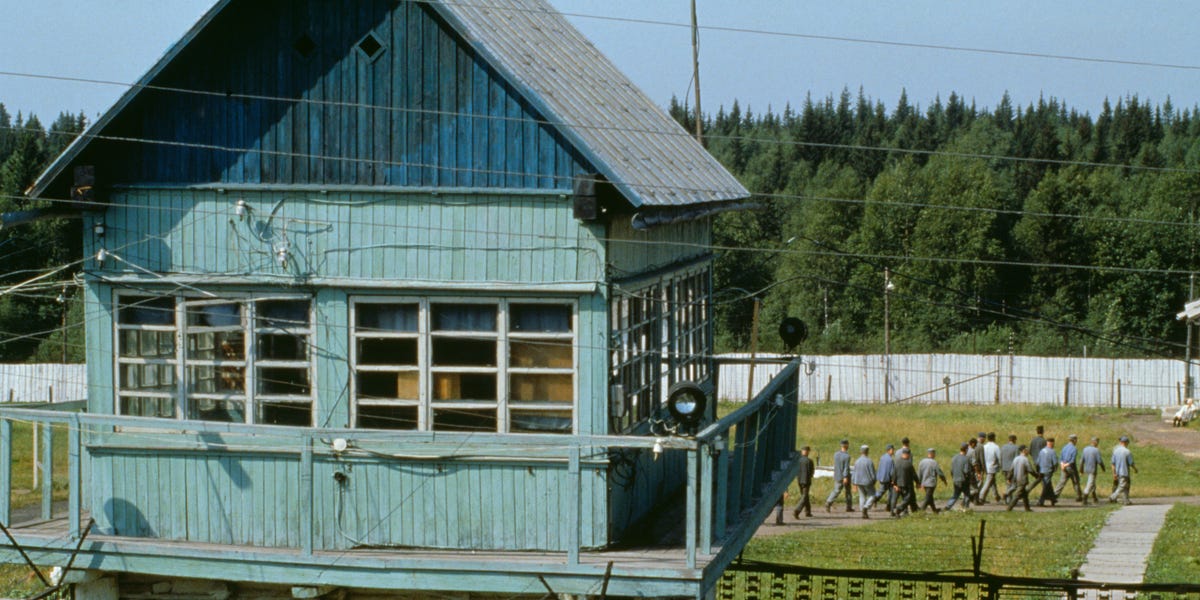
4 min readBetween the 1930s and the 1950s, the Soviet Union imprisoned millions of people in the Gulag, a vast network of forced-labor camps where political prisoners and other perceived enemies of the state were worked, starved, and often killed. The Soviet officials who ran it kept careful records, but those records tell only the version of events the captors wanted told. According to those files, Steplag, a Gulag camp complex in central Kazakhstan, operated from 1948 to 1956. But a new archaeological excavation at one of Steplag’s former camps, combined with a local eyewitness’ memories, suggests that at least one camp’s story didn’t end when the paperwork said it did.Archaeologists from the University of West Bohemia in Pilsen, Czech Republic, worked with Gulag.cz, a nonprofit that has studied Gulag history since 2009. Together they gained official access to a former Steplag camp mainly used for political prisoners in the village of Terekty, near Zhezkazgan in Kazakhstan. What they found tells a brutal story.“We have found the remains of a women’s camp, a men’s camp with archaeological artifacts as well as standing structures, an entire settlement for guards, and a command headquarters, which was later occupied by people from a nearby village that has since disappeared,” said Pavel Vareka, the university’s lead archaeologist, in a translated statement. “The remains of an economic zone have also survived, where imprisoned men and women were forced to perform slave labor, as well as a forgotten cemetery for the victims.”The teams documented the remains of the camp, which likely held more than 20,000 prisoners from Ukraine, the Baltic states, and other countries, including more than 20 Czechs.Stepan Cernousek, chairman of Gulag.cz, said that the official records show camp operations ending in 1956, but that date doesn’t match the archaeological evidence or the eyewitness account. “It appears that although Steplag itself was abolished, with its camp administration being eliminated in Moscow with the stroke of a pen, that did not mean that the camp actually ended,” he told Radio Prague International. “This camp, where the women were held, continued to operate. There were guards and prisoners, but it apparently came under a different structure.”In other words, Moscow officially dissolved Steplag in 1956, but some camps may not have released all their prisoners. According to Cernousek, the Moscow archives leave this out because the captors were the ones writing the reports.Physical evidence supports his view. The excavation uncovered glass bottles dating from 1959 to 1961. That matches the account of Terekty’s oldest resident, 78-year-old Mizambai Bralin, who moved to the village in 1959 and remembers the women’s camp still full of prisoners. The excavators also found spent cartridges at the base of the guard towers. “They kept those women there like animals,” Bralin said in a statement. “I cannot imagine how any man could ever shoot a woman.”Cernousek said Bralin’s testimony was essential. “Many things fell into place,” he said of their conversation. “Without him, we probably would not have answers to 90 percent of the questions—we would only have guesses.”Cernousek founded Gulag.cz to understand the history of the Soviet Gulag system and its impact on former Soviet satellite states. The group once did research in Siberia but can no longer travel to Russia. Kazakhstan, which had at least 20 camp complexes, has since opened its doors to researchers. The group’s work with the university archaeologists is the first archaeological research of its kind at a Gulag camp in Kazakhstan.Because archaeology can rewrite Gulag history in ways that archives can’t, Cernousek stressed the importance of exploring the former camps where the Gulag system imprisoned millions of people and forced them into labor. “The lives and horrors took place right there, on the site, in the steppe,” he said. “People spent months and years there in captivity, so that memory has somehow remained embedded in the ground and among the local inhabitants. It is important to go to these places, rather than relying only on archives in Moscow or Kyiv.”To rebuild the camp’s layout while preserving what remains, the team used drone surveys, surface documentation, metal detection, and limited excavation. The research also addresses a broader question. “Because it is said that the Czechoslovak communist camps were essentially copies of the Soviet Gulag, archaeologists are asking to what extent this is actually true,” Cernousek said. He added that the camps appear to have varied a lot in their appearance, building materials, and layout. Still, much was the same, including three layers of barbed-wire fencing, guard towers, solitary confinement cells, and some of the same everyday equipment.“Of course, the regime imposed on the prisoners was also the same,” he said.This first exploration in central Kazakhstan is helping write a new record of the Soviet Gulag camps, and it comes at a critical time. “Putin’s regime is trying to erase the history of the Gulag and Soviet repression from public memory and public space, while at the same time defending many Soviet crimes,” Cernousek said. “Kazakhstan is becoming increasingly open to this kind of research, and we are encountering a great deal of support and understanding here.”Tim Newcomb is a journalist based in the Pacific Northwest. He covers stadiums, sneakers, gear, infrastructure, and more for a variety of publications, including Popular Mechanics. His favorite interviews have included sit-downs with Roger Federer in Switzerland, Kobe Bryant in Los Angeles, and Tinker Hatfield in Portland.
An Excavation at a Soviet Gulag Camp Just Discovered What Russia Didn’t Want the World To Know
Full Article
Original Source
Read the full article at Popularmechanics →KhanList aggregates and links to publicly available news content. We do not host full articles from third-party sources. Always verify important information with original sources.