
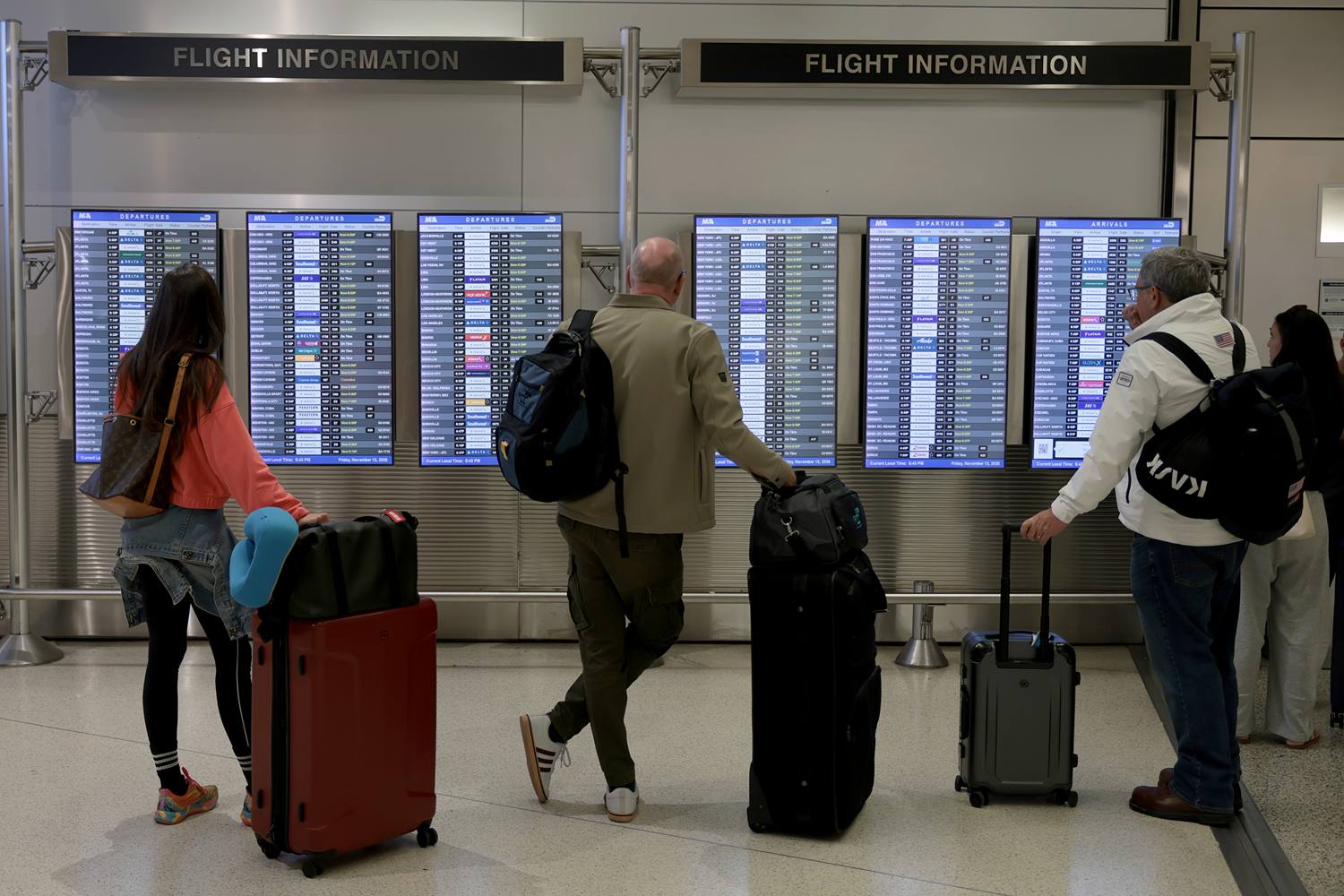
A wave of tech outages in the U.S. federal government and private sector over the past week have made a lot of people understandably nervous. The outages affected commercial air travel, email, banking, and more—in some cases causing disruptions worldwide. A global Microsoft outage that began last Thursday derailed a number of services that businesses, schools, and governments rely on. Then the U.S. Federal Aviation Administration (FAA) issued a rare nationwide ground stop on Friday leading to widespread flight cancellations and delays. Chase Bank, Bank of America, and Apple services also faced brief disruptions in recent days. And on Tuesday, some internal systems at the U.S. National Security Agency (NSA) went down. A wave of tech outages in the U.S. federal government and private sector over the past week have made a lot of people understandably nervous. The outages affected commercial air travel, email, banking, and more—in some cases causing disruptions worldwide. A global Microsoft outage that began last Thursday derailed a number of services that businesses, schools, and governments rely on. Then the U.S. Federal Aviation Administration (FAA) issued a rare nationwide ground stop on Friday leading to widespread flight cancellations and delays. Chase Bank, Bank of America, and Apple services also faced brief disruptions in recent days. And on Tuesday, some internal systems at the U.S. National Security Agency (NSA) went down. Given the outages occurred on such a massive scale and in quick succession, questions have been raised as to whether they were a result of nefarious activities. But there is currently no evidence that the recent incidents were due to cyberattacks or that they were linked. The Microsoft outage was the result of a combination of factors, including a “latent bug” from July that caused servers to become “overwhelmed and unresponsive,” Charles Lamanna, Microsoft’s executive vice president of Copilot, agents, and platform, said in a post on X. Lamanna said a “surge in load” and decreased server capacity had also contributed to the outage. The FAA is still assessing what led to the ground stop, which lasted less than five hours, but a preliminary investigation indicated that the technical problem was caused by the installation of a router at a radio facility in Arkansas that may have flooded its communications network. A radar site in Amarillo, Texas, is also being looked at as part of the inquiry. The short-lived Chase Bank outage on Monday, which led to issues with processing transactions and seemingly had a ripple effect that caused problems for customers at other banks, was the result of a “software bug in on-premise hardware systems,” the bank said in a post on X, adding that “there is no evidence this is cyber-related.” Apple said the outage it experienced on Tuesday, which lasted hours and disrupted the Apple Store and other services, was the result of an “internal update” and not due to a cyberattack. The NSA disruption, which reportedly caused the agency’s internal communications network for highly classified information, NSANet, to go offline, had a similarly prosaic cause. “The National Security Agency experienced temporary degradation during scheduled routine maintenance,” the agency said in a statement. “While some internal systems were affected, mission-critical capabilities remain fully operational and our ability to defend national security continues. NSA’s infrastructure is designed with multiple layers of redundancy to maintain operations during planned maintenance or unexpected events.” The Trump administration has acknowledged the unease the outages have caused among the public while emphasizing that there are currently no indications that any were tied to a cyberattack or coordinated by outside actors. “I understand the timing of these incidents can raise questions, and it should. The American people should ask us these questions,” Director of National Intelligence Jay Clayton told the House Homeland Security Committee on Wednesday. “But based on what we know today, after a great deal of digital diligence, these are separate service outages associated with maintenance and technical changes. They are not a coordinated or state-sponsored attack.” Secretary of State Marco Rubio on Tuesday recognized that people are “fearful” and “uncertain,” but he was unequivocal: “We are not under systemic attack,” he said. “These events—one has nothing to do with the other. They are not interrelated.” But it makes sense that people are on edge about technology and how its dominance over modern life can make societies vulnerable. All of these incidents came on the heels of a series of suspected cyberattacks on supermarket freezers in Europe that caused millions of dollars in damage. They’ve also come at a time when anxiety over the rapid development of artificial intelligence has reached a fever pitch. It doesn’t help that these outages hit as the increasingly symbiotic relationship between AI and the stock market was on many people’s minds amid the chaos swirling around Nvidia—following a salacious scandal that led to the resignation of the tech giant’s co-founder and CEO, Jensen Huang. And national security and tech experts say AI may be partly to blame for these disruptions—though not in the way you might think. AI tools are increasingly helping organizations to identify vulnerabilities in their computer systems. That’s mostly a good thing because those flaws can then be fixed before any potential bad actors can exploit them. But those fixes don’t always go smoothly. “AI code scanning has caused a tidal wave of vulnerability discovery,” and companies and government agencies are “rushing to make updates and fix” those vulnerabilities, David Agranovich, a director for intelligence on the National Security Council during the first Trump administration, said in a post on X. “[E]specially with legacy infrastructure, it can be incredibly hard to predict all of the different dependencies that might break because of those patches. The pace of manual patching has a cost, and that cost is reliability,” Agranovich added. “The result is many cascading and disparate system outages.” Democratic Sen. Mark Warner, the vice chairman of the Senate Intelligence Committee and a co-chair of the Senate Cybersecurity Caucus, offered a similar assessment. Warner said in a statement on Tuesday that he understood why Americans were so concerned about the widespread outages and underscored that there is “no indication that these incidents are the result of a cyberattack, foreign interference, or some coordinated effort.” But he added that what appears to be happening is a “consequence of how quickly artificial intelligence is changing the cybersecurity landscape.” AI has opened the door to “identify vulnerabilities across enormous numbers of systems at unprecedented speed, creating enormous pressure on companies and government agencies to patch those vulnerabilities immediately, often all at once, putting tremendous strain on systems that weren’t built to handle that pace of change,” Warner said. The recent disruptions should serve as a “wake-up call” on the ways in which AI is “moving faster than our ability to manage its consequences,” Warner said, reiterating his call for “commonsense guardrails on AI and stronger cybersecurity protections.”
The U.S. Tech Outage Wave, Explained
Full Article
Original Source
Read the full article at Foreignpolicy →KhanList aggregates and links to publicly available news content. We do not host full articles from third-party sources. Always verify important information with original sources.