
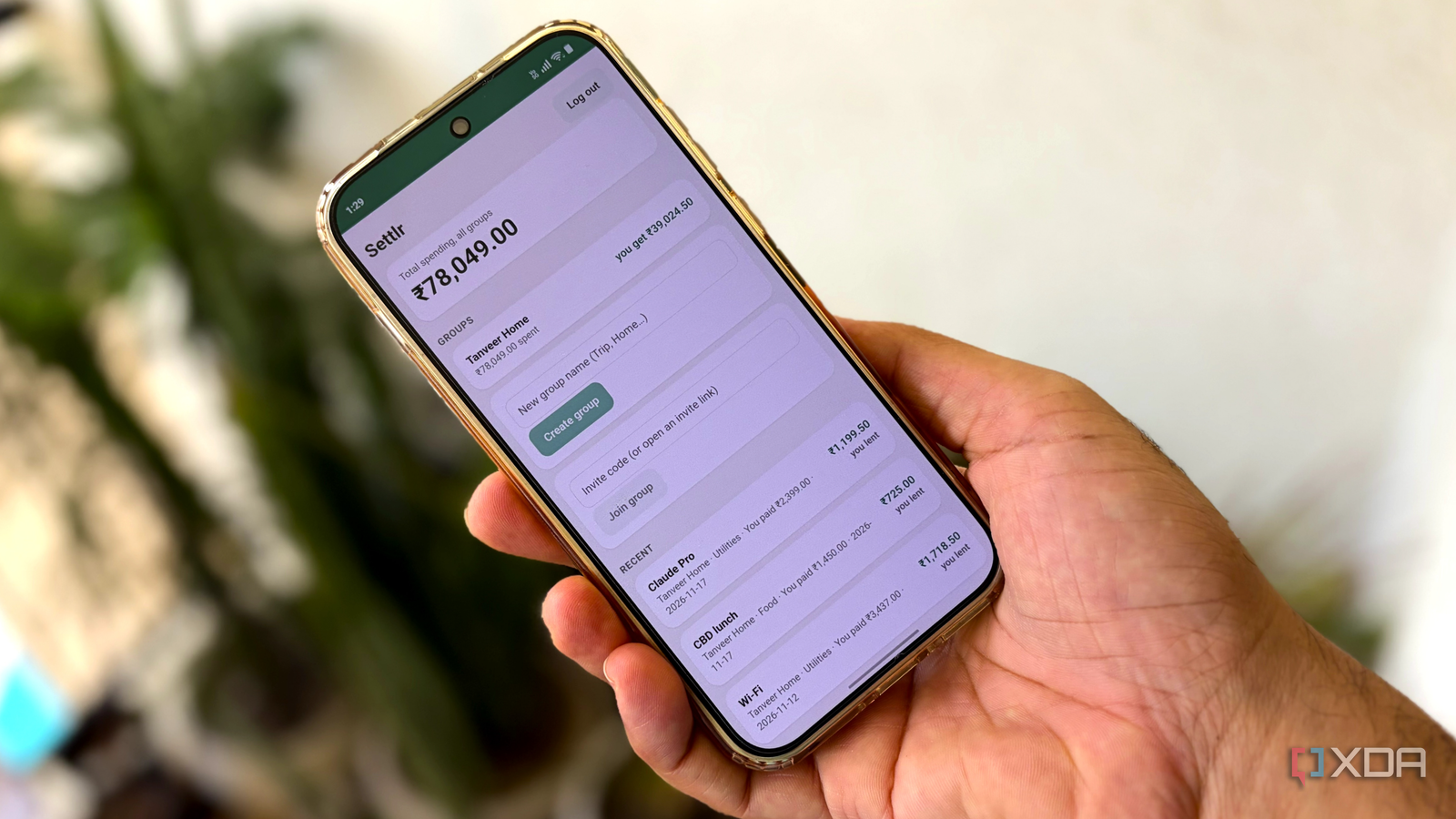
Published Nov 18, 2026, 5:30 PM EST After a 7-year corporate stint, Tanveer found his love for writing and tech too much to resist. An MBA in Marketing and the owner of a PC building business, he writes on PC hardware, technology, and Windows. When not scouring the web for ideas, he can be found building PCs, watching anime, or playing Smash Karts on his RTX 3080 (sigh). I'm always looking for free and open-source alternatives on my PC and smartphone. Whether it's bypassing ads on YouTube's TV app, editing videos on my PC, or saving passwords on my phone, I've managed to avoid subscriptions entirely. Well, except for one app that I've been using for almost a decade: Splitwise. For a few years, its free tier was enough, but as I started living with my partner, I had to pay for the $5/month subscription just so I could add household transactions without running into daily limits . With the recent wave of vibe-coded apps taking over, I decided to create a Splitwise replacement that did just enough so I could cancel my subscription. And the good news is that I was able to create it in under 30 minutes with Claude. It's a little rough around the edges right now, but I reckon one or two revisions are all I need to make it a full Splitwise clone. I wanted to cancel my expense-tracking subscription Even tiny subscriptions add up over time Unlike every other app on my phone, I have been paying for Splitwise for the past two years. There's just no way around it if you want to use it to manage all your shared expenses between a couple and a small circle of friends. The free tier is so frustrating with its limit of 3–4 transactions a day. Since we had been using it for the better part of a decade, paying $5 a month for Splitwise Pro didn't feel like a big deal. That said, the costs tend to add up over the course of two years. So, when I noticed everyone vibe-coding their way to free alternatives for almost everything, I decided to try the same for Splitwise. After all, I had used Claude more than a few times to reduce my game backlog and manage my Instagram saved post dump. However, I've never paid for a Claude subscription, and I didn't want to change that anytime soon. I had to manage my vibe-coding project within the constraints of the free tier. Vibe-coding a Splitwise replacement was fast but slightly involved I was still able to finish the setup in under 30 minutes To ensure I didn't run out of my free Claude usage, I used ChatGPT (again, free tier) to get the initial prompt that I would feed into Claude. I listed the features I needed in my vibe-coded app, and asked it to generate a detailed prompt for Claude. I also mentioned that I wanted minimal credit usage on Claude, so the prompt included instructions about not over-engineering the app and using contextual expense categorization instead of AI APIs. With my prompt ready, I started my Claude project. It took around 10 minutes to return a zipped folder with Supabase files, some JSON files, and a config file. Claude used React, TypeScript, and Supabase (an open-source Firebase alternative) to build a progressive web app that I could install just like any other app. Claude's 5-step guide to setting up everything took me around 15–20 minutes, so the overall project time was just under half an hour. Uploading the files on GitHub, linking the repo to Vercel for automated deployment, and adding the API keys to Supabase was straightforward. My focus was less on visual flair and rather on getting the functionality right. I also didn't want Claude to run out of messages in the middle of generating the app. I just needed an app that could replace my Splitwise subscription. Settlr is the Splitwise clone I'm using now That "settles" it for now I was delighted to see the Settlr app (as I named it) on my phone's home screen after installing it from the Vercel link. I had already turned off email authentication to make the sign-up faster, so my partner and I were able to get in simply by adding an email and creating a password. The app looked pretty basic, but it seemed to have everything I needed. Adding unlimited transactions, syncing group expenses between multiple users, simplifying debts, intelligent categorization, searching expenses, and using graphs for analysis and trends — almost every feature I used on Splitwise Pro was there on my vibe-coded alternative. I can tweak the app to get tabs at the bottom and improve the UI, but the backend is fairly robust already. The free tiers of Supabase and Vercel have usage limits, but a couple and a few friends adding daily transactions will never exceed them. While Supabase doesn't take automatic backups on the free plan, I can add an Export to CSV button to download my data once a month. I also need to add a feature that allows importing expenses from Splitwise, so that I can permanently move to Settlr. While vibe-coded apps do face hiccups every now and then, maintaining them is far easier than paying a recurring subscription for essentially the same functionality. I might finally start vibe-coding regularly Most of the friction surrounding AI adoption lies in the setup, and once you've gotten past it, you can finally start seeing the possibilities. After creating an AI-coded alternative to a paid app, I feel I should start tackling more real-world problems in our household, such as overhauling our Android TV interface. Claude is an AI assistant and LLM developed by Anthropic.
I vibe-coded a replacement for the only paid app on my phone, and I'm never paying $5 a month again
Full Article
Original Source
Read the full article at Xda-developers →KhanList aggregates and links to publicly available news content. We do not host full articles from third-party sources. Always verify important information with original sources.