
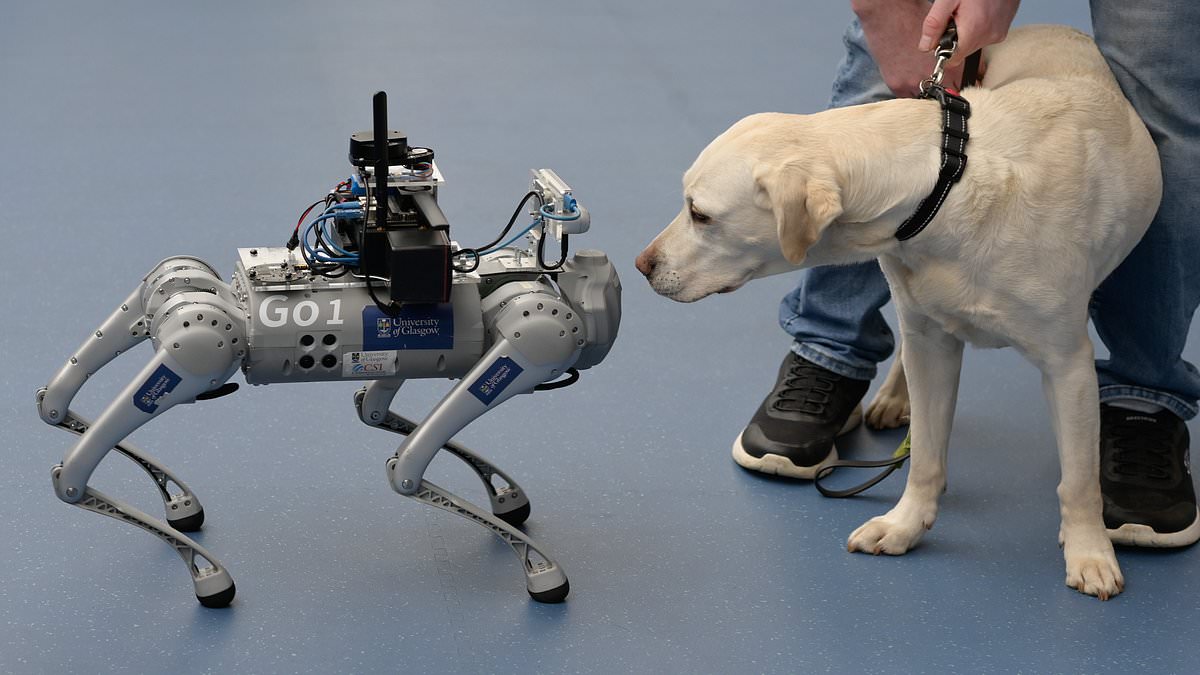
READ MORE: Hidden gem towns where Americans can snap up homes for less than 120K Updated: 11:57 EDT, 28 October 2026 A San Francisco start-up is offering people $20 an hour to walk robot dogs around the neighborhood – but the job comes with an unusual catch.Dimensional advertised the gig in a now-deleted post to the 'Bay Area Jobs' Facebook group on October 5, The New York Times reported.The start-up, ironically located in San Francisco's Dogpatch neighborhood, offered paid training for the gig workers, who would operate the four-legged robots on outdoor testing routes around the city for four to six hours.Applicants also needed to be comfortable carrying the 33-pound robot dog in the event it overheated and shut down.The company's founder, Stash Pomichter, said the goal was to improve the robots' ability to navigate urban environments autonomously.During the walks, workers would steer the robot dogs while their cameras and sensors record data about the journey, helping the company train its machines to navigate real-world environments.Dimensional hopes to equip its robots with AI agents that would allow consumers to give them instructions to carry out physical tasks, such as picking up heavy boxes and hauling items around.The start-up is developing an open-source operating system called dimOS, designed to let AI agents control different types of robots through natural-language instructions.Dimensional advertised $20 an hour to walk robot dogs around San Francisco between four and six hoursPomichter, 26, told The Times that he viewed it as 'barbaric' that humans were still performing repetitive physical labor that robots could eventually take over.But getting machines to perform those tasks reliably without human intervention remains a challenge.Research from AI company Anthropic found that language models paired with trained robotic controllers performed worse on certain simulated object-handling tasks than the controllers did on their own, highlighting how adding AI does not necessarily make robots better at carrying out physical work.Dimensional does not manufacture its own robots, instead buying hardware from US, Chinese and German companies. The start-up has purchased 100 robot dogs and 50 humanoid robots to support its experiments.The robot dogs used in the walking job advert were bought from Chinese manufacturer Unitree for around $2,000 each. They can be operated using a handheld remote or mobile app.But Dimensional's latest experiment showed just how far the technology still has to go before it can work independently as the company hopes.The start-up compared the dogs' performance under human control with how they fared when operated by an AI agent, finding that the AI struggled to control the machines effectively.'What we determined from our dog-walking experiment was that agents are still very bad at controlling hardware,' Pomichter told The New York Times. 'And humans are still needed in the loop.' The company's founder, Stash Pomichter, told The Times that the goal of the side gig is to improve the robots' ability to navigate urban environments autonomouslyDimensional ultimately wants its robots to work in factories, data centers and construction sites, as well as carry out security patrols.One example of this model is already operating at an apartment complex in Atlanta, where a robot dog patrols the grounds while a human operator based in the Philippines monitors it remotely. The machine effectively acts as a mobile security camera for its human counterpart.Pomichter has also programmed a robot dog to patrol Dimensional's warehouse-style office at night. He said he gave it the instruction: 'You are the world's best security dog,' and told it to follow anyone entering the building after midnight.If the robot spots someone, it sends Pomichter a text alert, allowing him to check security camera footage and determine whether the person is an employee working late or an intruder.
The robot dog-pocalypse: San Francisco start-up is paying gig workers $20 an hour to walk robot canines for 'training'
Full Article
Original Source
Read the full article at Dailymail →KhanList aggregates and links to publicly available news content. We do not host full articles from third-party sources. Always verify important information with original sources.