
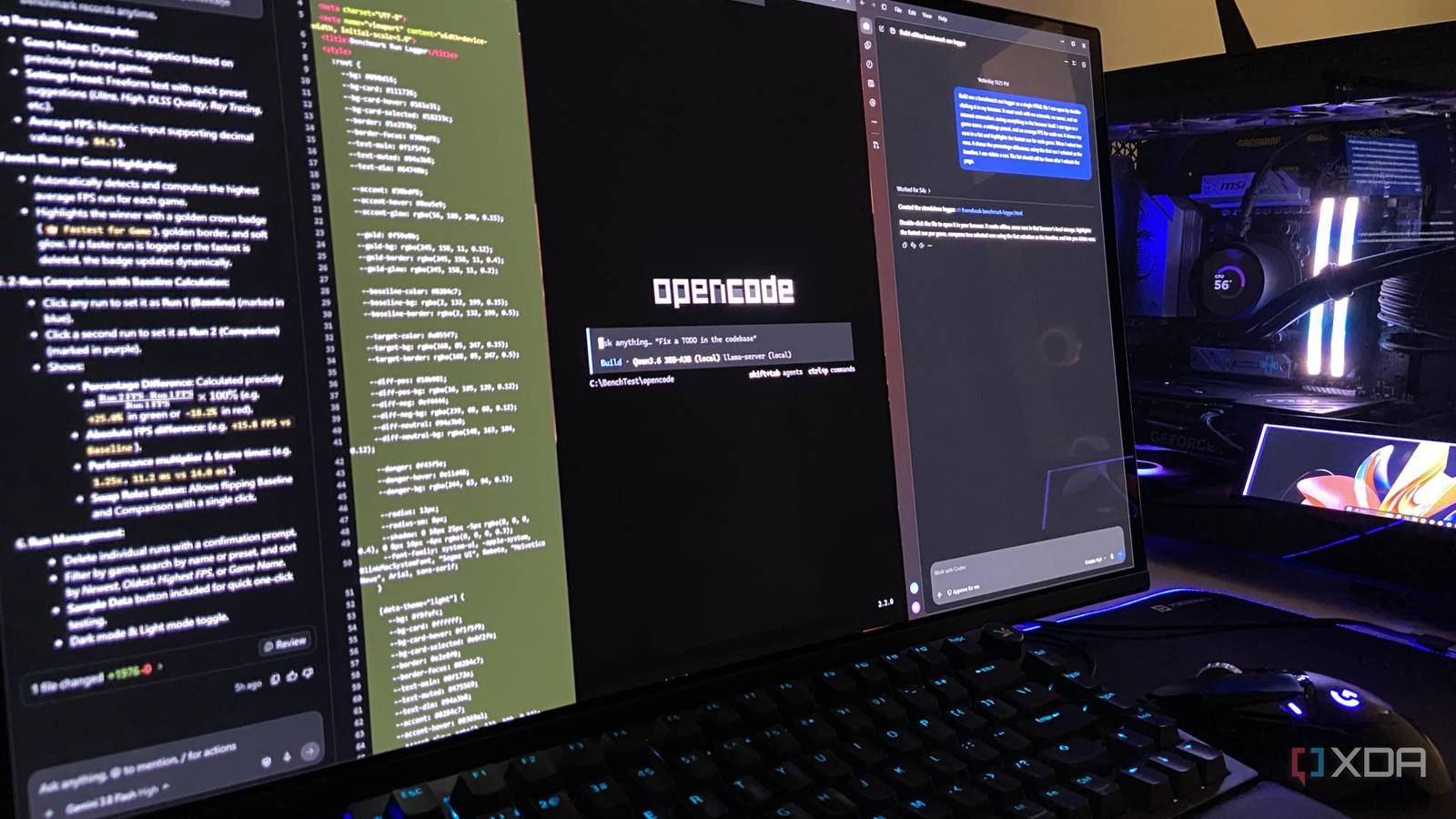
Published Oct 28, 2026, 7:00 PM EDT Abhinav pivoted from a career in banking to pursue his first love in writing. Even while working full-time, he continued contributing as an editor-at-large, a role he has held for more than 7 years. A lifelong tech enthusiast who has built three gaming and productivity powerhouse PCs since 2018, his passion for technology keeps him closely following the semiconductor industry, from NVIDIA and AMD to ARM. His MSc dissertation explored how artificial intelligence will reshape the future of work, reflecting his curiosity about the wider social impact of emerging technologies. It seems as though every week, a new thread on Reddit or a YouTube short on my feed tells me that I'm overpaying for Claude Code, and that it's finally time to move on from weekly and 5-hour usage limits. Every time, it's purported that either a rival or a free coding agent can do a better job, and Codex, Antigravity, and OpenCode come up in nearly all of those conversations. I decided that it was about time to stop listening to the discourse and give all three a job I would normally hand off to Claude Code without a second thought. The task was to build a utility that I use almost every other week to organize my benchmarking data which works fully offline, flags the fastest runs, and lets me compare any two runs for performance variance. Here's how I ran the test, and what I found. The task was to make my benchmarking experience easier A single HTML file that organizes my data and works fully offline One of the reasons why I chose this specific tool to build is because my workflow involves running and logging benchmarks every other week. Doing so manually means opening up a spreadsheet, populating the rows and columns for the title's name, the specific preset I chose, average FPS for each run, the fastest result for every game per given preset, and the percentage gap between any two runs. Every tool I tested got the same prompt in an empty folder with one attempt to build the utility, with no follow-ups, hand holding, or remedial prompts. Codex and Antigravity ran the best models their free tiers offer, GPT-5.6 Terra and Gemini 3.8 Flash, both set to high. Claude Code has no free tier, but for consistency, I ran it on Sonnet 5.5, the model Anthropic gives free users in chat, also set to high. OpenCode on the other hand, ran Qwen3.6-35B-A3B locally on my RTX 4070 Ti Super. I gave the following prompt to all three: Build me a benchmark run logger as a single HTML file I can open by double-clicking it in my browser. It must work with no accounts, no server, and no internet connection, saving everything in the browser itself. I can type in a game name, a settings preset, and an average FPS for each run. It shows my runs in a list and highlights the fastest run for each game. When I select two runs, it shows the percentage difference, using the first run I selected as the baseline. I can delete a run. The list should still be there after I refresh the page. Once the generation was completed, I devised the following criteria for evaluation. Check What I tested Adding runs Can a game, a preset, and average FPS be logged? Fastest run Is the highest FPS run for each game highlighted? Baseline Is the first run clicked the baseline? Deleting Can a run be removed from the list? Saving Do all runs remain after a page refresh? Self-check Did the tool test its own work before the handoff? OpenCode built a lean and clean logger, with one issue It picked the wrong baseline every time, and it changes things OpenCode's run is a little different from the rest, especially given that I'm running the stack on my hardware. It ran Qwen3.6-35B-A3B at UD-IQ4_XS, served through llama.cpp on my RTX 4070 Ti Super with a 64K context window and Qwen's recommended samplers for coding tasks. The model thought for about 1 minute and 42 seconds and produced a lean, clean, and fully offline logger that passed four of the six criteria, but slipped on the math on the baseline. When I clicked the 120 FPS run first, it still treated the lower of the two (100 FPS) as the baseline and reported a 20% gain instead of a drop of 16.7%. It turns out the issue was the model choosing the baseline by position on the list rather than my click selection. My first quick test missed this one entirely because it shows up only for certain combinations of entry and click order, which makes the issue difficult to diagnose if you're not putting the output and behavior under the microscope like I did. Antigravity over-engineered, but I'm not complaining Gemini 3.8 Flash delivered the most stunning interface of the lot Gemini 3.8 Flash's HTML tool arrived with an interface that was certainly dressed to impress, and if you're as much of a geek when it comes to impressive user interfaces as I am, you'd have chosen your winner at this step already. What's even better is the fact that the functionality itself wasn't lacking in any department, and the output passed all the six checks on the first attempt. Then, however, the model decided to keep going, and took three minutes to finish. For some context, 3.8 Flash's file ran to 1,976 lines, nearly five times the roughly 400-line average of the other three. The logger suggests game titles and common graphical presets as I type, and it adds search, game filters, sorting, and a stats bar, plus frame-times in every comparison. There's also a "Swap Roles" button that flips the baseline with a single click, which makes benchmarking less of a cognitive load-inducing activity. The most impressive aspect came as a surprise. It also checked its own work before handing it over, which I discovered later as I went through the reasoning. It ran a syntax check and set of logic tests on the file, which is more than what Codex did. What it didn't resist was going further than asked by writing the file and copying it to a mirrored version for good measure, which made it take slightly longer than Claude Code or Codex to finish. For a free model, that's highly impressive. Codex came closest to Claude Code GPT-5.6 Terra was the closest match on utility Codex was running GPT-5.6 Terra on high under the hood, and it finished generation in a total of 2 minutes and 42 seconds. Claude Code, on the other hand, took 2 minutes and 14 seconds, and passed all six checks on the first attempt. The response was rather characteristic of GPT, in that it delivered exactly what the prompt asked for, and nothing else. The HTML labels the baseline, spells out the result as a sentence, and saves all that data offline. GPT-5.6 Terra also ran a syntax check on the file before handing it over. Where it did fall short of Claude Code is depth, since Sonnet 5.5 tested the page in a browser, while Codex never bothered to open it. Two free models matched Claude Code, and that's a pleasant surprise Tool Model Time Checks Claude Code Sonnet 5.5 (High) 2m 14s 6/6 Codex GPT-5.6 Terra (High) 2m 42s 6/6 Antigravity Gemini 3.8 Flash (High) 3m 0s 6/6 Opencode Qwen3.6-35B-A3B (Local) 1m 42s 4/6 If you've gone through any of these model benchmarks in the last few months, you probably already expected Claude to take the crown outright when it comes to coding capabilities, because, after all, its flagship models lead most specialized agentic coding tests today. I would steer away from a decisive verdict based on one test, but it finally feels as though for everyday coding tasks for the average user, that gap may not be a metaphorical chasm anymore.
I tested the 3 Claude Code alternatives the internet keeps talking about, and only one let me down
Full Article
Original Source
Read the full article at Xda-developers →KhanList aggregates and links to publicly available news content. We do not host full articles from third-party sources. Always verify important information with original sources.