
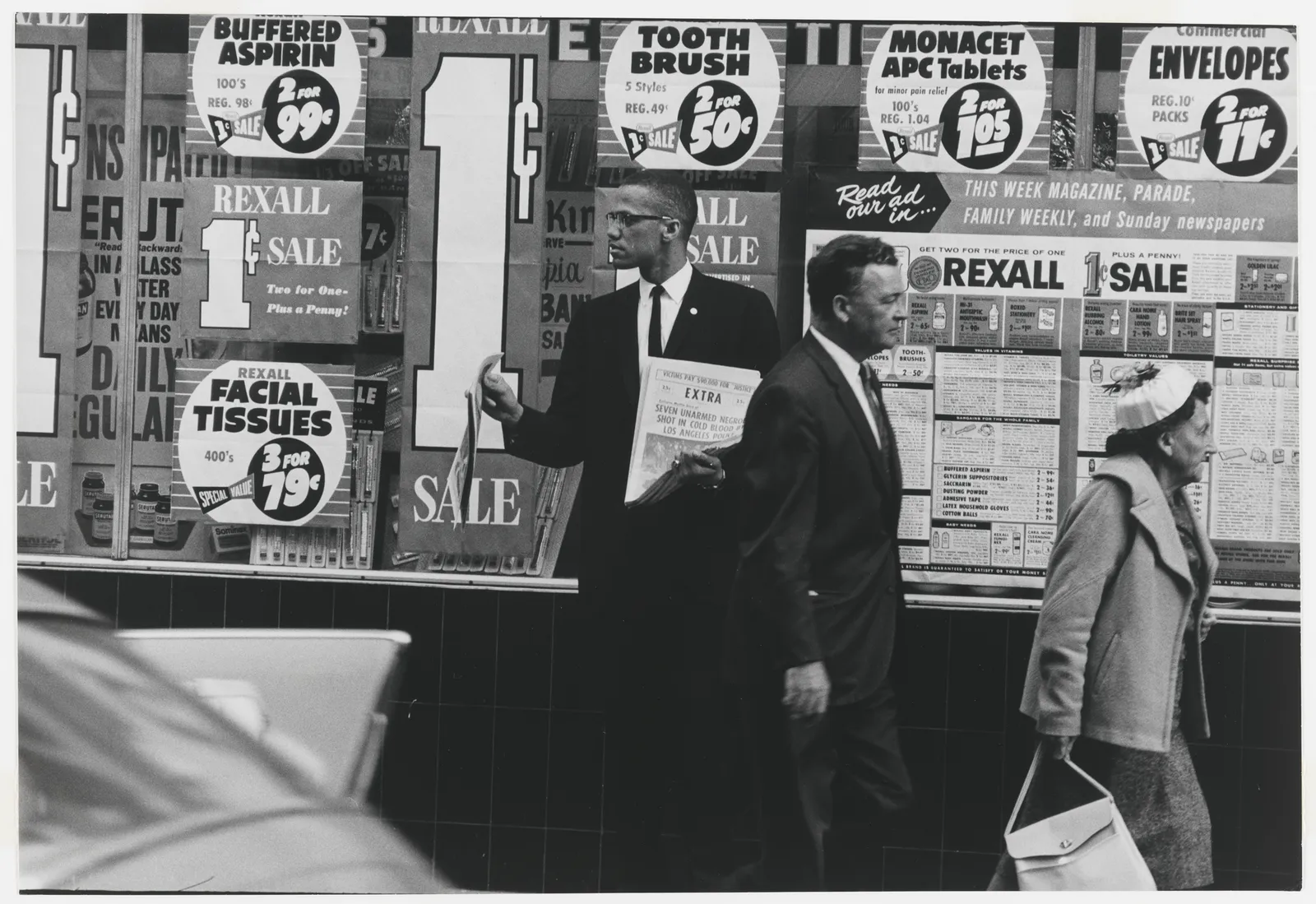
The National Portrait Gallery Wasn’t Allowed to Acquire Photographs When It Opened in 1968. Fifty Years Later, the Smithsonian Museum’s Collection Has Grown to 11,000 Photos and Counting A new exhibition at the Washington, D.C. gallery celebrates half a century of collecting through portraits spanning the history of photography. Featured figures include President Abraham Lincoln, journalist Ida B. Wells and inventor Thomas Edison November 13, 2026 7:45 a.m. A 1963 gelatin silver print of Malcolm X by Gordon Parks National Portrait Gallery, Smithsonian Institution / © Gordon Parks When the Smithsonian’s National Portrait Gallery opened to the public in 1968, its curators had a clear remit: to collect “painted or sculptured likenesses” of individuals who had left their mark on American history and culture. Photography didn’t make the cut, despite the fact that the medium had been invented nearly a century and a half earlier. This restriction wasn’t instated for aesthetic or ideological reasons. Instead, it came down to a turf war in the nation’s capital. Staff at the Library of Congress didn’t want to compete with the gallery when acquiring photos for their own collection, so Congress agreed to restrict the definition of portraiture in the act authorizing the museum’s creation. “The law was on its face petty and anachronistic,” the Washington Post wrote in 1977. “It was also antidemocratic. … Only those who had the time and money or, perhaps, the vanity, to sit for painters or sculptors would have been admitted to the museum.” An 1846 daguerreotype of Dolley Madison by John Plumbe Jr. NPG An 1898 glycerine-developed platinum print of Zitkála-Šá by Joseph T. Keiley NPG As Ann Shumard, the museum’s senior curator of photographs, says, it quickly became “glaringly apparent that if photographs continued to be excluded, there would be countless numbers of extraordinary, significant Americans whose likenesses would never find their way to the walls of the Portrait Gallery.” But it was only in 1976 that Congress—with the Library of Congress’ blessing—expanded the museum’s mandate to include “portraits and reproductions thereof made by any means or process, whether invented or developed heretofore or hereafter.” Half a century later, the Portrait Gallery’s photography collection has grown to more than 11,000 objects. To mark this milestone, the museum is staging an exhibition titled “Photographic Memory: Fifty Years of Collecting.” In addition to highlighting the breadth of the holdings, the show chronicles the history of photography itself, from mid-19th-century daguerreotypes to contemporary inkjet prints derived from digital files. Some of the works on view have never been publicly displayed before; chief among them is an 1846 daguerreotype of Dolley Madison, which is the earliest known photograph of a first lady.“Photographic Memory” includes iconic images such as Alexander Gardner’s “cracked-plate” portrait of Abraham Lincoln, taken just a few months before the 16th president’s assassination in April 1865, as well as lesser-known works like an intimate 1898 snapshot of Native American activist Zitkála-Šá and a 1960 picture of Mahalia Jackson that captures the gospel singer mid-performance. The oldest portrait in the show is an 1843 daguerreotype of John Quincy Adams, the first president to sit for a photograph, while the most recent is a 2020 inkjet print of Spanish American chef and humanitarian José Andrés. Encyclopedic in scope and ambition, the exhibition nevertheless features just a fraction of the museum’s photography collection. It “includes 129 objects,” Shumard says. “If you do the math, that’s roughly 1 percent of the total holdings.” To narrow down the pool of potential images, the curator compiled a list of major photographers whose work is represented in the gallery, such as Annie Leibovitz and Alfred Stieglitz. “Oftentimes,” she says, “folks may be more inclined to think about the individuals depicted than the artists represented, and consequently, visitors may not be as familiar with the range of significant photographers” featured in the collection. “From there,” Shumard adds, “I then looked for images of sitters whose portraits I thought epitomized the best work of these photographers, as well as representing wide-ranging fields of individual endeavor.” She also considered the photographic processes used to create the portraits, selecting pictures that reflected the evolution of these techniques. An 1890 cyanotype of Thomas Edison by William Kennedy Laurie Dickson NPG “There are certainly sitters and photographers who didn’t make the cut, not because I don't value both the quality of the image and the importance of the sitter,” the curator says. Practical considerations influenced the selection, with portraits competing for limited exhibition space. “It’s really important when you’re laying out a show to have works that are in harmony or in conversation with one another, and sometimes something dropped away just in that process,” Shumard adds. Other works weren’t eligible for inclusion simply because they’d been exhibited recently and are too fragile to be displayed again so soon. Ultimately, Shumard encourages visitors whose favorite figures are absent from the exhibition to conduct a search on the Portrait Gallery’s website. She says, “They might very well find that while that individual’s work is not represented in the exhibition, it’s certainly part of our permanent collection.” The French scientist and artist Louis-Jacques-Mandé Daguerre developed the daguerreotype, the world’s first commercially viable photographic process, in 1839. To create these one-of-a-kind portraits, photographers treated polished, silver-coated sheets of copper with iodine and bromine vapors, producing a light-sensitive surface that could be inserted into a camera to capture an image that was then developed over heated mercury. Daguerre’s technique quickly gained traction as a relatively inexpensive, convenient alternative to traditional portraiture. “It’s not as though they’re giving these daguerreotypes away,” Shumard told Smithsonian magazine in 2019, “but it’s so much cheaper than having a painted likeness made.” Families could sit for group portraits that served as treasured mementos or visit local galleries to see daguerreotypes that were widely touted as more truthful likenesses of famous faces than paintings and sculptures. “Photographic Memory” features both daguerreotypes and ambrotypes, the faster, cheaper process that largely replaced them in the mid-1850s. Standouts in this section include an 1856 photograph of Olive Oatman, a white woman who was taken captive by the Mohave as a teenager, and a daguerreotype of abolitionist John Brown, created by Black photographer Augustus Washington around 1846 or 1847. Whereas a posthumous oil painting of Brown shows him with a frenzied, unfocused stare and an overgrown beard, the studio portrait depicts a man firmly in control of his image, with his gaze steely and his hand raised in a pledge to the antislavery cause. A circa 1856 ambrotype of Olive Oatman NPG A circa 1846-47 daguerreotype of John Brown by Augustus Washington NPG The exhibition also showcases portraits of naturalist Henry David Thoreau and abolitionist Frederick Douglass. Both were acquired before the Portrait Gallery was officially authorized to collect photographs. To circumvent the ban, staff found private donors whose funds could be used to purchase the portraits for the museum’s secondary support collection. Although this workaround enabled the acquisition of several major photographs prior to 1976, it was only in the bicentennial year that the gallery’s collecting efforts truly kicked off. That November, the Portrait Gallery hired its founding curator of photography, William F. Stapp. “He was very eager to make sure that the collection would make it possible to trace the development of photographic portraiture from its earliest days up to the present time,” says Shumard, who joined the staff three years later, in 1979. “It was very prescient because … since then, much of that very early photography has become increasingly rare to come by.” One such timely acquisition offered a glimpse at a man more often found behind the camera: Mathew Brady, the photographer best known for his unvarnished images of the Civil War. Dated to around 1851, the picture is classified as “a self-portrait, even though Brady was not actually operating the camera when the daguerreotype was made,” Shumard says. “But he is really serving as an art director in a sense. The composition is a really strong, triangular one with him at the apex,” flanked by his wife and his sister. A circa 1856 ambrotype of Frederick Douglass NPG A circa 1851 daguerreotype of Mathew Brady, Juliet Brady and Ellen Brady Haggerty NPG Brady’s work (or that of his studio, which featured Gardner, Timothy H. O’Sullivan and other photographers) is a recurring thread in the exhibition. It pops up in sections about the Civil War; westward expansion; and salted paper prints, a process used to print positive images from photographic negatives. The show highlights the Brady studio’s portraits of prominent 19th-century figures, from Confederate spy Rose O’Neal Greenhow to Union General George B. McClellan to Lincoln. One of the Lincoln portraits on view dates to February 27, 1860, the same day that the soon-to-be president delivered a rousing antislavery speech at the Cooper Union in New York City. As historian Harold Holzer wrote in a 2006 essay, Brady sought to convey a specific image of the politician, surrounding him with “symbols of both learning and public service.” The photographer also asked Lincoln to pose while standing rather than sitting down, to “emphasize, rather than disguise, his subject’s most striking physical attribute: his height.” After the Republican Party selected Lincoln as its presidential candidate in May 1860, Brady’s portrait of the clean-shaven, sunken-cheeked nominee circulated widely in lithograph, engraving and tintype reproductions. By introducing voters across the country to Lincoln, Brady helped the candidate win the election. Lincoln himself acknowledged the photographer’s contribution to his political success, once declaring, “Brady and the Cooper Union speech made me president.” The two Brady portraits of Lincoln exhibited in “Photographic Memory” are printed on salted paper, a medium that is “particularly vulnerable to light fading,” Shumard says. Although the Portrait Gallery has a sizable collection of salted paper prints, these fragile images are rarely displayed, the curator adds, as “our exhibitions typically stay on view for a longer time period, and with brighter light levels than would be advisable.” A February 27, 1860, salted paper print of Abraham Lincoln by Mathew Brady NPG To account for conservation concerns, the museum has placed several salted paper prints on view in a separate gallery space with motion-activated lighting. Featured sitters include religious leader Brigham Young, sculptor Harriet Goodhue Hosmer and Seminole chief Billy Bowlegs. Rounding out the exhibition’s medium-specific sections is a trove of seven stereographs. Ever so slightly different, these paired prints appear three-dimensional when viewed through a stereoscope. Museum visitors can look through one such optical device to find themselves face to face with Lincoln, author Harriet Beecher Stowe and Lieutenant Colonel George Armstrong Custer, among other famous names. These portraits differ from the genre of stereographs most popular in the late 19th and early 20th centuries: visions of faraway lands. As physician and poet Oliver Wendell Holmes Sr. wrote in an 1859 essay for the Atlantic, the “infinite volumes of poems that I treasure in this small library of glass and pasteboard” transported him to Rhenish vineyards, Roman arches, Alpine glaciers and ancient Egyptian pyramids. “The first effect of looking at a good photograph through the stereoscope is a surprise such as no painting ever produced,” Holmes argued. “The mind feels its way into the very depths of the picture.” A 1906 stereoscopic gelatin silver print of Booker T. Washington and distinguished guests NPG Aside from the galleries dedicated to various photographic processes, the exhibition is organized largely chronologically. “Photographic Memory” explores both the Civil War and its aftermath through images spanning the second half of the 19th century, including an evocative albumen silver print of Lincoln assassination co-conspirator Lewis Thornton Powell and a studio portrait of Ko K’un-hua, the first native Chinese speaker to teach Mandarin at an American university. According to Shumard, Boston merchants lobbied Harvard University to hire a Chinese professor so that “students who might be interested in pursuing careers in commerce” would be able to converse with their Chinese counterparts without an intermediary. George Kendall Warren’s portrait of Ko K’un-hua, dated to between 1879 and 1882, shows “a dignified, middle-aged man in the long, high-necked, heavy garments of a scholar-official of the Qing dynasty,” Harvard magazine noted in 2008. Although Ko K’un-hua taught just four or five students before he died of pneumonia in 1882, he “won many admirers and personal friends in America in a short time”—an achievement made all the more impressive by the pervasive anti-Chinese sentiment sweeping the nation at the time, historian Xu Guoqi writes in Chinese and Americans: A Shared History. A circa 1879-82 albumen silver print of Ko K’un-hua by George Kendall Warren NPG A circa 1893 collodion print of Ida B. Wells-Barnett NPG Jumping ahead to the 20th century, Shumard calls attention to a pair of photographs taken in 1935. One is a portrait of novelist John Steinbeck, who drapes his arms over the back of a chair while clasping a cigarette in his right hand. The other is a Dorothea Lange picture of documentary filmmaker Pare Lorentz at work in California. “Both are, of course, so focused on the Great Depression, the Dust Bowl and the migration of those who were so severely impacted by that economic and climatic disaster,” the curator says. The Lorentz photograph also underscores the museum’s “elastic definition of portraiture,” which extends far beyond formal studio portraits. “There are photojournalistic images that might not have been conceived by the photographer as a portrait, but in fact, that photojournalistic image allows us to understand an individual and their role in our nation’s history better, perhaps, than a formal studio portrait,” Shumard says. She points to Gordon Parks’ 1963 print of Malcolm X handing out copies of an article headlined “Seven Unarmed Negroes Shot in Cold Blood by Los Angeles Police,” as well as a photograph of civil rights activist Ella Baker delivering a speech on the Atlantic City boardwalk in 1964. “It really captures her in action rather than in a more static pose,” Shumard explains. “Someone might say, ‘Well, is that really a portrait?’ And in my view, it is.” A 1935 gelatin silver print of John Steinbeck by Sonya Noskowiak NPG / © Estate of Sonya Noskowiak A 1935 gelatin silver print of Pare Lorentz by Dorothea Lange NPG / © The Dorothea Lange Collection, the Oakland Museum of California, City of Oakland / Gift of Paul S. Taylor Other highlights from the later sections of the exhibition include Herb Ritts Jr.’s 1996 portrait of Christopher Reeve and Tseng Kwong Chi’s New York, New York. The first is a side view of the Superman actor in a motorized wheelchair, taken the year after an equestrian accident that left him paralyzed from the neck down. During Reeve’s portrait session, “you could feel his determination,” Ritts told the New York Times. “Even his chair was stoic.” Both the photographer and his subject would die less than a decade after the session: Ritts succumbed to pneumonia at age 50 in 2002, while Reeve died after falling into a coma at age 52 in 2004. The second standout is a self-portrait from Tseng’s “East Meets West” series, which found the Hong Kong-born photographer assuming the persona of a self-declared “ambiguous ambassador.” Dressed in a Mao suit, Tseng “traveled throughout the United States as well as abroad, making self-portraits in the guise of this character at major monuments,” from the Statue of Liberty to the Golden Gate Bridge to the Lincoln Memorial, Shumard says. A 1996 gelatin silver print of Christopher Reeve by Herb Ritts Jr. NPG / © Herb Ritts Foundation As Melissa Ho, a curator at the Smithsonian American Art Museum, wrote in a 2022 blog post, Tseng used his distinctive ensemble to challenge racial stereotypes about Chinese people. “His donning of the Mao suit can be understood as racial camp—a playful, self-protective maneuver that did not prevent Tseng from being misinterpreted but did allow him to take control of the manner of the misreading,” Ho argued. “Even as he presents himself to the Orientalist gaze, he is in command of the means of representation.” Overall, Shumard says that the Portrait Gallery’s photography holdings have “really benefited from a variety of viewpoints and curatorial perspectives that allowed the collection to grow in a variety of directions” throughout the past 50 years. Stapp’s successor Mary Panzer, for example, “was particularly interested in photojournalism and civil rights photography.” Shumard, for her part, says her interest is “really from soup to nuts.” She concludes, “I’ve just enjoyed working to find good pictures across the board.” “Photographic Memory: Fifty Years of Collecting” is on view at the Smithsonian’s National Portrait Gallery from November 14, 2026, to November 7, 2027. New York, New York, Tseng Kwong Chi, 1979 (printed 2017) © 1979, Muna Tseng Dance Projects, INC. You Might Also Like Get the latest on what's happening At the Smithsonian in your inbox. More about: Abraham Lincoln American Presidents Archives of American Art Asian Americans Civil Rights Civil War Disability Exhibitions Exhibits John Quincy Adams Library of Congress Museums National Portrait Gallery Photographers Photography Photojournalism Portraiture Smithsonian American Art Museum Smithsonian Institution Washington, D.C.
The National Portrait Gallery Wasn't Allowed to Acquire Photographs When It Opened in 1968. Fifty Years Later, the Smithsonian Museum's Collection Has Grown to 11,000 Photos and Counting
Full Article
Original Source
Read the full article at Smithsonianmag →KhanList aggregates and links to publicly available news content. We do not host full articles from third-party sources. Always verify important information with original sources.