
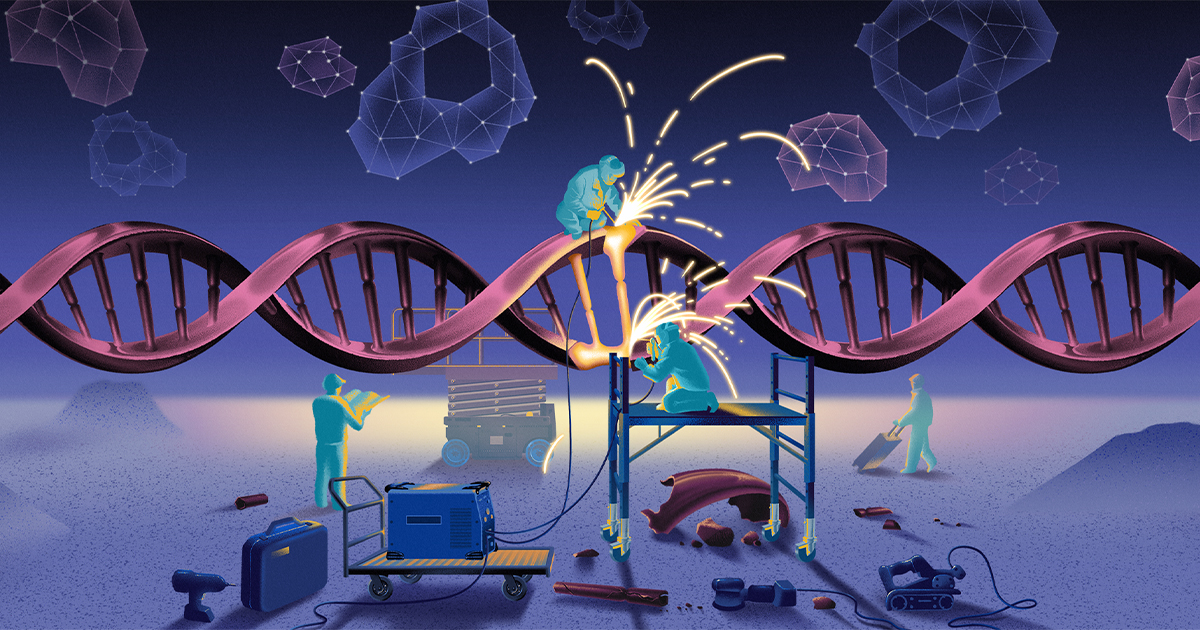
Genetic information is sturdy, but its physical structure is sensitive. Natural tools for repairing a cell’s thousands of daily injuries are fundamental to gene-editing technologies. Ada Zejun Shen for Quanta Magazine Introduction Humans have debated the meaning of life for many millennia, but from evolution’s perspective, it is simple: Preserve the genome. Of course, mutation is allowed, as is the genetic mixing and matching of sexual reproduction, to create variety and evolutionary diversity. But we all exist because a viable lineage of DNA has persisted for 4 billion years. The genome’s policy is typically, “If the code works, don’t change it.” You’d think, then, that cells would keep their DNA under lock and key, protected from the elements like the precious blueprint it is. But this isn’t possible. DNA is a working document. Cells need near-constant access to these instructions for making the molecules required by life. The huge, complex molecular structure is therefore exposed to nonstop assault by the by-products of everyday cellular metabolism, as well as environmental factors, such as radiation (including ultraviolet and X-ray), alcohol, pesticides, and more. “DNA damage occurs all the time,” said Björn Schumacher, a molecular biologist at the University of Cologne. “[DNA] contains all the information for building a cell, building an organism, maintaining cells and tissues, and all that — but yet it is surprisingly unstable.” He estimates that some cells endure up to 100,000 DNA damage events every day. “Damage to the DNA is the default,” he said. These events can injure sections of the DNA molecule — or, worse, break the strand in half. Even minor DNA damage risks changing or destroying the essential instructions a cell needs to operate, which can make cells malfunction, die, or become cancerous. However, many of those tens of thousands of daily lesions get repaired quickly. Cells have native repair mechanisms that recognize and replace faulty DNA before lasting damage and dysfunction set in. In fact, the ability to repair damaged or broken DNA had to evolve at essentially the same time as DNA, Schumacher said, “because you cannot have stable genetic information without DNA repair.” These mechanisms are essential not only to the evolutionary lineage of all known life, but also to promising technologies to treat genetic diseases. Scientists and doctors who experiment with gene editing must rely on DNA’s natural self-editing and repair tools to insert, delete, or mutate genes to study and treat disease. So perhaps instead of a master blueprint protected behind glass, it’s better to imagine DNA as a beloved cookbook that is constantly in use. While it’s open on the kitchen counter, it’s bound to get splattered with sauce — or even have a page ripped. But spills can be wiped off. Torn pages can be taped up. And a smear obscuring an odd ingredient might even improve a recipe. Do the Twist To understand how DNA gets damaged so easily, we need to see its structure, beyond the impossible elegance of the double helix. Most DNA is packed into chromosomes, dense structures formed by long, delicate filaments of DNA wrapped tightly around proteins. If you were to unwrap the DNA and untwist its double helix, you’d see a ladder made of nucleotides: the building blocks of DNA. A single DNA strand — one side rail and half of each rung — encodes a specific arrangement of the four nucleotides, also known as bases. Each is a complex molecule represented by a single letter: A, T, G, or C. Across from it is a backup on the opposite, complementary strand, made up of each nucleotide’s natural partner (A’s partner is T, and G’s is C). The “rungs” of the DNA ladder are held together with relatively weak, transient bonds that allow the helix to be opened and closed like a zipper, so enzymes can access, read, and copy the code. In 1994, Maria Jasin’s team first showed that intentionally introducing a double-strand break could compel DNA to repair the injury with an introduced gene sequence. Courtesy of Memorial Sloan Kettering Cancer Center “[DNA has] all that clever structure to it, to enable it to come apart and replicate,” said Penny Jeggo, a molecular biologist who is now emeritus faculty at the University of Sussex. “But a consequence of [that structure] is that it’s sensitive to damage, and unlike proteins or RNA, it actually matters if it gets damaged.” Even though DNA is precious, it also needs to be constantly accessed to provide the instructions for making the cells’ proteins. And it’s important to remember that the enzymes don’t “read” it from a distance. Every step is a tactile, chemical process. Like toddlers, enzymes physically touch, interact with, and occasionally change the DNA to work with it. “[DNA is] a working molecule,” said Maria Jasin, a molecular biologist at Memorial Sloan Kettering Cancer Center. “So just by its nature, DNA is going to be subject to chemical forces that will modify it.” When that modification — let’s call it what it is, damage — affects just a single nucleotide base, a process called base excision repair sends in enzymes to pop the incorrect or injured molecule off the strand and replace it with an undamaged one. Sometimes the jobs are heftier, such as when ultraviolet radiation or carcinogenic chemicals cause a base to fuse with an adjacent one, creating a bulky distortion in the DNA backbone. In this case, enzymes snip out entire nucleotide chunks from the problematic strand and replace them using the complementary strand as a template — a process called nucleotide excision repair. The most devastating DNA injury of all is a double-strand break. When this happens, the genome is severed into two pieces, resulting in a potentially catastrophic loss of information from both copies of the code. In these cases, the cell deploys the full DNA damage response. An intricate network of more than 500 proteins senses the damage and quickly intervenes to stabilize the damaged segments. It also issues a temporary moratorium on any DNA replication or RNA transcription to prevent the cell from using faulty code. Double-strand breaks are dangerous. A cell might opt to self-destruct rather than risk perpetuating serious mutations. However, most double-strand breaks can be repaired through one of two main pathways. “One is beautiful in its simplicity,” Jeggo said, “and the other one is just as beautiful or elegant in its complexity.” The simpler pathway, and the one used more commonly by human cells, is called nonhomologous end joining. Proteins stabilize the free-floating ends of the DNA, clear out any damaged nucleotides, trim the ends so they are flush, and then basically stick them back together. Some nucleotides are irrevocably lost, and mutations may arise as a result, but for most cells, it gets the job done. The other, more accurate pathway for restoring double-strand breaks is called homologous recombination. It’s available only during cell division, after DNA has replicated but before the cell divides. In this moment, the nucleus holds two identical copies of each chromosome, known as sister chromatids. If a double-strand break occurs in this brief window, any lost code can be filled in by its sister through homologous recombination. Proteins choreograph an elegant pas de deux where a damaged DNA strand intertwines with the complementary strand from its undamaged sister. The intact strand serves as a perfect template for copying over any nucleotides that may have been lost. Putting Nature to Work Homologous recombination is not a “good enough” form of repair. It is so accurate that scientists have harnessed it for gene editing. In 1994, Jasin’s team intentionally introduced a double-strand break in the mouse genome. In place of a sister chromatid, her team provided DNA with a new gene in it, surrounded by sequences designed to coax the cell to stitch it in using homologous recombination. Indeed, the new gene was added to the existing DNA sequence right where the strand had been broken. Jasin’s team was not the first to edit genes using homologous recombination, but they showed that the process was immensely more efficient if the DNA strands had been broken first. However, their approach had a major limitation: The enzyme that broke the DNA strands, called an endonuclease, could only make a cut at a specific DNA sequence. For every editing project, the endonuclease would have to be redesigned to match its target gene — a significant effort. That burden was lifted in 2012 with the realization that CRISPR-Cas, a bacterial immune system, had massive potential as a gene-editing tool. Cas is an endonuclease that finds its cutting site by a different method: A piece of RNA guides it to the target DNA segment. Because synthesizing a strand of RNA is far easier than designing an endonuclease, CRISPR-Cas enabled researchers to make cuts virtually anywhere in the genome. This approach is a kind of genetic surgery. It makes incisions in the DNA with scalpel-like precision and relies on the body’s natural mechanisms to heal it. But it does this on a molecular scale, so its intervention is more fundamental than what the most skilled surgeon could produce. Like earlier tools, CRISPR-Cas relies on the cell’s native DNA repair machinery to put things back together with the edited genes. Some researchers use homologous recombination to add in a desired gene sequence while others take advantage of nonhomologous end joining to intentionally introduce mutations. More recently, an emerging gene-editing technology called base editing lets researchers target and change individual bases without introducing a double-strand break. For treating human conditions caused by single mutations, base editing may be far safer than CRISPR-Cas, since it doesn’t require double-strand breaks. Instead, it competes with and manipulates the base excision repair process to change a single nucleotide. Indeed, in 2025, it was used to treat a baby with a rare genetic condition; a personalized gene-editing cocktail fixed his precise mutation. However, a 2026 study of base editing reported that the technique is not precise enough to be safely used in human embryos. Researchers will continue to leverage the DNA repair mechanisms that evolution has developed to create research tools and possibly even cure challenging genetic diseases. But, as with surgery, there will always be some risk involved. DNA works as a conveyor of life’s instructions because it is imperfect enough to enable evolution. And that means that imperfections will appear in our attempts to work with it, too. The Quanta Newsletter Get highlights of the most important news delivered to your email inbox Also in Biology Comment on this article Next article Network Researchers Nail Down Theory of ‘Perfect Resilience’
The Incredible, Elegant DNA Repair System Makes Gene Editing Work
Full Article
Original Source
Read the full article at Quantamagazine →KhanList aggregates and links to publicly available news content. We do not host full articles from third-party sources. Always verify important information with original sources.