
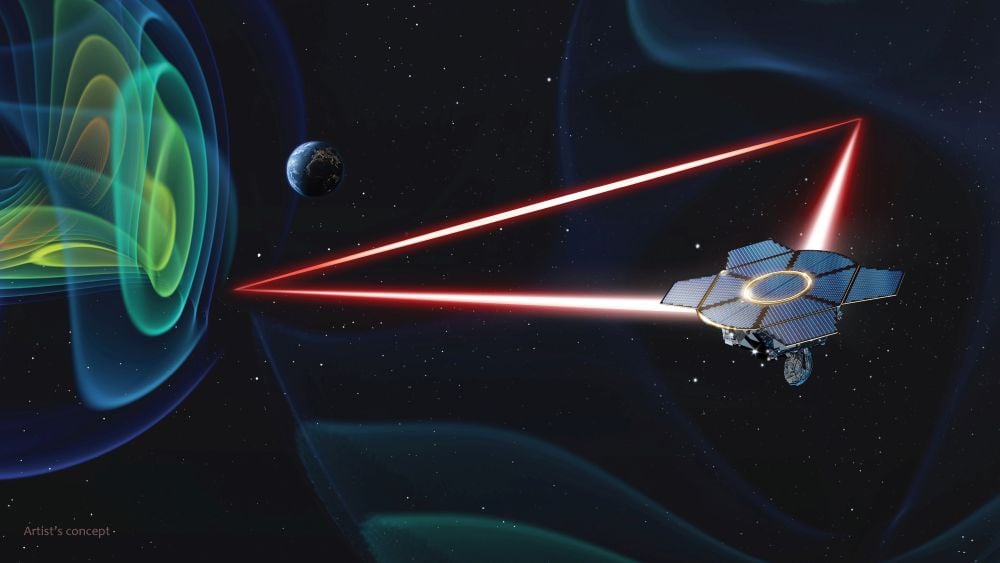
LISA, the Laser Interferometer Space Antenna, is scheduled to be launched in 2035. The ESA is still developing the mission, but it's basic design is established. It will feature three separate spacecraft flying in an equilateral triangle formation. They'll be connected by laser interfometry, and LISA will use that interferometry to detect gravitational waves (GW). GWs are ripples in spacetime that are the signatures of mergers between massive objects, either compact binaries containing stellar mass black holes, white dwarfs, and neutron stars, or between supermassive black holes (SMBH). Astronomy is concerned with light in all its wavelengths, but gravitational waves open another window on the Universe. By detecting GWs from SMBH mergers, scientists study how galaxies merged and grew so massive. GWs from mergers between compact binaries can act as distance markers, helping cosmologists measure the expansion of the Universe. And the Universe was opaque to light in its first 380,000 years, so that time period is behind a curtain. But that curtain of opacity can't stop gravitational waves, so they can potentially bring those crucial years of the Universe's evolution into view. But now researchers are saying that LISA may also be able to detect exoplanets. This artist's impression shows gravitational waves from the merger of two compact objects. The presence of an exoplanet can leave a signature on these waves that LISA can detect. Image credit: NASA “The most common source for LISA is expected to be double white dwarf systems, which are binaries composed of white dwarfs in tight orbits,” said Casey McGrath, a postdoctoral researcher at the University of Maryland and NASA’s Goddard Space Flight Center. “If an exoplanet also orbits within one of these systems, its presence becomes imprinted on the gravitational wave signal in a way we’ll be able to uncover.” Two new papers outline LISA's planet-detection potential, and McGrath is involved in both. He's the sole author of "Receiving Exoplanet Messages with Gravitational-wave Carriers: The Gravitational-wave Radial Velocity Method," published in The Astrophysical Journal. It explains how LISA could detect exoplanets. "Gravitational-wave (GW) radial velocity (RV) may offer a new method for detecting exoplanets, one that would primarily target planets orbiting GW-emitting, ultracompact, post-main-sequence stellar objects such as white dwarfs, neutron stars, and black holes," McGrath writes in the first paper. The GWRV operates on the same principle as the RV exoplanet detection method does. In those instances, astronomers measure the tiny wobble a star experiences as an orbiting exoplanet tugs on it. Stars rotate, and the visible part of the star rotating toward the observer is blue-shifted, while the visible part of the star rotating away is red-shifted. The wobble creates doppler shifts in the red and blue light that astronomers measure with spectrographs. In GWRV, an orbiting exoplanet creates a wobble in the center of mass of a compact binary. That creates a detectable doppler shift in the gravitational waves instead of in starlight. The method is more sensitive to high-mass, long-period planets than traditional RV, which more readily detects massive planets on short-period orbits around lower-mass stars like M dwarfs. If the method works, it has some advantages over other exoplanet detection methods. "For one, GW observatories have potentially much farther reach into the Milky Way and beyond, since the GW amplitude is inversely proportional to the source distance," explains McGrath. "They will also inherently be probing post-main-sequence stellar systems, where EM observatories simply have not found as many exoplanets." Exoplanets that go undetected in compact binaries can also cloud the GW signal. That can create misunderstandings as researchers try to understand and constrain the GWs. So detecting them also clarifies the GW signal from the compact binary. This graphic shows how LISA works by detecting tiny changes in the distances between the spacecraft. Image Credit: By ESA / ATG Medialab, CC BY-SA IGO 3.0, CC BY-SA 3.0 igo, https://commons.wikimedia.org/wiki/Special:Redirect/page/144582237 This graphic shows how LISA works by detecting tiny changes in the distances between the spacecraft. Image Credit: By ESA / ATG Medialab, CC BY-SA IGO 3.0, CC BY-SA 3.0 igo, https://commons.wikimedia.org/wiki/Special:Redirect/page/144582237 This work is just an initial attempt to understand how it could all work. There's much more work to be done, as McGrath himself acknowledges. For one thing, the movement of LISA itself introduces some Doppler effect into the signal that has to be managed. Ground-based GW observatories don't move, and LISA will be the first one that does. "Future, more complex and robust analyses will be needed to better understand the ability to detect exoplanets in GW signals," McGrath writes. "But hopefully this work can better shed light on the fundamental physics that can inform those studies." If LISA does detect a signal in a GW that indicates a possible exoplanet, it will only be a candidate. That signal will have to be confirmed, and that will require observations in the electromagnetic regime. That's the subject of a second paper. McGrath is also the lead author on another paper in the same journal that focuses on validating GW exoplanet candidates. It's titled "Multimessenger Exoplanets: Combining Infrared Excess and Astrometry with Gravitational-wave Detections of Double White Dwarf Exoplanets." It explains how the JWST can confirm GW exoplanet detections, possibly with help from Gaia or the Habitable Worlds Observatory. “By themselves, double white dwarfs will emit gravitational waves at a nearly continuous frequency," said Scott Noble, a theoretical astrophysicist at NASA Goddard and a coauthor on the second paper. "Add a sufficiently massive planet to the system, and its presence causes the binary to experience reflex motion, adding a Doppler modulation to the gravitational signal.” LISA will see these as signals that bracket the primary GW signal from the DWD. These secondary signals are positioned in frequencies above and below the primary. So while the primary signal carries information about the DWD, the secondaries carry information about the exoplanet. Every observatory, whether electromagnetic or gravitational, is built to detect signals at particular frequencies. LISA's frequency range means it will excel at detecting DWDs with short orbital periods. White dwarfs aren't rare, since they're the main evolutionary outcome for stars like the Sun, once they leave the main sequence. DWDs are rarer than single WDs, but astronomers still think that there are about 10 million DWDs with orbital periods of less than one hour in the Milky Way. Of those 10 million, researchers expect LISA to find about 10,000. Astronomers think that LISA will find about 10,000 white dwarf doubles (DWDs) with short orbital periods. LISA should be able to detect exoplanets in DWDs, if they're there. Image Credit: Tod Strohmayer (GSFC), CXC, NASA, Illustration: Dana Berry (CXC) LISA should be able to find the bracketed signals that exoplanets on circumbinary orbits around DWDs display. They would be candidates at first, and if those signals can be confirmed, they would be the first of those exoplanet types to be found. "This population is unique: no such planets are currently known around DWDs, and only a handful of circumbinary planets around main-sequence stars and planets orbiting white dwarfs (WDs) have been identified," the authors write. "Independent EM confirmation will be essential, especially for the first GW-detected exoplanets, to validate this method." Validation is critical, and it'll rely on electromagnetic confirmation. In their work, they use a representive known DWD (ZTF J2243+5242) to compute its detectability by LISA GWRV. "We then demonstrate two complementary EM techniques—JWST infrared (IR) excess and Gaia or Habitable Worlds Observatory astrometry—that could independently confirm a GW-detected planet in this fiducial system," the authors write. An exoplanet orbiting a DWD produces more infrared than the stars themselves. The JWST is all about detecting infrared light, and it should have no problem detecting infrared excess out to a distance of about 500 light years. In their test case for a DWD at that distance, the JWST can detect an exoplanet with about five Jupiter masses, while LISA could detect one much smaller, with as little as 0.5 Jupiter masses, under perfect conditions. “Once LISA captures its first exoplanet detections, it will be critical for us to validate some of them,” said Mary Anne Limbach, an assistant research scientist at the University of Michigan and a co-author on the confirmation paper. “These joint detections will allow us to establish that the gravitational signals correspond to genuine planets rather than false positives.” The authors say we're about to enter a new phase of exoplanet detections once LISA is operational. The JWST's initial planned mission was for 5 to 10 years, but it may last 20. If it does, then it will overlap with LISA for several years, and it can be used to validate LISA exoplanet detections. "A multimessenger exoplanet would be a historic discovery, and a DWD circumbinary would help to provide key insights into planetary and stellar evolution and into a part of the exoplanet census not yet probed," the authors write. When the first gravitational wave was directly detected by LIGO/VIRGO in 2015, astronomers declared that a new window into the cosmos had been opened. LISA is prying that window open wider than ever, and as this work shows, the view might be even more detailed than thought. If it can detect exoplanets beyond the scope of traditional methods, then it'll give astronomers an even more expansive view of the cosmos than they anticipated.
LISA's Gravitational Wave Detections Could Reveal Exoplanets
Full Article
Original Source
Read the full article at Universetoday →KhanList aggregates and links to publicly available news content. We do not host full articles from third-party sources. Always verify important information with original sources.