
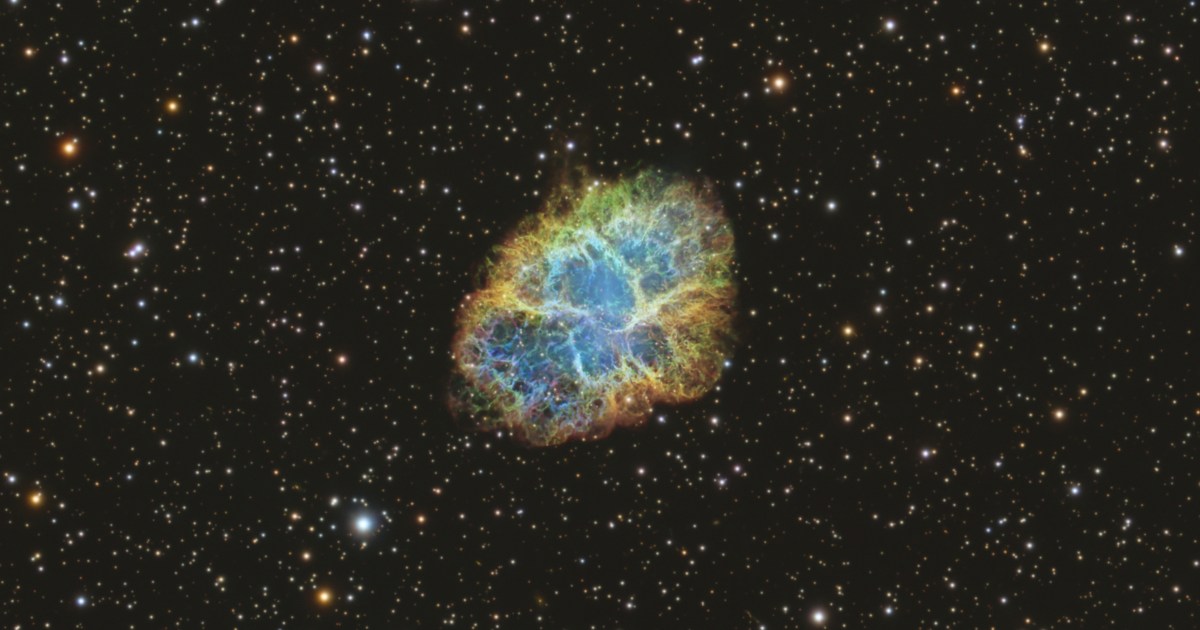
This supernova remnant may not be much to visually look at, but holds immense interest nonetheless. | Published: November 23, 2026 The author’s Crab Nebula in narrowband (right) is colored like the famous Hubble image; this photo was taken with a 9-inch reflector and 38.5 hours of total exposure time. Credit: Molly Wakeling One of my personal favorite objects in the night sky is the Crab Nebula (M1). It’s No. 1 on Charles Messier’s list, although I don’t think he ordered his objects by how cool they are (a missed opportunity!). It’s not exactly impressive visually in most scopes — mostly a gray blob, or a spiky gray blob in larger apertures — but it’s one of those targets that if you know what you are looking at, it becomes immensely more interesting to observe. The Crab Nebula burst onto the scene in 1054 C.E., when a massive star in the constellation Taurus collapsed in on itself in a supernova whose light was visible during the day, as documented by multiple civilizations around the world. Its leftover shell of gas and dust has been expanding ever since, and the bright glow is still visible thanks to what remains of the progenitor star: a rapidly spinning neutron star, known as a pulsar. The “crab” moniker stems from a drawing made by the William Parsons, Earl of Rosse, in the early 1840s with a 36-inch telescope, which depicts crab-leg-like appendages, although he later noted that observations through a 72-inch resulted in a view that looked rather different than his original drawing. Pulsars are some of the most extreme objects in the universe. The Crab Pulsar, which is approximately 12–17 miles (20–28 kilometers) in diameter, spins at a breakneck 30 times per second — once every 33 milliseconds. At magnitude 16.6, it is a very difficult catch, but possible in large (20-plus-inch) scopes on nights with steady skies. It sits only a few arcseconds from a slightly brighter magnitude 15.8 star that guides the way. The pulsar produces a relativistic-speed stellar wind that generates synchrotron radiation, which occurs when charged particles move along curved paths, bent by strong magnetic fields. This is seen across the entire electromagnetic spectrum, from radio to gamma rays, forming the main diffuse part of the nebula’s emission. This radiation has a total luminosity some 100,000 times greater than the Sun’s! The pulsar is slowing down gradually as a result of energy carried away by its stellar wind, increasing its period by 36 nanoseconds per day. The nebula is still expanding, even nearly 1,000 years later, at a rate of 3.4 million mph (5.5 million km/h) — that’s 950 miles (1,527 km) per second, or 0.5% the speed of light! While not noticeable in a single observation, comparing images across several years shows the expansion on very human-accessible timescales. In wideband one-shot color (left), the Crab Nebula shows a murky, largely gray interior. This image is from a 10-inch reflector with 11 hours of total exposure. Credit: Molly Wakeling The author’s Crab Nebula in narrowband (right) is colored like the famous Hubble image; this photo was taken with a 9-inch reflector and 38.5 hours of total exposure time. Credit: Molly Wakeling Imaging the Crab The Crab’s intricate filaments are what make it so visually stunning in images. These structures are the remnants of the star’s atmosphere, consisting of gases like ionized helium, hydrogen, carbon, oxygen, nitrogen, iron, neon, and sulfur. It’s a moderately tricky astrophotography target to process: In wideband, it has a largely gray interior wrapped in red tendrils, so it is best imaged in narrowband, where it can display incredible, intricate detail that looks well and truly alien. A famous colorful 2005 Hubble image uses narrowband light from oxygen and sulfur and has oxygen-III set as red, sulfur-II as green, and oxygen-I as blue. When I’ve shot the Crab, I used hydrogen-alpha as blue, since it is a similar wavelength to oxygen-I (which are both red in reality) to create an image reminiscent of the Hubble one, much to my delight. Whether you are a primarily visual astronomer or a high-tech shutterbug like me, the Crab Nebula is worth spending a little time with this month. Take a moment during your observing to realize how incredible this object is. Rising in the evening hours, it will be up all night for you to enjoy. How much detail can you tease out? Can you spot the pulsar? Only one way to find out! Molly Wakeling is an avid astrophotographer active in STEM outreach. She has a Ph.D. in nuclear engineering. Browse the Observing basics archive at www.Astronomy.com/author/molly-wakeling
The amazing Crab Nebula
Full Article
Original Source
Read the full article at Astronomy →KhanList aggregates and links to publicly available news content. We do not host full articles from third-party sources. Always verify important information with original sources.