
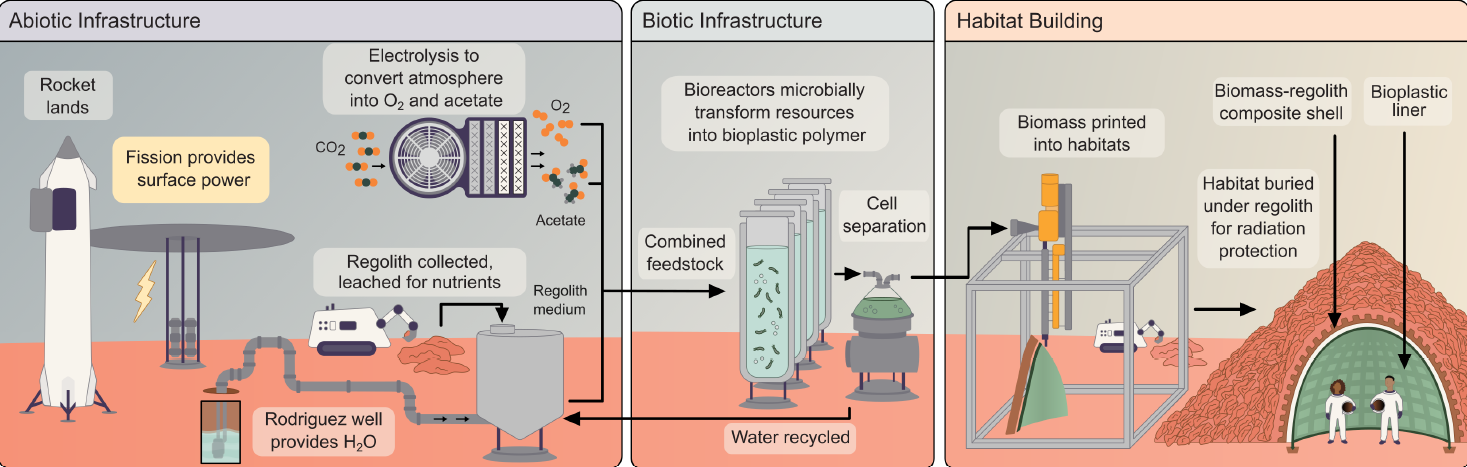
As we gear up to eventually land a human on Mars, more and more ideas are coming out about how to prepare for that. A recent one from Pioneer Labs, a research institute founded by bioengineer Erika DeBenedictis to develop biological technologies for space exploration, is now available on arXiv, without any plans to release it in a paid journal as part of the “Open Science” policy of The Astera Institute, who funded the research. It details “Mars Seed” - a new architecture that is self-contained and can produce a full 870 sq meters of pressurized habitat using nothing but Martian inputs within roughly every four Earth years. Mars Seed tackles plenty of in-situ resource utilization challenges all at once. One of the most notable is weight. According to the paper, the entire system weighs in at 20 metric tons - well below the threshold of Martian payloads for Starship or NASA’s proposed 25 ton Mars landers. And crucially, rather than relying on sugar or chemical inputs from Earth, the entire system won’t need any further input from our home planet once it is established on the Red one. The plan starts off with a landing at a mid-latitude Martian site, with flat terrain and sub-surface water ice deposits. Immediately after landing, an autonomous rover sets about unloading the package’s hardware and assembling a 40kW nuclear fission reactor modeled on the compact nuclear reactors NASA is already developing for Mars and Moon missions. About a month later, the reactor should be fully up and running, providing both electricity and “waste” heat that can be used to climate control a habitat. Fraser interviews Dr. Congrui Jin about using bioreactors to grow Martian habitats. Or in the case of this particular mission structure, to melt some ice. The system would put the heat from the nuclear reactor into a Rodriguez well - a type of ice-drilling technique that melts a pocket of underground ice and pumps the liquid water to the surface, which has already been proven in Antarctica. Water is a crucial component in the entire system’s operation. Once the first supply of it has been obtained from the “Rodwell” as it’s known, the system uses a scaled-up version of the urine-recycling system currently in place on the International Space Station (ISS) to recover around 90 percent of the water from each production batch of material. But water isn’t the only component input from Mars itself - another is dirt, or “regolith” in the language of space exploration. The paper estimates the system will require around four tons of Martian soil deposited into its hoppers every day. This could be collected by autonomous mining machines, like NASA’s RASSOR. Approximately 800 kg of that dirt is then stirred into water-filled mixing tanks to dissolve out nutrients like phosphorus and nitrogen. But that still leaves the most deadly component of Martian soil - perchlorates. Fraser interviews Dr. Michael Hecht, one of the main scientists behind the MOXIE experiment to create oxygen out of the atmosphere of Mars. While these would kill a normal microorganism, Pioneer Labs’ speciality is designing biological systems for use in space exploration. So they simply evolved a hardy strain of the bacterium Cupriavidus necator, which they call sPL.001, which can thrive in the equivalent of a perchlorate-laced broth of Martian regolith simulant back on Earth. That bacterium is also the key engine in creating the bioplastics that are used to 3D print the radiation-shielded habitats. Bacteria need food though, and shipping it from Earth would be prohibitively expensive. So there’s one final input to the system from the Red Planet - its atmosphere. The first step in that process is an upgraded version of the MOXIE experiment that successfully showed an ability to split the carbon dioxide in Mars’ atmosphere into carbon monoxide and oxygen. Typically, that system simply gets rid of the carbon monoxide to capture the oxygen for use in rocket fuel. But in Mars Seed, carbon monoxide is actually the prize. Using a technique inspired by an emerging field called “electro-agriculture,” the system combines waste carbon monoxide gas with water to produce liquid acetic acid - the main ingredient in vinegar. Fraser talks in detail about what we can find to live off of when we eventually do send humans to the Red Planet. While a diet of straight vinegar might not sound appealing to a human, to a microbe it's nourishing enough. In four separate 1,000L fermentation tanks, the engineered microbes eat this vinegar, combined with oxygen, packing themselves with a bioplastic called polyhydroxybutyrate, with the polymer eventually making up 70% of their body weight. At that point, a high-speed centrifuge harvests the bacteria cells from the liquid broth, and the resulting paste is split into two separate assembly lines. Half of the raw paste is mixed with Martian dirt and fed into a giant gantry 3D printer, which then extrudes a corrugated, arched outer protective shell. Rovers then work to pile around 2m of dirt onto the outer shell, creating a barrier to the cosmic rays and micrometeorites that plague the Martian surface. The other half of the bacteria is subjected to a pressure bath of liquid carbon dioxide, again pulled straight from the atmosphere. This extracts the pure bioplastic, which is then melted and spun into an airtight, reinforced inner tent that is capable of holding a breathable atmosphere. Interview with Dr. Erika DeBenedictis, the founder of Pioneer Labs. Credit - The New Biology YouTube Channel So, in essence, this 20 ton system can be dropped on Mars, including a pair of helping rovers, and extract all of the necessary components to continually and consistently build atmosphere-tight, safe shelter for astronauts, at a rate of about 75 sq meters every 130 days. The paper notes that, comparing the system to directly launching 20 tons of pre-made plastic building materials from Earth, the break-even point of the stand-alone biofabrication facility is around 1,400 Martian days - which lines up nicely with the two orbital alignment cycles NASA is planning to utilize before sending human crews. The main difference is that the biofabrication facility never stops producing those safe habitats, which clearly is a major advantage. Despite its promise, though, there are still plenty of engineering challenges to overcome before this system will be anywhere near launch ready. But, when that time comes, it appears that we might be able to literally grow safe habitats out of Martian water, air, and soil. And that is something any future mission planner will be thrilled to have as an option. Learn More: D. A. Stork et al - Mars Seed: A Reference Architecture for Biomanufacturing Habitats from Martian Resources UT - Could We Really Turn Mars Green? UT - Terraforming Mars Could Be Within Reach UT - Could Bioplastics be the Solution to Living Beyond Earth?
Bacteria and Nuclear Power Could Grow Ready-Made Homes on Mars Before Astronauts Arrive
Full Article
Original Source
Read the full article at Universetoday →KhanList aggregates and links to publicly available news content. We do not host full articles from third-party sources. Always verify important information with original sources.