
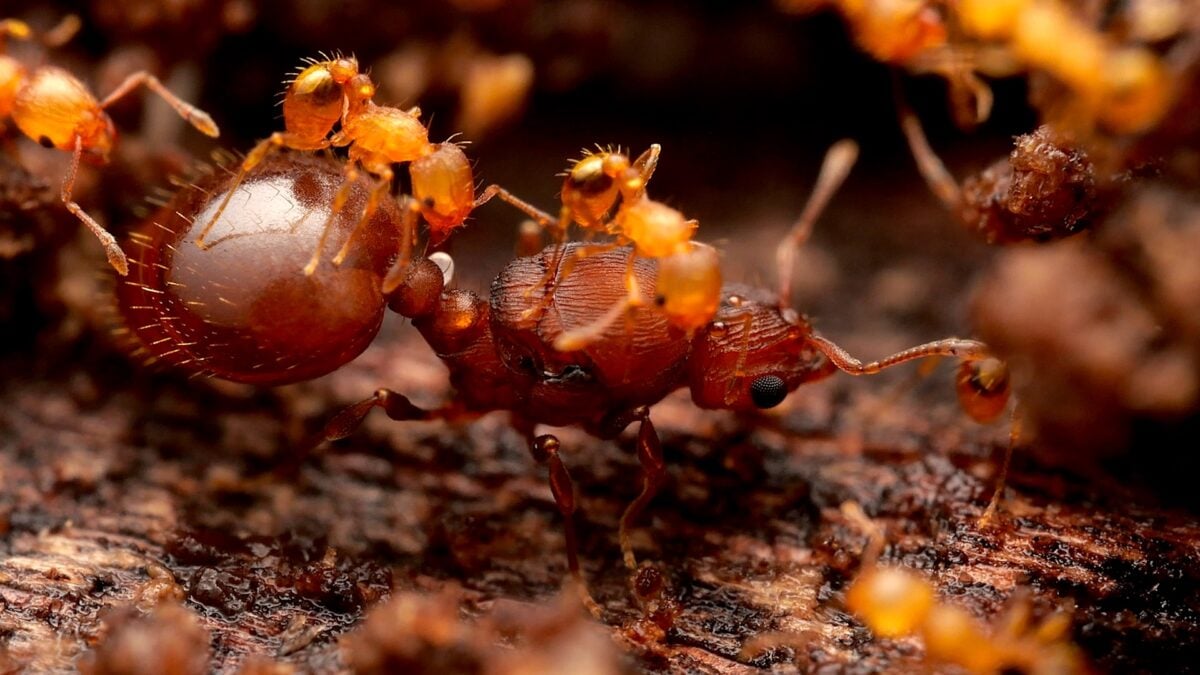
For an insect just one sixteenth of an inch (1.5 millimeters) long, the little fire ant (Allomerus auropunctatus, or formerly Wasmannia auropunctata) is genuinely ferocious. The searing sting from this invasive species is reportedly potent enough to cause blinding “cornea trauma” in creatures many orders of magnitude larger than itself, including elephants. But the little fire ant saves its most devious stratagems for its rival invasive ant species, like the red imported fire ant (Solenopsis invicta) against which it is now vying for space around the coastal province of Guangdong in southern China. A study comprised of over 150 ant combat experiments, conducted by entomologists at South China Agricultural University’s Laboratory of Quarantine and Invasive Pests, has uncovered two decisive tactics that A. auropunctatus uses to best S. invicta. The little fire ant overwhelms its fellow invader when it knows it has the numerical advantage, but plays dead when outnumbered, a gambit the researchers call “thanatosis.” “While intermediate interactions (avoidance, threat displays) were observed, our analysis specifically quantified the frequency of thanatosis to confirm it as a primary defensive node,” the lab’s leader, Yijuan Xu, and his colleagues explained this month in the journal Proceedings of the Royal Society B: Biological Sciences. These strategies, they argue, help explain how S. invicta—a species whose workers can grow up to 0.2 inches (5.1 mm) long or over three times the size of A. auropunctatus—has managed to lose ecosystem territory to a tiny ant it should physically dominate. Compared to an equivalently tiny local ant (Solenopsis jacoti) that Xu and his colleagues pitted against S. invicta as a control group, A. auropunctatus and its “death-feigning” trick displayed “outstanding ecological efficacy in evading lethal physical attacks,” they wrote. Armies of ants The potent venomous power packed into the tiny gold exoskeletons of A. auropunctatus has garnered it the nickname “the electric ant” over the course of its spread from its home base in South and Central America into North America, Europe, Africa, Asia, and Australia. Until this year, the species was more frequently known as Wasmannia auropunctata, until new genomic analyses started to complicate entomologists’ consensus on the species’ true place among Earth’s many thousands of ant species. But both the little fire ant and its red imported fire ant foe definitively fall within the subfamily Myrmicinae. And, as Xu and his coauthors put it, “both the species are notorious for their massive supercolonies,” including in Guangdong’s Shantou and Enping cities, where these competing fire ants now choke out the province’s native ant species. The researchers’ experiments sometimes pit multiple S. invicta against one A. auropunctatus. In other cases, the team pitted multiple A. auropunctatus against one S. invicta. In both scenarios, and their S. jacoti controls, the researchers escalated these battles from two to four to six to finally eight against one, although the researchers went by the electric ants’ older name. “Preliminary experiments demonstrated that out of 151 cumulative encounters between S. invicta and W. auropunctata across 36 replicates, intense aggressive behaviours erupted only nine times—all initiated by W. auropunctata,” Xu’s team reported. “In all other instances, aggression was initiated by S. invicta, but W. auropunctata responded with death-feigning (thanatosis) behaviour.” The enemy of my enemy is my friend Xu and his team’s “survival experiments” pitting these invasive fire ants against each other were also augmented by field studies exploring how their rivalry has impacted native ant species. It turns out that all this great power competition between ant empires has modestly helped local ants survive. “This robust interspecific antagonism partially ameliorates their combined exploitation of native resources, unexpectedly providing a buffer zone for native ant communities,” the researchers noted. “Over time, however, this buffer decays as W. auropunctata progressively displaces S. invicta, precipitating the extirpation of native ants.” Much like Europe during the Napoleonic Wars, in other words, all of these ant species wind up underestimating the aggressive small guy.
This Ant Is a Third the Size of Its Enemy. Its Game Plan Is Kinda Brilliant
Full Article
Original Source
Read the full article at Gizmodo →KhanList aggregates and links to publicly available news content. We do not host full articles from third-party sources. Always verify important information with original sources.