
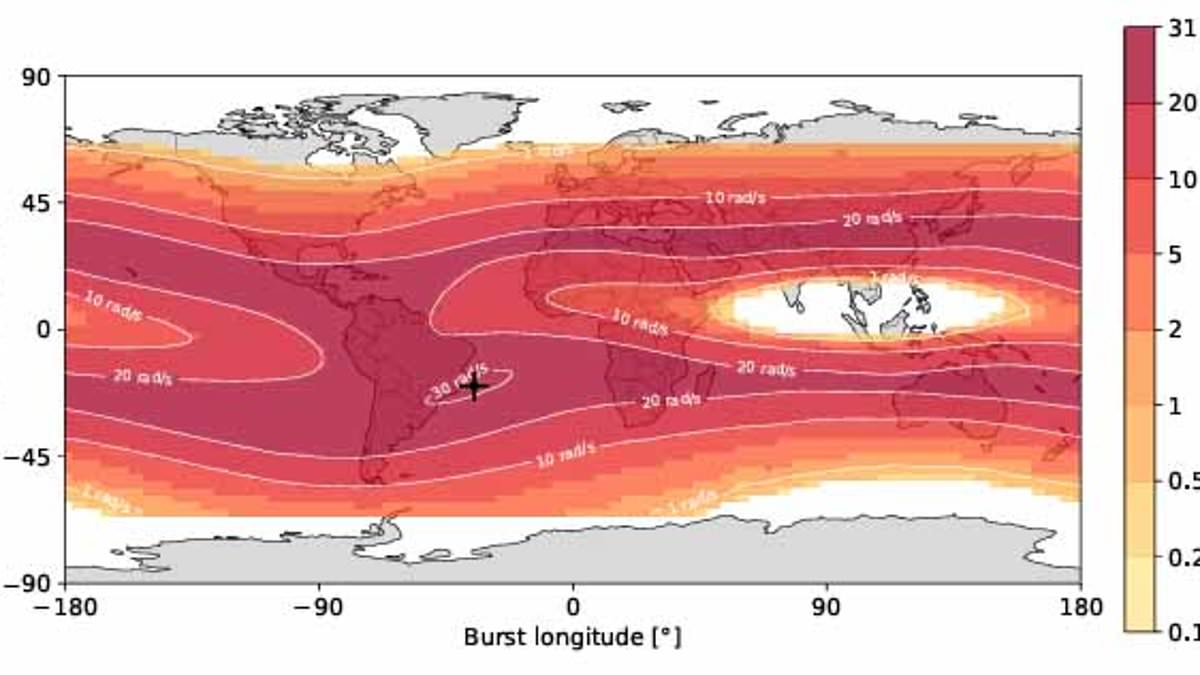
The idea of detonating a nuclear weapon in space might sound like the plot of the latest science fiction blockbuster.But what would happen if it really happened?Scientists have simulated the effects of a single nuclear detonation in space – and their results suggest it would be 'very, very bad'.If the explosion occurred at a high enough altitude, it could disable virtually every satellite in low-Earth orbit, according to the simulation.James McKeon, Vice President of Nuclear Philanthropy, said: 'It would be bad. Very bad. Very, very bad.'We must do everything we can to prevent this from ever happening.' Scientists have simulated the effects of a single nuclear detonation in space – and their results suggest it would be 'very, very bad' While the idea of detonating a nuke in space might sound farfetched, the scientists point out that this has happened before. On 9 July 1962, the 'Starfish Prime' nuclear test saw a 1.4-megaton detonated 248 miles (400km) above Johnston Atoll in the PacificWith more than 13,000 satellites operating in low-Earth orbit, concerns are beginning to grow that nuclear weapons could be used in space to target them. Writing in their study, which is published as a pre-print on arXiv, the researchers, led by Zachary Peterson, explained: 'In 2024, the United States stated that Russia was developing a nuclear anti-satellite capability. 'Russia denied plans to place nuclear weapons in space but vetoed a UN Security Council resolution reaffirming the Outer Space Treaty’s prohibition on placing nuclear weapons in orbit. 'These developments renewed concern that a nuclear weapon could be used against orbital infrastructure, with consequences extending beyond the satellites targeted. 'Such a weapon could be delivered by a missile or placed in orbit as a payload and detonated later.'Until now, the effects of a nuclear detonation in low-Earth orbit have remained unclear. Beyond the initial X-ray burst, scientists know that electrons released by radioactive fission products can become trapped in Earth’s magnetic field, repeatedly exposing satellites as an artificial radiation belt. If a 1-megaton nuclear bomb was detonated 310 miles (500km) over the South Atlantic, repeated exposure to the artificial radiation belt would disable approximately 98 per cent satellites within one week, the simulation suggestsTo understand the impact this would have in reality, scientists from the University of Wisconsin-Madison, and Princeton University carried out a simulation combining prompt radiation, electron trapping and belt evolution with satellite failures, collisions and atmospheric drag. Their results suggest that a nuclear explosion in space would be catastrophic. If a 1-megaton nuclear bomb was detonated 310 miles (500km) over the South Atlantic, repeated exposure to the artificial radiation belt would disable approximately 98 per cent of satellites within one week, the simulation suggests. In addition, we'd see a spike in satellite collisions, with approximately 20 collisions expected within two years. What's more, with radiation and debris expected to last for years, it wouldn't simply be a case of sending replacement satellites up. The team added: 'Replacement satellites could remain exposed to radiation and debris for years. 'A single detonation could devastate orbital infrastructure and support efforts to prevent the deployment and use of nuclear weapons in space.'As for the impact this would have on life on Earth, the consequences would be enormous, with modern society relying on satellites for everything from navigation and communications to weather forecasting and financial transactions. While the idea of detonating a nuke in space might sound farfetched, the scientists point out that this has happened before. On July 9, 1962, the 'Starfish Prime' nuclear test saw a 1.4-megaton warhead detonated 248 miles (400km) above Johnston Atoll in the Pacific.The huge blast, conducted by the US, not only knocked out streetlights and disrupted telephone communications on the ground in Hawaii, but also created man-made radiation belts that wrecked satellites – with the impacts felt more than five years later.The scientists point out that there are many more satellites in orbit today than there were in 1962, meaning a similar blast would be even more devastating. They added: 'A comparable event today would occur in a much more densely populated orbital environment.'WHAT SHOULD YOU DO IN THE EVENT OF A NUCLEAR ATTACK?Toronto-based YouTubers Gregory Brown and Mitchell Moffit have detailed a number of tips to prepare for a nuclear bomb.Pack an emergency supply kit containing water and non-perishable food items.When a nuclear bomb goes off, it sends out radiation that can ruin your mobile phone and laptop, so preparing battery-powered radios for communication is wise. For the blast, it is important to get as much concrete between you and the blast as possible. For the fall-out it's important to have thick walls and a thick roof, he says, and in a house it is a good idea to blockade all the windows. But if you are outside and know the blast is coming, you might have time to get to a better shelter.First you should get on the ground with your hands behind your head and brace yourself for the blast.Never look at the blast, because it can cause you to go blind temporarily.The, after the blast, you have 30 minutes to get to the best place. Once you get inside remove your clothes and clean yourself straight away and blow your nose, to stop the radioactive materials from spreading, and do not use conditioner.If you cannot have a shower, wipe yourself with a wet cloth.
The catastrophic impact of a nuke in space: Simulation reveals how a single explosion could disable 99% of satellites within days
Full Article
Original Source
Read the full article at Dailymail →KhanList aggregates and links to publicly available news content. We do not host full articles from third-party sources. Always verify important information with original sources.