
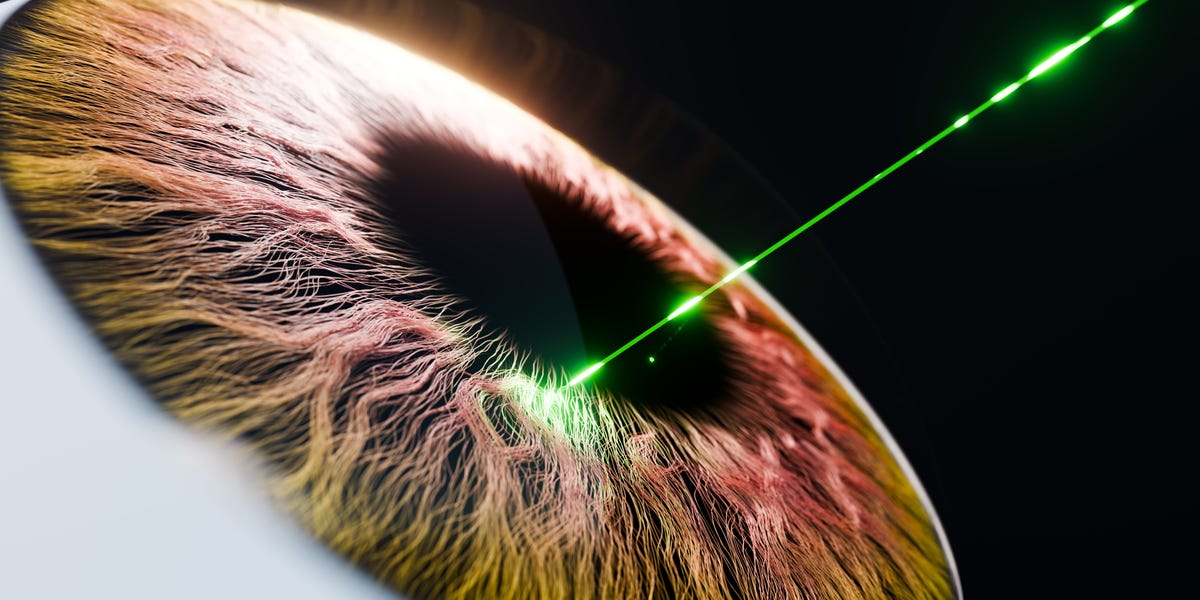
Here’s what you’ll learn when you read this story:Scientists made mice “see” phantom shapes when they activated just a tiny cluster of neurons with holographic lasers.The experiment shows that your brain starts “filling in” a perception of reality in the brain’s first visual processing area even though it has to go through more steps to correctly identify what you see.It turns out your brain creates an illusion of reality, partly based on your previous experiences, letting you make decisions quickly when needed.How do you make a mouse hallucinate? (And why would you even try?)Hyeyoung Shin, PhD, an assistant professor of neuroscience at Seoul National University, turned to mice to help explain what makes one person perceive reality differently from another. Take the great dress debate from 2015, for example, when people across social media argued over whether an online post depicted a white-and-gold or a blue-and-black garment (Spoiler: It was the latter).Shin herself wondered what her brain was doing when she looked at the dress image online. More than 10 years later, in a study published in Nature Neuroscience, she was finally able to explain why.In their study, Shin and her colleagues zapped the brains of six mice with ultraprecise holographic lasers, targeting a tiny cluster of cells in the brain’s first layer of image-sensing neurons, an area called V1. Researchers asked whether sparking those cells alone could make the brain “see” something that wasn’t really there.The animals’ brains lit up as if they were seeing phantom shapes, like the Kanizsa triangle, where Pac-Man cutouts trick you into seeing a triangle that isn’t actually present. The team baptized these cells “IC-encoder neurons,” because a spark from them can ripple outward, recruiting tens of thousands of other neurons to finish the picture.Shin says she hadn’t expected this “filling-in” to happen so early, right in the brain’s first visual processing area.That means reality is in the eye of the beholder. It implies that “perception is not a direct recording of reality, but a process of inference,” says Shin. In neuroscience, inference means the brain makes its best guess about what’s out there—filling in perception gaps and leaning on past experience. She’s quick to dismiss going so far as to call reality a “controlled hallucination,” though, since hallucination means experiencing things that don’t exist in any form. “Instead, illusion—and perception in general—is the brain interpreting sensory evidence based on your beliefs about the sensory world,” she says.It turns out our brains create an illusion of reality based on both our previous experiences and the evolutionary design of our primary visual cortex. Located at the back of the brain, where it receives signals from our eyes, this first layer of image sensing (called V1) doesn’t just take pictures. In fact, it helps decide—if not dictate—what we see.And that’s crucial, because this design enables our ability to make decisions quickly based on how we perceive the world around us, scientists say. Otherwise, we might spend too much time trying to recognize important stimuli in our environment, such as danger.In everyday life, we mostly do agree on what we see. Even in the dress debate—a perception anomaly in itself—no one saw red or fuchsia. The fight was only between two specific color combinations. So are our brains all running on the same basic code?This story has reporting from Stav Dimitropoulos.Download Pop Mech Digital Issues
Scientists Zapped Mouse Brains With Lasers to Give Them Phantom Visions
Full Article
Original Source
Read the full article at Popularmechanics →KhanList aggregates and links to publicly available news content. We do not host full articles from third-party sources. Always verify important information with original sources.