
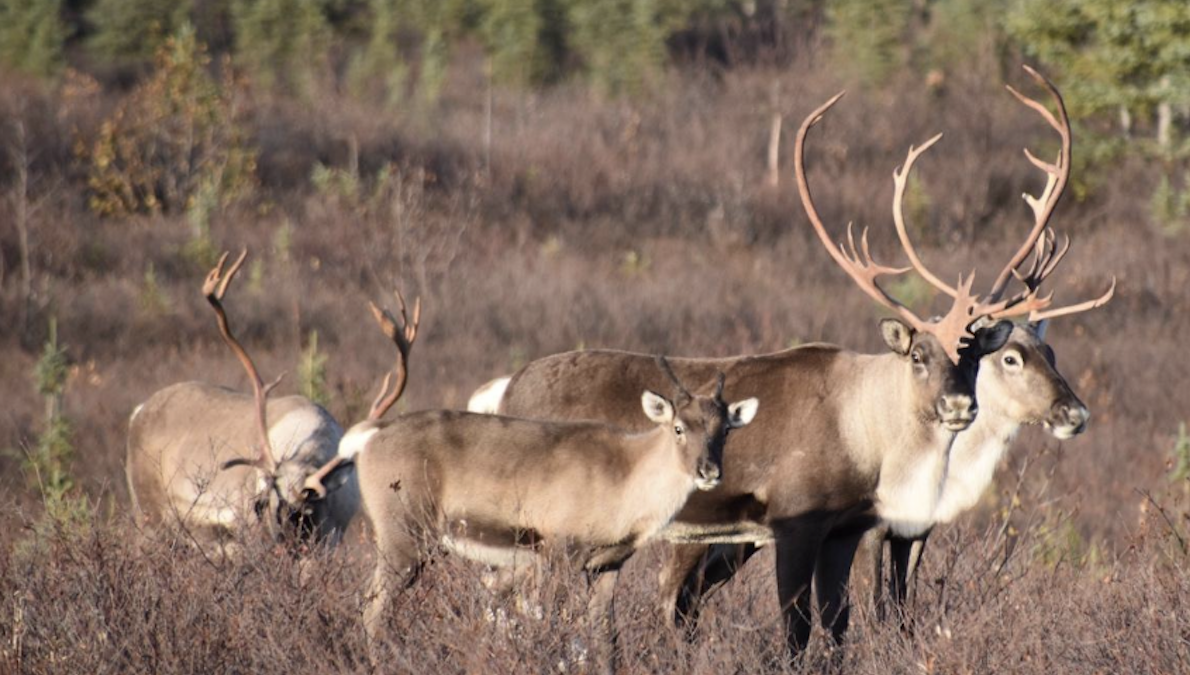
Changes to Arctic landscapes caused by global warming have led to decreasing caribou herd numbers across multiple Arctic herds. In line with previous research, a new study found that Earth's northernmost latitudes are warming the fastest. Credit: NOAA/K. Joly, public domain Research & Developments is a blog for brief updates that provide context for the flurry of news that impacts science and scientists today. On average, global temperatures have warmed about 1.44°C (2.60°F) since preindustrial times. But scientists are confident that the world has likely already entered the 20-year time period in which it will breach the 1.5°C (2.7°F) warming limit set by the Paris Agreement when it was signed in 2016. The United Nations agrees: A September report stated the world has virtually no chance to stay below the Paris limit. “Today’s global mean climate is already statistically indistinguishable from a one and a half-degree warming world.” A new study, published in Nature Climate Change, indicates that at the regional level, many places on Earth have already surpassed 1.5°C (2.7°F), and suggests that other regions have warmed as much as 2°C (3.6°F) due to human-caused climate change. The study is the first to provide such an analysis of warming on a regional scale by filling in data gaps for regions that lack historic climate observations. “Today’s global mean climate is already statistically indistinguishable from a one and a half-degree warming world,” Francis Zwiers, a climate scientist at the University of Victoria and coauthor of the new study, said at a press conference. To understand warming on a regional scale, the authors analyzed in-region climate observations, global climate observations, and simulations of past climate change for dozens of regions referenced in the Sixth Assessment Report from the Intergovernmental Panel on Climate Change (IPCC). The method was meant to estimate warming in places without complete historical observations of climate change. “In some parts of the world, historical records are sparse or even nonexistent,” Xuebin Zhang, a climate scientist at the University of Victoria and coauthor of the paper, said at a press conference. In Canada, for example, adequate climate observations only stretch back to 1948, Zwiers said, “and the same is true in many countries and regions around the world.” “We are starting to see the impacts of climate change that policymakers in Paris were keen to avoid if at all possible.” After filling in the gaps, researchers found that the current climate has already breached 1.5°C (2.7°F) of warming since preindustrial times in up to 94% of regions. Some regions have warmed faster: In Canada and large portions of Europe, for example, temperatures have already warmed more than 2°C (3.6°F). In some very high-latitude regions, warming exceeded 2.5°C (4.5°F). The Russian Arctic, for example, has warmed 3.3°C (5.9°F). “We are effectively already living in a 1.5°C [2.7°F] world,” Peter Stott, a climate scientist at the University of Exeter who was not involved in the research, wrote in a commentary about the study for Nature Climate Change. “This means that we are starting to see the impacts of climate change that policymakers in Paris were keen to avoid if at all possible.” The authors also predicted when average temperatures will break through the Paris Agreement limit worldwide. They projected that under a high-emissions scenario (SSP5-8.5), global average temperatures will reach 1.5°C (2.7°F) in 2029 and 2°C (3.6°F) in 2042. “That’s only 16 years from now,” Zwiers said. (The IPCC seems poised to drop the high-emissions scenario in its next assessment, but the researchers did not include projections for other scenarios in the paper.) “It’s still possible to limit warming to no more than 2°C [3.6°F], but this would require very rapid emissions reductions from current levels,” Zwiers said. Zhang emphasized the need for more climate observations to continue to track how the climate is changing regionally. “The need for better climate information remains as important as ever,” he said. “Sustained climate monitoring and high-quality observations are so important; they help us track how the climate is changing, understand the impacts on people and ecosystems, and provide evidence needed to make informed adaptation decisions.” —Grace van Deelen (@gvd.bsky.social), Staff Writer These updates are made possible through information from the scientific community. Do you have a story about science or scientists? Send us a tip at [email protected]. Text © 2026. AGU. CC BY-NC-ND 3.0Except where otherwise noted, images are subject to copyright. Any reuse without express permission from the copyright owner is prohibited.
Many Regions Have Warmed Beyond 1.5°C and Some Beyond 2°C, New Study Finds
Full Article
Original Source
Read the full article at Eos →KhanList aggregates and links to publicly available news content. We do not host full articles from third-party sources. Always verify important information with original sources.