
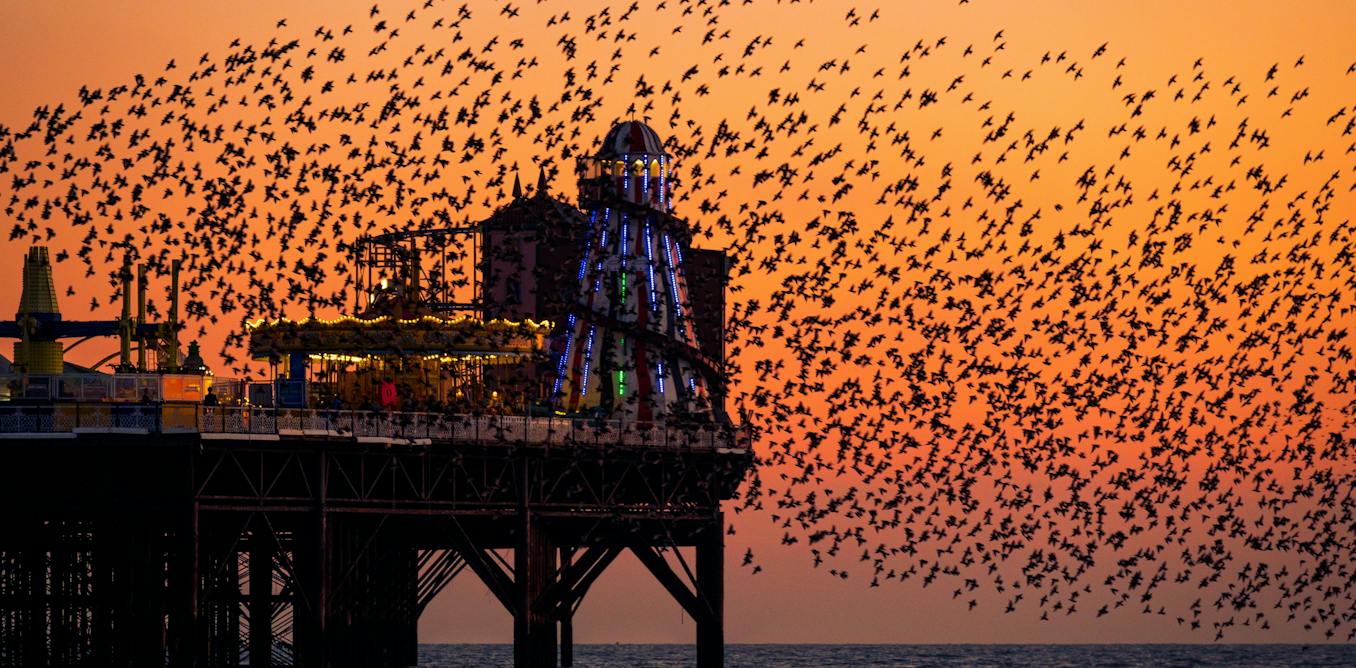
Every autumn, from city centres to wetlands, starling murmurations attract crowds of spectators. Thousands of birds fill the sky, twisting and turning in extraordinary waves as the sun sets. An entire flock moves as one, creating shapes that shift and dissolve as quickly as they appear. But Britain’s breeding starling population has declined dramatically over recent decades, while changes in climate, migration and habitats are reshaping the lives of many birds. Could these wider changes also be affecting murmurations? By repeating a major citizen-science survey we carried out 12 years ago, we’re hoping to find out whether these spectacular displays are changing in size, timing or location. According to the British Trust for Ornithology, the UK’s breeding starling population declined by 61% between 1995 and 2024. This is part of a wider pattern of bird declines: the UK’s farmland bird population index has fallen by 62% since 1970, with intensification of farming playing a major role. But that doesn’t necessarily mean individual murmurations are becoming smaller. Changes in where birds gather, when they arrive and how they behave could all influence the displays we see each winter. Climate change may also be playing a part in shifting patterns and timings of murmuration displays. Britain’s winter starling population includes large numbers of birds arriving from continental Europe. As winter conditions change, so might their migration patterns, potentially affecting the timing, location and size of murmurations. Changes in food availability and roosting habitat could also be important. Our original citizen-science project began in 2014. Working with the Royal Society of Biology, we harnessed people power to record murmurations between 2014 and 2016. Volunteer citizen scientists submitted more than 3,000 observations, noting the size, duration and location of murmurations, plus the presence of any birds of prey. Observations from 23 countries provided an unusually large dataset. Back then, our main question wasn’t whether murmurations were changing, but why they happened at all. Over the last 20 years, scientists have made considerable progress in understanding how thousands of birds coordinate their movements, with each responding to its neighbours to produce those extraordinary patterns. But why do starlings gather in such spectacular formations in the first place? Some starlings roost in reedbeds. Cristian Zamfir/Shutterstock One explanation was that the displays helped attract birds to communal roosts, where gathering in large numbers might provide warmth. Another was that murmurations helped protect starlings from predators such as peregrine falcons and sparrowhawks. Moving together in a dense, constantly changing flock could make it harder for a predator to single out a specific bird, while providing more eyes to detect approaching danger. Our findings, published in 2017, provided strong support for this predator avoidance explanation. Murmurations tended to be larger and last longer when predators were present, particularly when they approached or attacked the flock. Although we couldn’t establish cause and effect from these observations alone, the evidence suggested that avoiding predators was a major reason for these spectacular displays, with attracting birds to a warm communal roost on cold nights being a secondary factor. Seasonal records Our research also revealed a seasonal pattern in murmuration size and duration, with day length associated with how long displays lasted. Twelve years later, we are exploring whether those patterns have persisted, and whether the relationships between murmurations, predators and temperatures remain the same. Once again, we’re asking the public to help. By recording where and when they see murmurations, how many birds are involved, how long the displays last and whether predators are present, observers can help us investigate whether this extraordinary behaviour is changing. A starling murmuration isn’t just a feast for the eyes. As the birds sweep low overhead, you can hear the collective rush of thousands of wings. And there’s another sensory experience, too: a shower of starling droppings. Somehow, even that adds to the occasion, although we’d recommend taking an umbrella. If you’re lucky enough to witness a murmuration this autumn or winter, take a moment to enjoy the spectacle and log what you see. Your observations could help reveal whether one of nature’s most extraordinary displays is changing.
Starling numbers are declining – we’re investigating whether their spectacular murmuration displays are changing too
Full Article
Original Source
Read the full article at Theconversation →KhanList aggregates and links to publicly available news content. We do not host full articles from third-party sources. Always verify important information with original sources.