
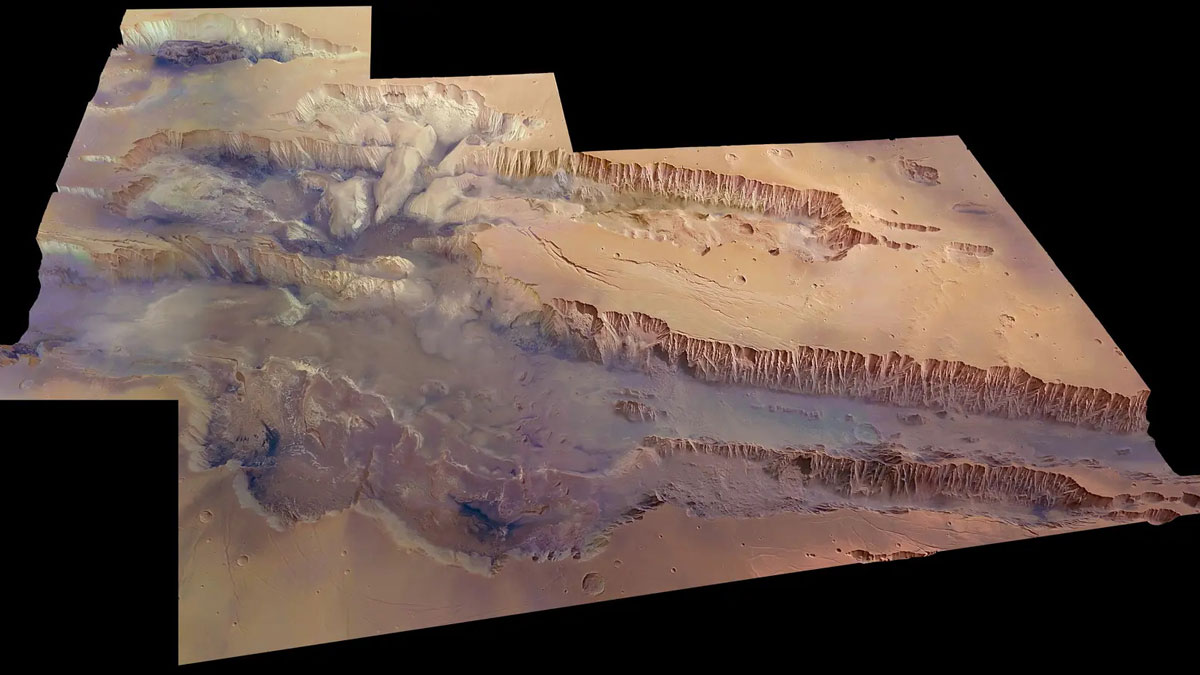
Compared with Earth, Mars is a geologically quiet world. Its volcanoes are old and dormant, and because it has no apparent tectonic plates, most of its seismic activity comes from meteorite impacts. However, a growing number of results show that Mars could still experience some intrinsic shaking—not on the scale of Earth’s constant activity, but enough to shape the planet. In particular, a recent study published in Nature Communications traced the source of a marsquake detected by the InSight lander to the giant canyon system known as Valles Marineris, almost on the opposite side of the planet. The nature of the quake—labeled S0976a because it was detected on the 976th Martian day of InSight’s operation—hints strongly at the existence of an active fault beneath the canyon. This finding has implications for understanding the geologic evolution of planets. This map of the entire surface of Mars shows the location of the InSight lander at Elysium Planitia, as well as the position of the detected marsquake near the giant canyon system Valles Marineris. The blue and white “beachballs” represent previously studied seismic events. Credit: Song et al., 2026, https://doi.org/10.1038/s41467-026-78193-6, CC BY 4.0 “This is the farthest event recorded by InSight mission, but it’s very high quality,” said Jung-Hun Song, a seismologist at Imperial College London who is the lead author of the study. He noted that most of the work around marsquake S0976a focused on what the quake tells us about the Martian interior, rather than the nature of the source. “If we can identify it as some tectonic quake, then we can say something about the Valles Marineris system: Is it still active, is it still a rifting system, or is it a closing system?” “This is an ancient fault that just got reactivated recently, with this quake being the proof.” In particular, the analysis traced S0976a’s source to a region 20–40 kilometers underneath the canyon, meaning it’s an active fault, perhaps similar to midcontinent rifts like the New Madrid Seismic Zone on Earth. “There is no current plate tectonics, but maybe there was some in the past. We don’t actually know for sure,” said planetary geologist Caroline Beghein of the University of California, Los Angeles, who worked on InSight but was not involved in the Valles Marineris study. “So this is an ancient fault that just got reactivated recently, with this quake being the proof.” Shaking the Grandest Canyon Named for NASA’s Mariner 9 spacecraft, whose data revealed its existence, Valles Marineris (Latin for Mariner Valleys) is the largest canyon system in the solar system. It runs more than 4,000 kilometers from end to end and stretches out to 200 kilometers wide; its deepest point lies at least 7 kilometers below the surface. Like the Texas-sized volcano Olympus Mons, the canyon’s dimensions are staggering by Earth standards. While comparisons to the Grand Canyon in Arizona abound, Valles Marineris is nearly 10 times as long and more than 4 times as deep. Geologically, the Martian canyon system more closely resembles the East African Rift system that extends from Mozambique into western Asia, as both were formed through crust movement rather than erosion. However, because Mars lacks tectonic plate boundaries—making it what is charmingly known as a “single-lid” planet—Valles Marineris almost certainly formed when the Martian crust cracked as the planet cooled. Over time, erosion widened the canyons, but the question long remained whether Valles Marineris was still seismically active. Then in 2012, geologist An Yin hypothesized the canyon system’s structure was shaped by a strike-slip fault beneath the surface. This evidence came from the Mars Odyssey and Mars Reconnaissance Orbiter spacecraft rather than from seismic data, which is where S0976a comes into play. “Why did they all start from the same mix, and yet Earth is the only rocky planet we know that has active tectonics?” To understand what caused the quake, Song and his colleagues characterized its properties, both ruling out other explanations (such as landslides or meteorite impacts) and classifying what the source must be. “The quake is different from surface events,” Song said, adding that they simulated a variety of synthetic waves to compare S0976a to other possible sources, as well as various types of tectonic quakes. “There is reflection from the surface and interactions between the crustal layering that only deep [subsurface] events can generate.” Both Song and Beghein said such a marsquake is likely to be relatively common, and both called for future missions that deploy multiple seismometers spread out over larger regions of the planet. The single instrument on InSight allowed researchers to study many events, but even a second probe operating in tandem would allow better triangulation, lower noise, and superior source characterization. Beghein added that the discovery of Martian faults is important to understand how rocky planets form—and why Earth is so different from the others in the solar system. “Why did they all start from the same mix, and yet Earth is the only rocky planet we know that has active tectonics?” she asked. “Did [Mars] have it before and it stopped, and, [if so,] why? These are really all-important questions to understand where we come from.” —Matthew R. Francis (@BowlerHatScience.org), Science Writer Citation: Francis, M. R. (2026), Quake traced to a fault deep below Mars’s largest canyon, Eos, 107, https://doi.org/10.1029/2026EO260373. Published on 20 November 2026. Text © 2026. The authors. CC BY-NC-ND 3.0Except where otherwise noted, images are subject to copyright. Any reuse without express permission from the copyright owner is prohibited.
Quake Traced to a Fault Deep Below Mars’s Largest Canyon
Full Article
Original Source
Read the full article at Eos →KhanList aggregates and links to publicly available news content. We do not host full articles from third-party sources. Always verify important information with original sources.